
Category: Education in Movement Disorders
Objective: Evaluating the usefulness of clinical acrostic for the differential diagnosis of atypical Parkinsonian syndromes
Background: Differentiate Parkinson’s disease from atypical parkinsonian syndromes is challenging mostly in early stages, due to the wide variability of phenotypes and clinical signs. The ATYPICAL acrostic has been proposed to help healthcare professionals systematically identify the key signs and symptoms
Method: This was a retrospective, descriptive, exploratory inlcuide reviewing the medical records of consecutive patients, diagnosed by movement disorder specialists by international criteria during their routine clinical practice (1-4).The patients were seen at medical center in Cali, Colombia, between March 2023 and January 2026. The signs described by the ATYPICAL acrostic. The group was divided according to diagnosis (Parkinson’s disease and atypical parkinsonism) and the clinical correlations were compared. Descriptive data were presented as mean and standard deviation, or frequencies where appropriate. Pearson’s chi square and t test, were used for comparison. Statistical significance was set at 0.05. Statistical analysis was performed with the SPSS statistical package (version 25; Chicago, IL, USA)
Results: One hundred patients were evaluated, 50 with Parkinson’s disease (PD) and 50 with atypical Parkinsonism (APS), 68 y 64 % were man respectively, and of the latter group, 18 (36%) had progressive supranuclear palsy (PSP), 10 (20%) had multiple system atrophy (MSA), and 20 (40%) had Lewy Body dementia (DCL) and 4% other parkinsonisms.The APS group had a higher mean age (71.6 (SD 8.6) vs. 65 (SD 9.6) years in the PD group), while the PD group had a longer disease duration (9.4 (SD 6) years vs. 5.9 (SD 3.1) years in the AP group). The AP group showed a marked predominance of positive clinical signs according to the ATYPICAL classification, most of which were statistically significant (Table 1).
Conclusion: The ATYPICAL acrostic has great potential as a simple and easy-to-remember tool to help physicians systematically assess the characteristics that differentiate APS from PD in routine clinical practice. A prospective, multicenter validation study with diagnostic performance metrics and reliability assessment is recommended.
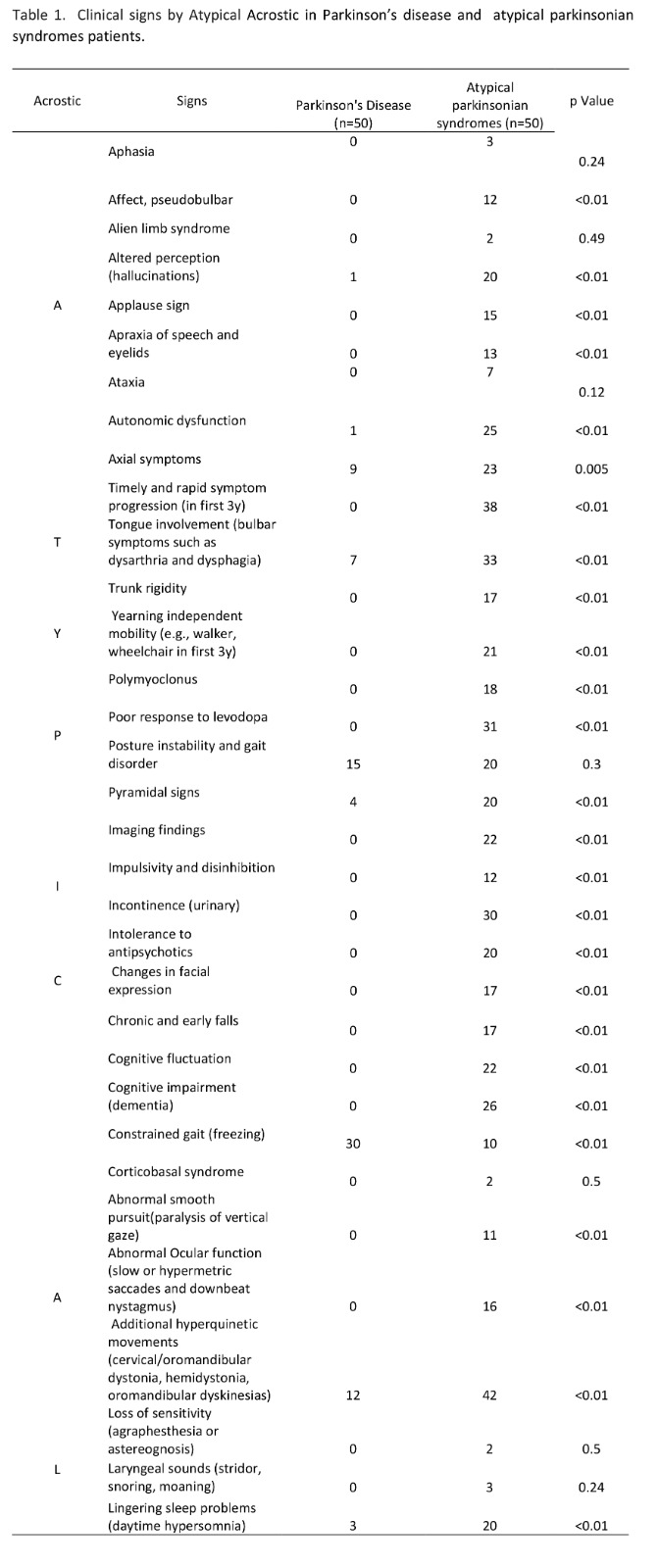
Table 1. Clinical signs
References: 1. Wenning GK, Stankovic I, Vignatelli L, et al. The Movement Disorder Society criteria for the diagnosis of multiple system atrophy. Mov Disord 2022; 37: 1131–48.
2. McKeith IG, Boeve BF, Dickson DW, Halliday G, Taylor JP, Weintraub D, Aarsland D, Galvin J, Attems J, Ballard CG, Bayston A, Beach TG, Blanc F, Bohnen N, Bonanni L, Bras J, Brundin P, Burn D, Chen-Plotkin A, Duda JE, El-Agnaf O, Feldman H, Ferman TJ, Ffytche D, Fujishiro H, Galasko D, Goldman JG, Gomperts SN, Graff-Radford NR, Honig LS, Iranzo A, Kantarci K, Kaufer D, Kukull W, Lee VMY, Leverenz JB, Lewis S, Lippa C, Lunde A, Masellis M, Masliah E, McLean P, Mollenhauer B, Montine TJ, Moreno E, Mori E, Murray M, O’Brien JT, Orimo S, Postuma RB, Ramaswamy S, Ross OA, Salmon DP, Singleton A, Taylor A, Thomas A, Tiraboschi P, Toledo JB, Trojanowski JQ, Tsuang D, Walker Z, Yamada M, Kosaka K. Diagnosis and management of dementia with Lewy bodies: Fourth consensus report of the DLB Consortium. Neurology. 2017 Jul 4;89(1):88-100. doi: 10.1212/WNL.0000000000004058.
3. Höglinger GU, Respondek G, Stamelou M, Kurz C, Josephs KA, Lang AE, Mollenhauer B, Müller U, Nilsson C, Whitwell JL, Arzberger T, Englund E, Gelpi E, Giese A, Irwin DJ, Meissner WG, Pantelyat A, Rajput A, van Swieten JC, Troakes C, Antonini A, Bhatia KP, Bordelon Y, Compta Y, Corvol JC, Colosimo C, Dickson DW, Dodel R, Ferguson L, Grossman M, Kassubek J, Krismer F, Levin J, Lorenzl S, Morris HR, Nestor P, Oertel WH, Poewe W, Rabinovici G, Rowe JB, Schellenberg GD, Seppi K, van Eimeren T, Wenning GK, Boxer AL, Golbe LI, Litvan I; Movement Disorder Society-endorsed PSP Study Group. Clinical diagnosis of progressive supranuclear palsy: The movement disorder society criteria. Mov Disord. 2017 Jun;32(6):853-864. doi: 10.1002/mds.26987. Epub 2017 May 3. PMID: 28467028; PMCID: PMC5516529.
4. Armstrong MJ, Litvan I, Lang AE, Bak TH, Bhatia KP, Borroni B, Boxer AL, Dickson DW, Grossman M, Hallett M, Josephs KA, Kertesz A, Lee SE, Miller BL, Reich SG, Riley DE, Tolosa E, Tröster AI, Vidailhet M, Weiner WJ. Criteria for the diagnosis of corticobasal degeneration. Neurology. 2013 Jan 29;80(5):496-503. doi: 10.1212/WNL.0b013e31827f0fd1. PMID: 23359374; PMCID: PMC3590050.
To cite this abstract in AMA style:
L. Ortega-Bolaños, V. Martinez-Villota, E. Gatto, D. Bolaños Ortega, K. Ortega Dorado, C. Hurtado Gonzalez, J. Fernandez Boccazzi. Acrostic for the differential diagnosis of atypical Parkinsonian [abstract]. Mov Disord. 2026; 41 (suppl 1). https://www.mdsabstracts.org/abstract/acrostic-for-the-differential-diagnosis-of-atypical-parkinsonian/. Accessed October 1, 2026.« Back to 2026 International Congress
MDS Abstracts - https://www.mdsabstracts.org/abstract/acrostic-for-the-differential-diagnosis-of-atypical-parkinsonian/