
Category: Parkinson's disease: Neuroimaging
Objective: To test whether active contact location within the subthalamic nucleus (STN) predicts postoperative change in phonemic fluency (PF) after bilateral STN deep brain stimulation (DBS) in Parkinson’s disease (PD).
Background: PF decline is one of the most consistent cognitive adverse effects after STN-DBS, but predictors of inter-individual vulnerability remain unclear1. Spatial differences in active contact placement may contribute, particularly in the language-dominant hemisphere.
Method: Nineteen PD patients undergoing first-time bilateral STN-DBS completed standardized preoperative and 6-month postoperative neuropsychological testing including PF for Slovak letters K and P (1 minute each). PF change was computed as absolute change (post–pre) and relative change (%). Active contact coordinates (x, y, z) were extracted in MNI space using Lead-DBS software from postoperative imaging and stimulation settings stabilized after initial programming2. Multiple linear regression tested whether active contact coordinates predicted PF change separately for the left and right STN; complementary models controlled for baseline PF.
Results: PF declined postoperatively (mean decline ~2.24 words, corresponding to ~15.7% relative reduction). Left active contact localization explained ~37% of variance in PF absolute change (R²≈0.37). More posterior and more ventral left-hemispheric contacts were associated with larger PF decline (notably along the Y and Z axes), and these associations persisted after controlling for baseline PF. In contrast, right STN contact coordinates were not significantly related to PF outcomes (R²≤0.15; all p≥0.37). VTA laterality indexes were not associated with PF change.
Conclusion: Postoperative PF decline after bilateral STN-DBS is significantly associated with left STN active contact position, with more posterior/ventral stimulation linked to worse PF outcomes. These findings support hemispherically informed targeting and programming approaches to mitigate language-related side effects.
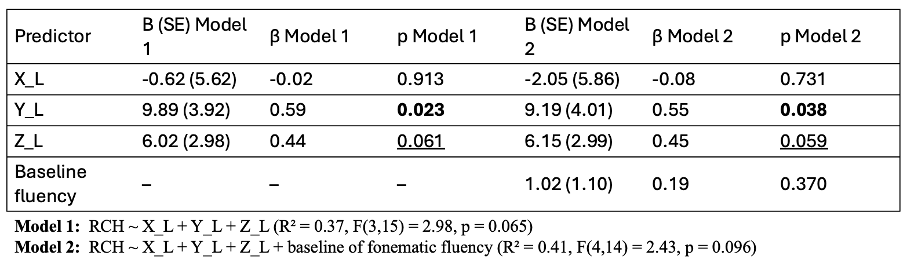
Table 1
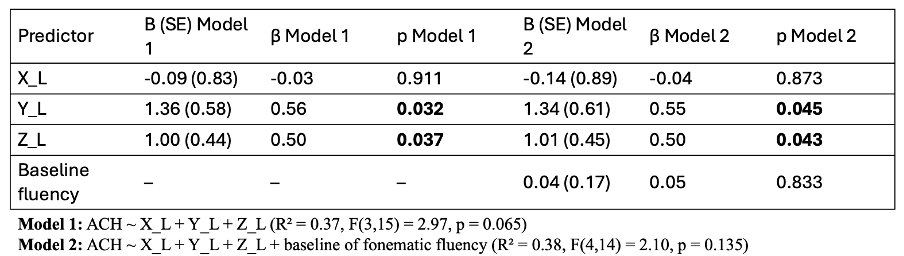
Table 2
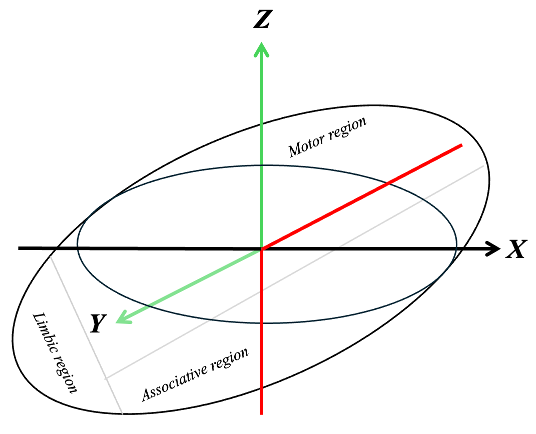
Figure 1
References: 1. Højlund, A., Petersen, M. V., Sridharan, K. S., & Østergaard, K. (2017). Worsening of Verbal Fluency After Deep Brain Stimulation in Parkinson’s Disease: A Focused Review. Computational and Structural Biotechnology Journal, 15, 68–74. https://doi.org/10.1016/j.csbj.2016.11.003
2. Horn, A., Li, N., Dembek, T. A., Kappel, A., Boulay, C., Ewert, S., Tietze, A., Husch, A., Perera, T., Neumann, W.-J., Reisert, M., Si, H., Oostenveld, R., Rorden, C., Yeh, F.-C., Fang, Q., Herrington, T. M., Vorwerk, J., & Kühn, A. A. (2019). Lead-DBS v2: Towards a comprehensive pipeline for deep brain stimulation imaging. NeuroImage, 184, 293–316. https://doi.org/10.1016/j.neuroimage.2018.08.068
Funding sources:
This study was funded by the Slovak Grant and Development Agency under contract APVV-24-0369.
To cite this abstract in AMA style:
š. Janovič, S. Hollý, B. Al-Fatly, P. Zvarová, M. Kľoc, T. Harag, M. Chmelík, D. Juskanič, L. Hapáková, A. Kušnírová, B. Gaštanová, Z. Košutzká. Active Contact Localization in the Subthalamic Nucleus Predicts Phonemic Fluency Decline After Bilateral STN-DBS [abstract]. Mov Disord. 2026; 41 (suppl 1). https://www.mdsabstracts.org/abstract/active-contact-localization-in-the-subthalamic-nucleus-predicts-phonemic-fluency-decline-after-bilateral-stn-dbs/. Accessed October 1, 2026.« Back to 2026 International Congress
MDS Abstracts - https://www.mdsabstracts.org/abstract/active-contact-localization-in-the-subthalamic-nucleus-predicts-phonemic-fluency-decline-after-bilateral-stn-dbs/