
Category: Parkinson's Disease: Surgical Therapy
Objective: To describe the use of electrophysiologically guided adaptive deep brain stimulation (aDBS) and directional volume of tissue activation (VTA) shaping to manage stimulation-induced focal dystonia in Parkinson’s disease with a narrow therapeutic window.
Background: Subthalamic nucleus (STN) deep brain stimulation improves motor fluctuations in Parkinson’s disease but may provoke stimulation-related side effects when leads are near adjacent motor pathways. Adaptive DBS modulates stimulation based on local field potential (LFP) activity and may balance therapeutic benefit and side effects.
Method: A 58-year-old woman with Parkinson’s disease underwent bilateral STN DBS for motor fluctuations and dyskinesia. After implantation she developed severe stimulation-exacerbated gluteal dystonia and buttock pain that limited continuous stimulation and impaired ambulation. Electrophysiological mapping using monopolar recordings identified oscillatory activity in the alpha-beta range in each STN. Directional leads were used to shape the VTA toward contacts with higher LFP magnitude while avoiding side-effect regions [figure1]. The patient was transitioned from continuous stimulation to a sensing-enabled adaptive DBS paradigm using patient-specific sensing bands centered on detected oscillatory peaks.
Results: Adaptive stimulation dynamically modulated output in response to oscillatory activity and medication cycles. Longitudinal programming data demonstrated the transition from conventional continuous DBS to adaptive stimulation with refined amplitude limits [figure2]. Chronic LFP data review and streaming data confirmed modulation of stimulation amplitude during oscillatory bursts, reducing time spent at higher amplitudes compared with prior continuous stimulation [figure3]. Final titration of adaptive stimulation limits suppressed wear-off symptoms while minimizing stimulation-induced side effects. Clinically, the patient experienced improved OFF periods and reduced gluteal dystonia and pain while maintaining motor benefit.
Conclusion: Electrophysiologically guided adaptive stimulation combined with directional VTA shaping may expand the therapeutic window in patients with stimulation-related side effects following STN DBS. This case highlights the potential of sensing-enabled DBS to balance baseline dystonia and stimulation-induced symptoms while preserving therapeutic benefit.
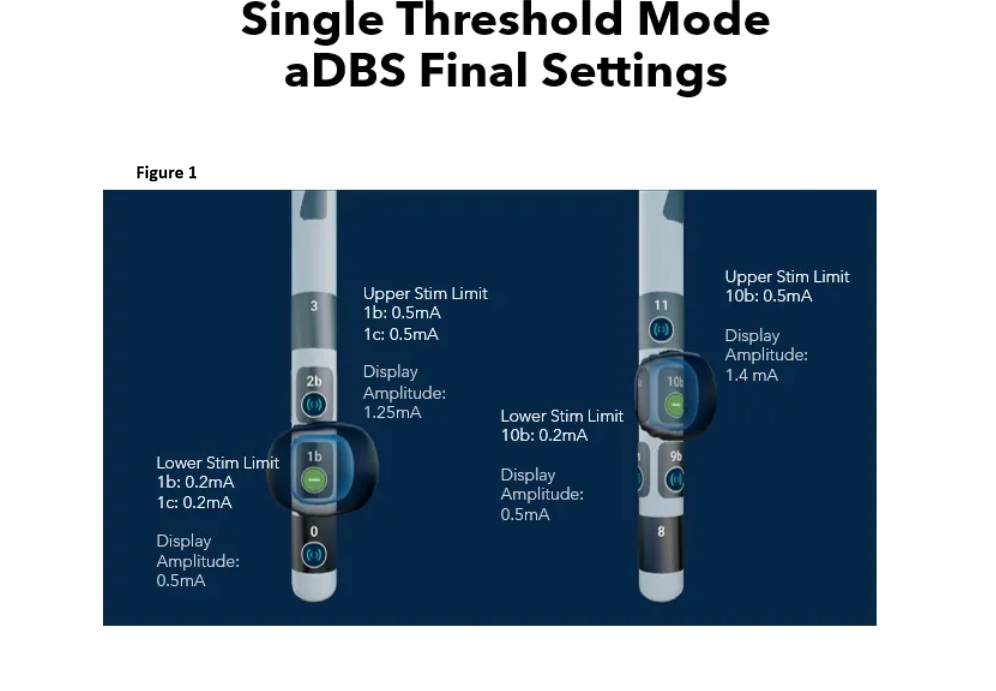
Electrophysiological Mapping and Contact Selection
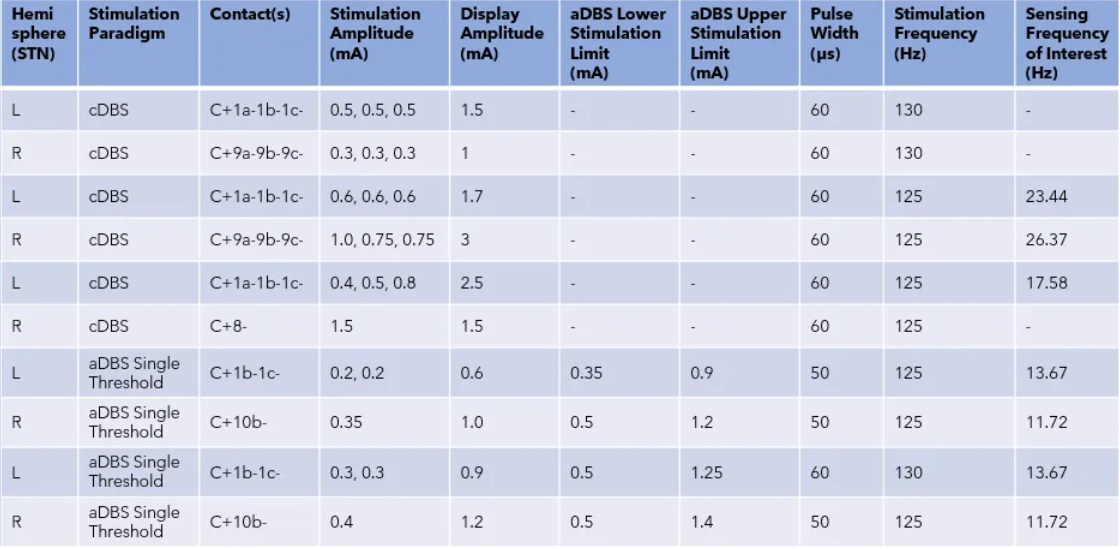
DBS Programming Timeline: cDBS to Adaptive DBS
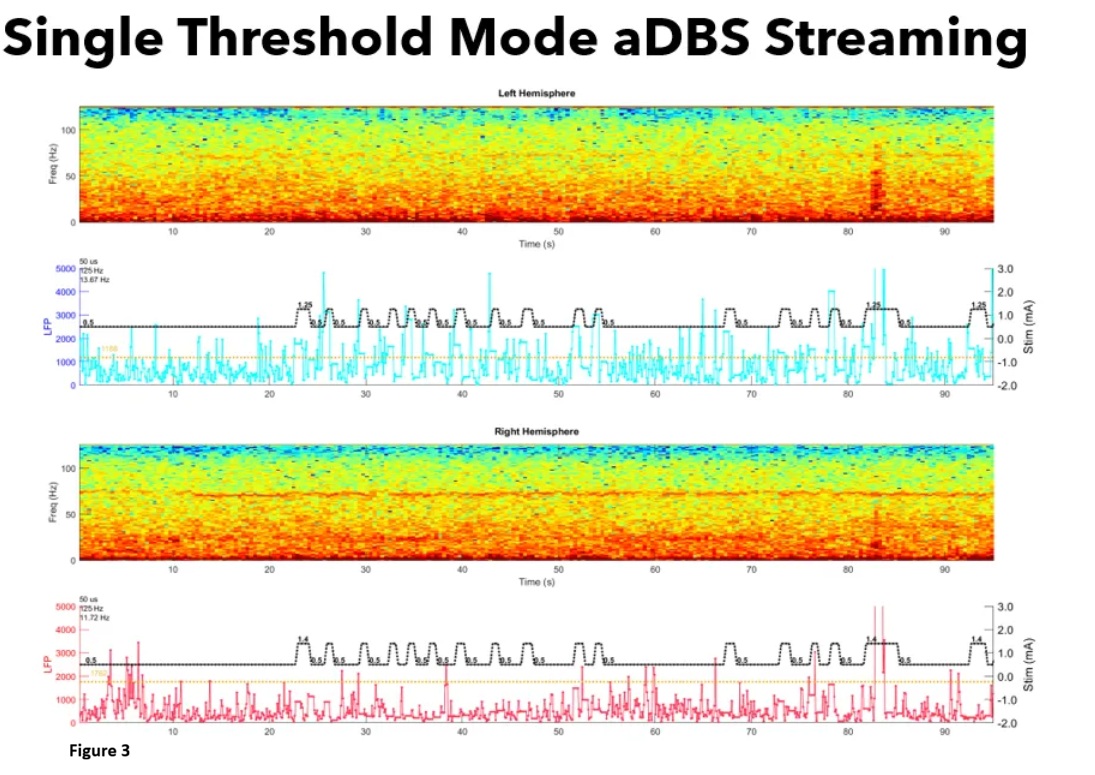
Adaptive DBS Modulation from STN LFP Activity
To cite this abstract in AMA style:
K. Adabi, R. Ash, M. Sedrak. Adaptive Deep Brain Stimulation Guided by Electrophysiological Mapping for Stimulation-Induced Gluteal Dystonia in Parkinson’s Disease [abstract]. Mov Disord. 2026; 41 (suppl 1). https://www.mdsabstracts.org/abstract/adaptive-deep-brain-stimulation-guided-by-electrophysiological-mapping-for-stimulation-induced-gluteal-dystonia-in-parkinsons-disease/. Accessed October 1, 2026.« Back to 2026 International Congress
MDS Abstracts - https://www.mdsabstracts.org/abstract/adaptive-deep-brain-stimulation-guided-by-electrophysiological-mapping-for-stimulation-induced-gluteal-dystonia-in-parkinsons-disease/