
Category: Technology
Objective: We aimed to identify a set of daily-life wearable-derived gait features that discriminate PD gait patterns from healthy controls’ and evaluate their combined discriminative ability with that of a conventional clinical assessment of mobility (Timed Up and Go).
Background: Gait impairment is one of the earliest and most disabling motor symptoms of PD. Wearable sensors enable the extraction of a large set of kinematic gait features in daily-life, providing opportunities for objective outcome measures in clinical trials. However, many gait features are highly correlated and are influenced by gait speed. Although gait speed is intuitive and clinically easy to interpret, objectively measuring other gait features may provide more mechanistic and personalized insight in gait impairment.
Method: For this project, we used data from 426 people with PD (PwPD) and 90 controls from the Dutch multicenter Profiling Parkinson’s Disease (ProPark) cohort. Participants wore a lower-back accelerometer continuously for one week and performed the Timed Up and Go (TUG) test at the beginning of the week. Gait features were extracted per 10-second epochs within all gait episodes lasting ≥10 seconds. Three elastic net regression models (wearables only, TUG only, and wearables and TUG combined) were fitted and cross-validation was used to obtain the Area Under the Curve (AUC) for each model. All models included age and gender as covariates.
Results: [figure1] shows the features included in the combined model. Gait features showed good ability to discriminate PD and control subjects (Wearable AUC: 0.75). Performance did not improve significantly when adding the TUG score (TUG only AUC: 0.69, Combined AUC: 0.77, p > 0.05).
Conclusion: A set of features has been identified that provides mechanistic insight into Parkinsonian gait and has similar discriminative ability as standardized clinical evaluation of functional mobility.
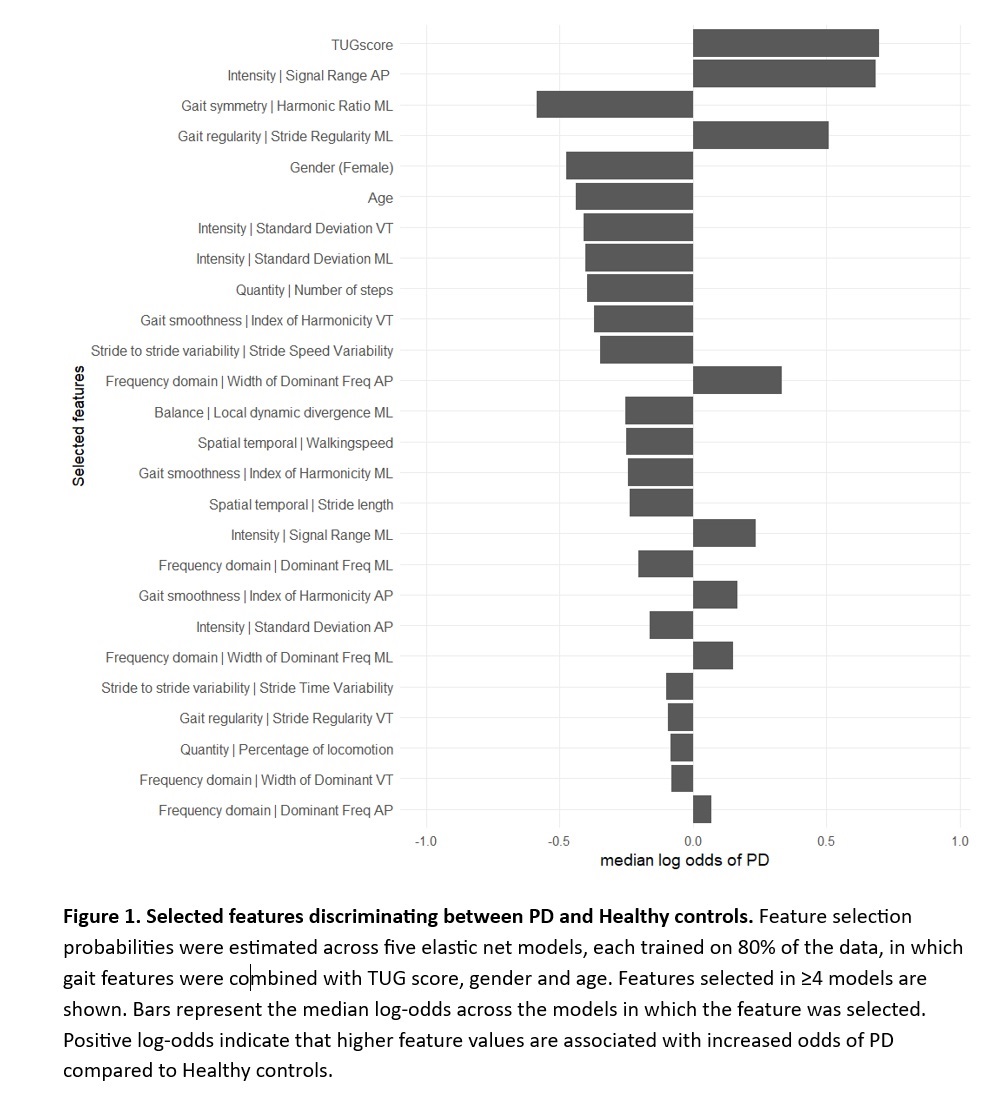
Figure 1.
To cite this abstract in AMA style:
R. Weijer, V. Exadaktylos, K. van Schooten, A. Ionescu, E. van Wegen, M. Rietberg, L. Kerckhaert, J. van Hilten, D. Hepp. Added Value of Wearable-Derived Gait Features Beyond Clinical Assessments in Parkinson’s Disease [abstract]. Mov Disord. 2026; 41 (suppl 1). https://www.mdsabstracts.org/abstract/added-value-of-wearable-derived-gait-features-beyond-clinical-assessments-in-parkinsons-disease/. Accessed October 1, 2026.« Back to 2026 International Congress
MDS Abstracts - https://www.mdsabstracts.org/abstract/added-value-of-wearable-derived-gait-features-beyond-clinical-assessments-in-parkinsons-disease/