
Category: Parkinson's Disease: Surgical Therapy
Objective: Stimulation induced dyskinesia is a known phenomenon in subthalamic nucleus (STN) deep brain stimulation (DBS) for Parkinson’s disease. However, stimulation induced dyskinesia affecting the ipsilateral side has not been reported. We describe a case of a woman with Parkinson’s disease exhibiting ipsilateral stimulation induced dyskinesias.
Background: A 70-year-old right-handed Caucasian female with a history of tremor predominant Parkinson’s disease underwent right STN DBS placement (Medtronic 3387) in 2018, and left STN DBS placement (Medtronic SenSight B33005) in 2025 for medication refractory tremor. She did not report any dyskinesias prior to left STN lead implantation. Activation of either the left or right STN lead individually caused left hemibody dyskinesias. The stimulation induced dyskinesias were present in the medication OFF state as well as the medication ON state. During DBS monopolar review, local field potential (LFP) recordings revealed a finely tuned gamma (FTG) peak at approximately half the stimulation frequency. The emergence of this FTG signal coincided with the minimum stimulation threshold required to elicit dyskinesias. Notably, the FTG peak was more pronounced in the left STN than in the right (Fig 1).
Method: N/A
Results: N/A
Conclusion: This case illustrates an atypical motor response pattern following STN DBS lead implantation. Our previous work implicated the subthalamo-pallidal pathway in stimulation-induced dyskinesias (SID) during both STN and pallidal DBS. The observation of both ipsilateral and contralateral responses may suggest the involvement of cross-hemispheric connectivity in this case or alternatively, modulation of the SID pathway may represent a global prokinetic state rather than a focal motor phenomenon.
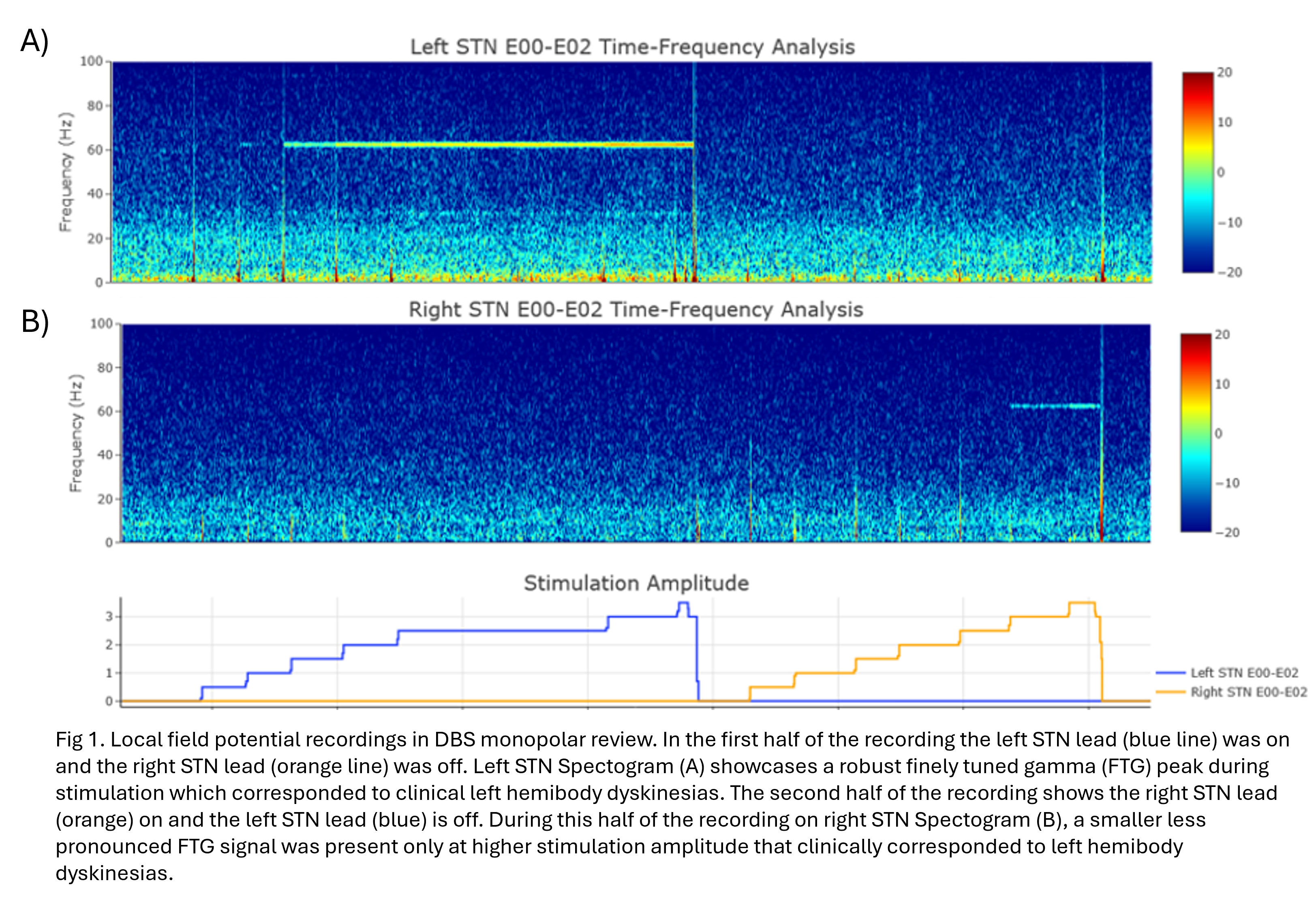
Figure 1
To cite this abstract in AMA style:
P. Gupta, D. Vuddandam, A. Madamangalam, G. Kenworthy, J. Wong, L. Fanty. All Left: A Case of Ipsilateral Stimulation Induced Dyskinesia [abstract]. Mov Disord. 2026; 41 (suppl 1). https://www.mdsabstracts.org/abstract/all-left-a-case-of-ipsilateral-stimulation-induced-dyskinesia/. Accessed October 1, 2026.« Back to 2026 International Congress
MDS Abstracts - https://www.mdsabstracts.org/abstract/all-left-a-case-of-ipsilateral-stimulation-induced-dyskinesia/