
Category: Parkinson’s Disease: Clinical Trials
Objective: To evaluate the safety, tolerability, and preliminary efficacy of putaminal implantation of XS411 (allogeneic iPSC-derived dopaminergic progenitors) in advanced PD (NCT07080775).
Background: Parkinson’s disease (PD) is characterized by progressive dopaminergic loss. Preliminary evidence suggests that grafting induced pluripotent stem cell (iPSC)-derived dopaminergic progenitors may effectively replenish these neurons.
Method: This open-label, Phase 1 trial (3+3 dose-escalation design) enrolled nine advanced PD patients into three cohorts receiving escalating doses of XS411 (4.5, 9.0, or 18.0 million cells) via bilateral stereotactic putaminal implantation. Patients received a triple-drug immunosuppressive regimen (basiliximab, tacrolimus, and corticosteroids). Primary endpoints were safety and tolerability; secondary endpoints included clinical efficacy (motor function, motor fluctuations, and quality of life) and graft viability.
Results: To date, follow-up assessments were completed at 1, 3, and 6 months for the low-dose cohort; at 1 and 3 months for the medium-dose cohort; and at 1 month for the high-dose cohort. None of the nine patients experienced DLTs, SAEs, or graft-related adverse events. At 3 months, median (range) MDS-UPDRS III “OFF” scores improved by 28.0 (10.0-34.0) and 39.0 (18.0-40.0) points in the low- and medium-dose cohorts, respectively. Corresponding median increases in daily “Good ON” time (5.5 [3.0-6.4] and 3.3 [1.3-6.4] hours) and reductions in “OFF” time (5.2 [3.1-6.3] and 3.7 [3.6-7.3] hours) were observed. PDQ-39 scores similarly improved by 24.9 (6.0-25.1) and 16.8 (1.4-18.5) points. In the low-dose cohort, clinical benefits persisted at 6 months across these measures: MDS-UPDRS III (28.0 [11.0-35.0] points), “Good ON” time (4.5 [3.2-6.5] hours), “OFF” time (3.8 [3.4-6.3] hours), and PDQ-39 (25.1 [5.9-28.3] points). At 3 and 6 months, PET showed that SUVR of 18F-DOPA increased by 4.7% (2.8%-14.9%) and 22.0% (7.2%-36.7%) in the left putamen, respectively, from baseline in the low-dose cohort. At 3 months, putaminal 18F-DOPA uptake in the medium-dose cohort was higher than that in the low-dose cohort.
Conclusion: Preliminary data suggest that putaminal XS411 implantation is safe, well-tolerated, and potentially efficacious in advanced PD. Results indicate functional graft survival. Long-term follow-up is ongoing, and a Phase 2 trial was initiated in 2026.
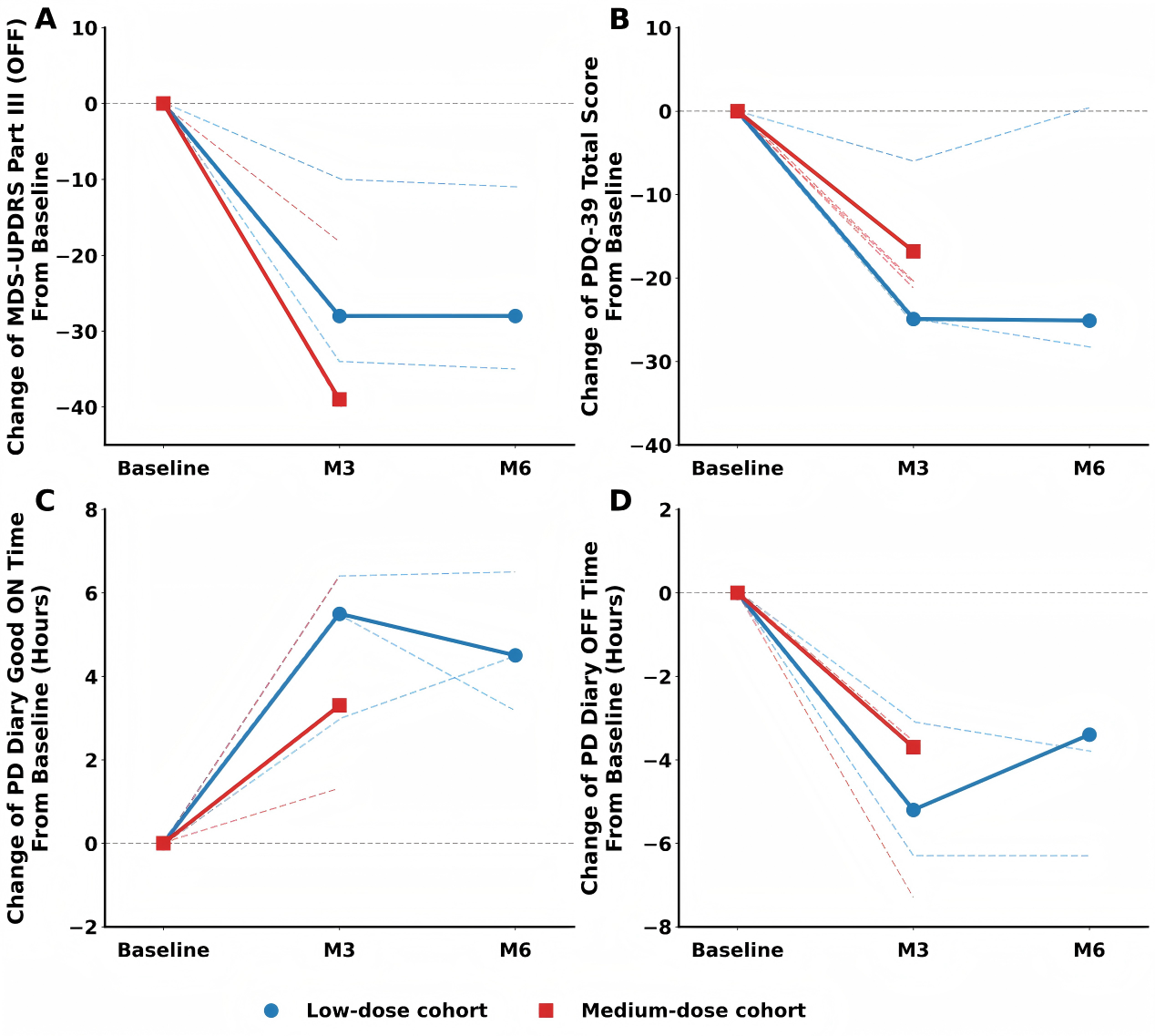
Figure 1 Changes in clinical outcomes
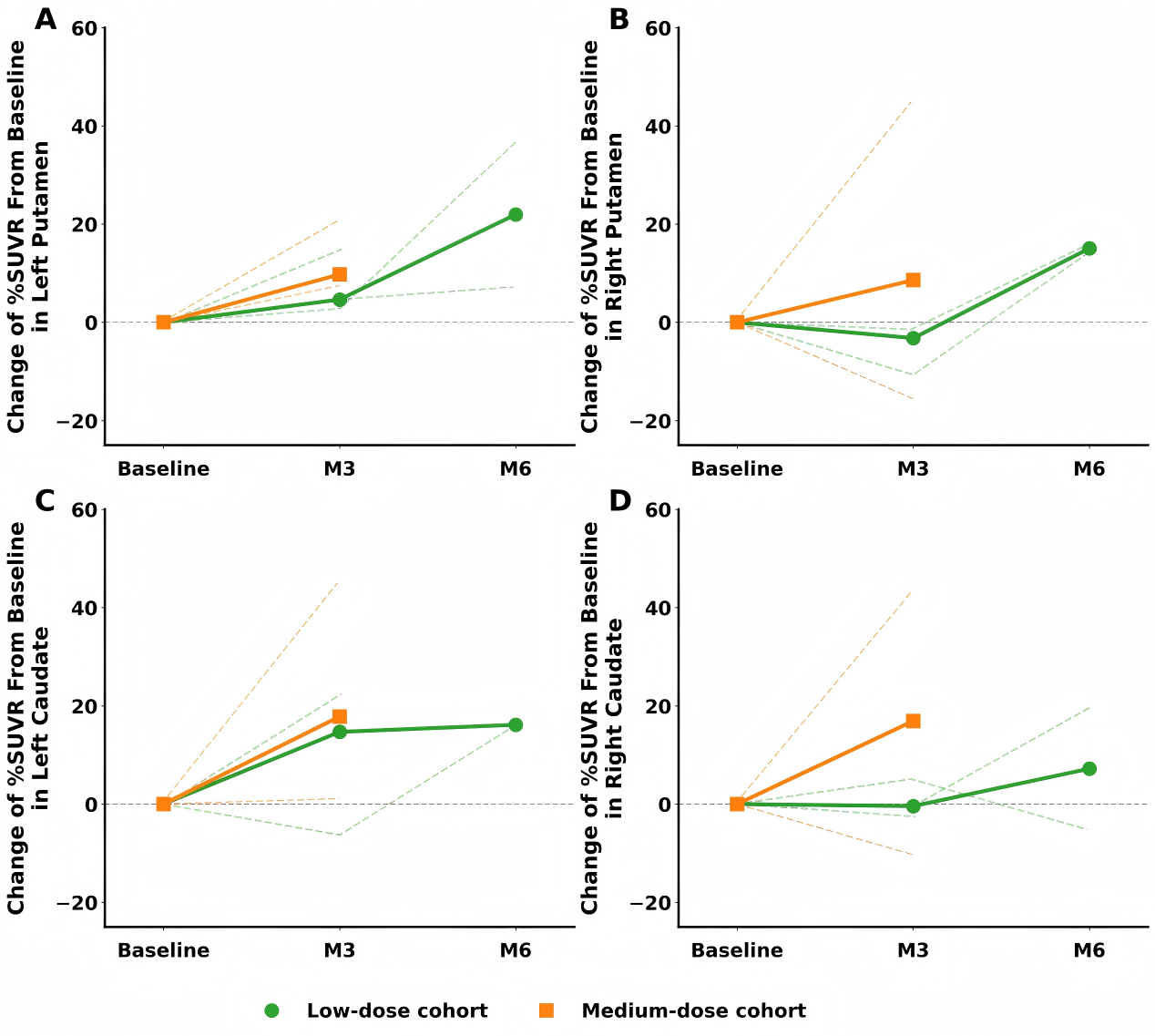
Figure 2 Changes in 18F-DOPA uptake
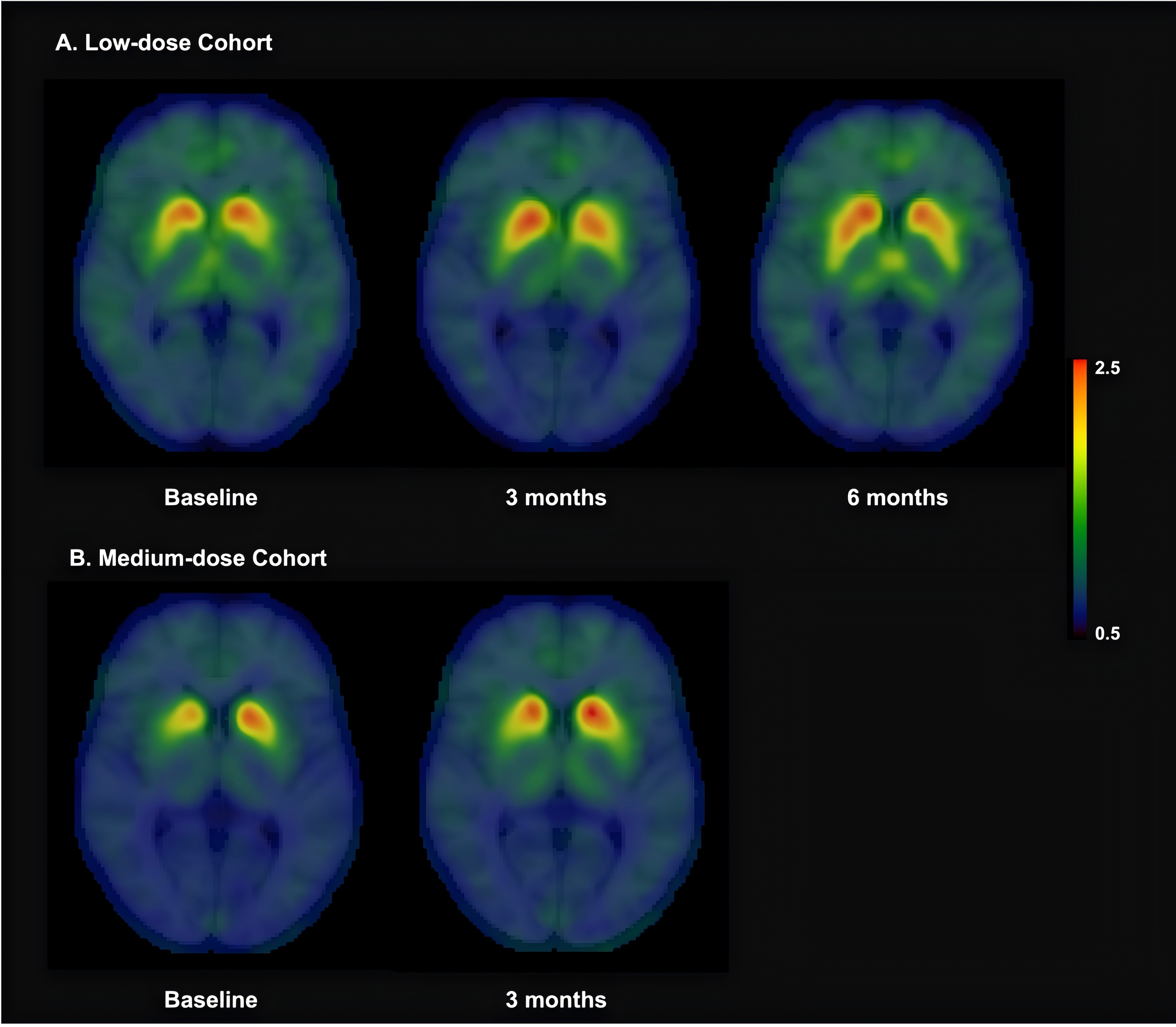
Figure 3 Mean SUVR image
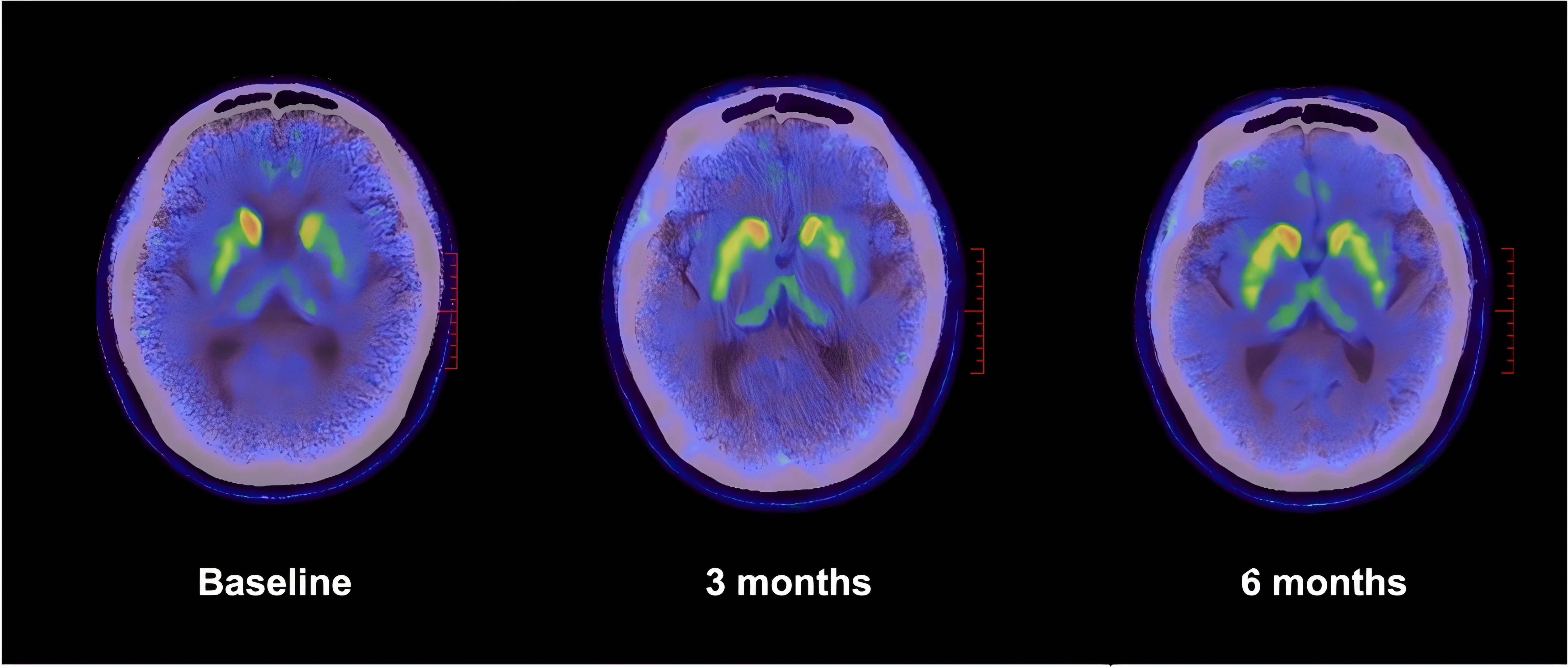
Figure 4 18F-DOPA PET/CT of Subject 1
To cite this abstract in AMA style:
D. Su, X. Wang, J. Zhang, X. Zheng, J. Luo, Z. Wang, L. Ma, J. Xi, P. Yan, X. Li, F. Meng, T. Feng. Allogeneic iPSC-Derived Dopaminergic Progenitor Transplantation for Parkinson’s Disease: A Phase 1, Dose-Escalation Trial [abstract]. Mov Disord. 2026; 41 (suppl 1). https://www.mdsabstracts.org/abstract/allogeneic-ipsc-derived-dopaminergic-progenitor-transplantation-for-parkinsons-disease-a-phase-1-dose-escalation-trial/. Accessed October 1, 2026.« Back to 2026 International Congress
MDS Abstracts - https://www.mdsabstracts.org/abstract/allogeneic-ipsc-derived-dopaminergic-progenitor-transplantation-for-parkinsons-disease-a-phase-1-dose-escalation-trial/