
Objective: To develop an international consensus framework for clinical video acquisition and metadata reporting optimized for Computer Vision-based movement analysis
Background: Advances in Computer Vision (an AI method for analyzing digital images) now enable objective analysis of neurological motor signs from clinical videos. While >100 studies demonstrate this potential, inconsistent recording and reporting practices – not algorithmic capability – have become the primary barrier to reproducibility and clinical translation. Currently, no guideline exists for acquiring measurement-grade video in neurology
Method: A multidisciplinary panel of 23 experts across 6 motor domains (hand/upper limb, gait, face, posture/balance, eye movements, head/neck) completed a two-round modified Delphi process. Round 1 (n=23) elicited experiential knowledge through open-ended prompts and domain-specific synthesis groups. Round 2 (n=19) presented a tiered framework for confirmatory rating; items were classified as mandatory if ≥70% of panelists endorsed this category
Results: Panelists strongly agreed that video acquisition should constitute a protocolized measurement step (mean 4.52±0.73) and that multicenter harmonization is necessary for video-based studies in Neurology (4.48±0.59). The panel converged on a framework distinguishing mandatory, optimal, and contextual elements across a 16-item acquisition protocol and 21-item metadata reporting guideline. Two acquisition items reached mandatory consensus: video setup defined in the study protocol (89%) and standardized motor task instructions (84%). Four metadata items were mandatory: task instructions (89%), disease severity and motor confounders (84%), video frame rate (79%), and patient demographics (74%). Panel confidence was high for both blocks (acquisition: 4.32± 0.46; metadata: 4.26± 0.64). 84% of respondents reported that existing studies at least partially underrepresent patient diversity.
Conclusion: This produces the first consensus framework for Computer Vision-optimized video acquisition in neurology. Targeted standardization of recording setup, task design, and metadata reporting provides a pragmatic path to transforming routine clinical video into reproducible quantitative movement analysis and digital biomarkers. Improving diversity and equity in video-based datasets will be essential to ensure generalizable clinical applications.
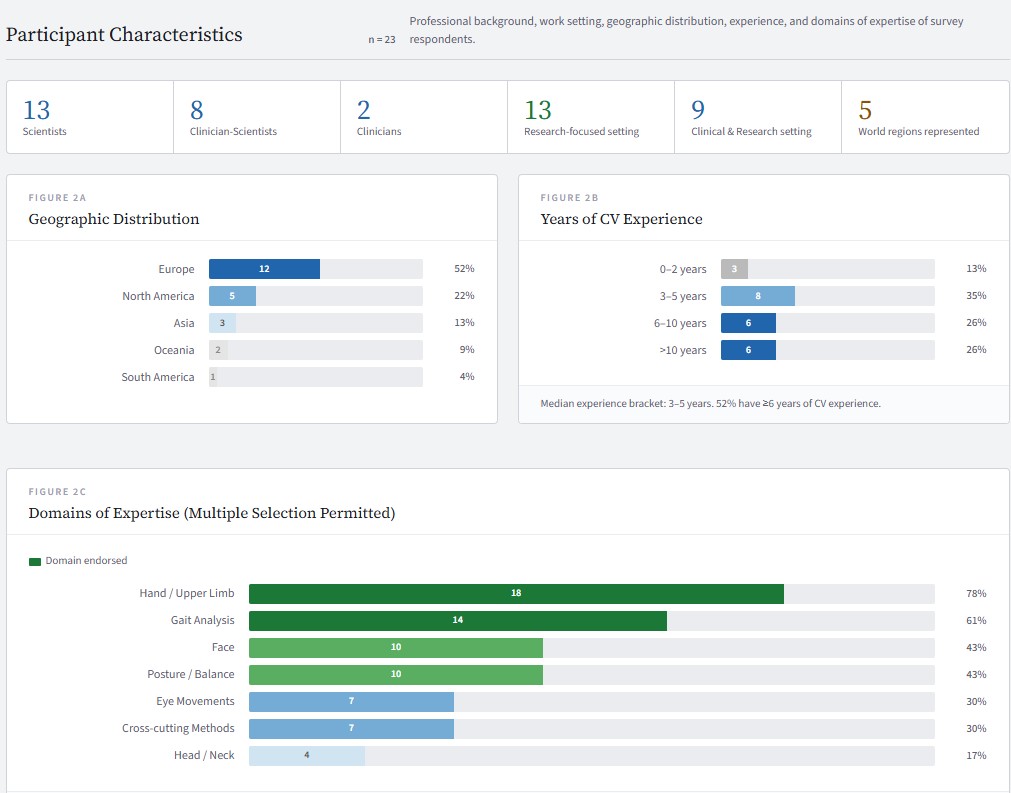
Fig 1. Participant characteristics
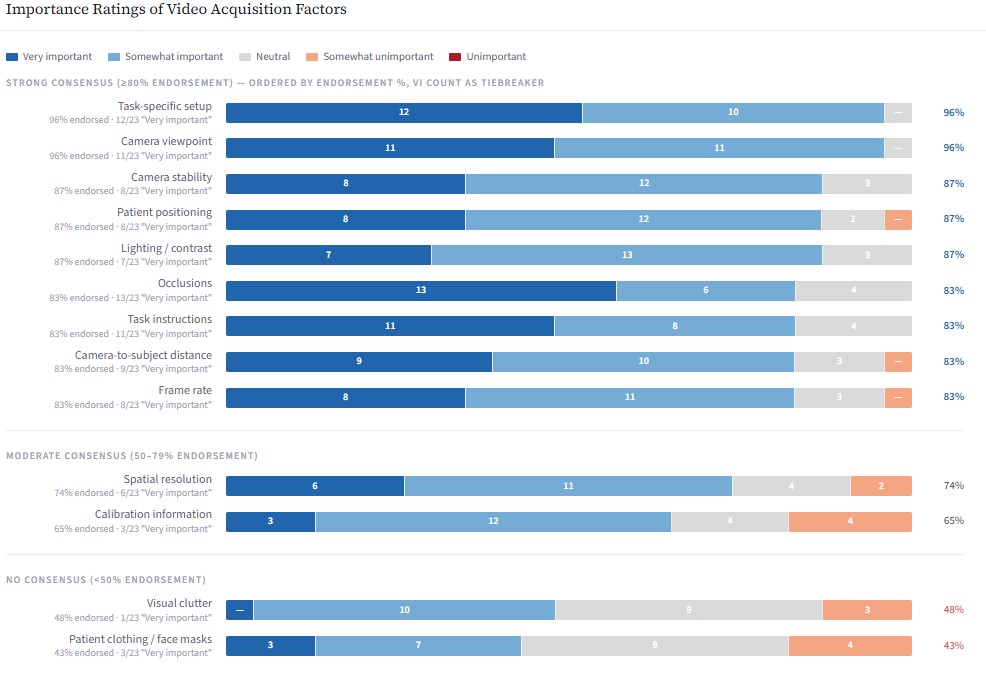
Fig 2. Consensus on video acquisition features
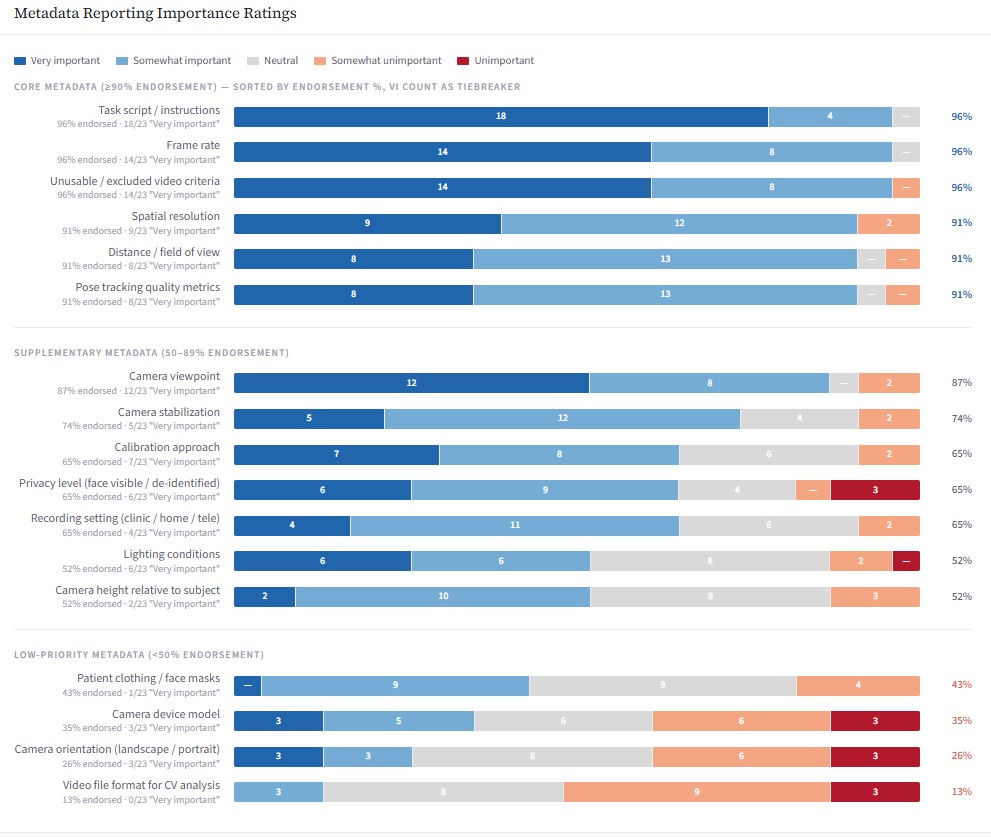
Fig 3. Consensus on metadata
References: Friedrich MU, Relton S, Wong D, Alty J. Computer Vision in Clinical Neurology: A Review. JAMA Neurol. 2025 Feb 17. doi: 10.1001/jamaneurol.2024.5326
To cite this abstract in AMA style:
J. Alty, G. Amprimo, J. Shin, M. Wuehr, M. Novotny, M. Merello, M. de Koning-Tijssen,, H. Haberfehlner, S. Relton, D. Wong, J. Taeger, A. Zwergal, S. Walther, B. Taati, R. Roemmich, C. Ferraris, M. Mckeown, A. Gupta, R. Li, M. Friedrich. An International Consensus Framework for Computer Vision-ready acquisition and reporting: Toward Measurement-grade video in Neurology [abstract]. Mov Disord. 2026; 41 (suppl 1). https://www.mdsabstracts.org/abstract/an-international-consensus-framework-for-computer-vision-ready-acquisition-and-reporting-toward-measurement-grade-video-in-neurology/. Accessed October 1, 2026.« Back to 2026 International Congress
MDS Abstracts - https://www.mdsabstracts.org/abstract/an-international-consensus-framework-for-computer-vision-ready-acquisition-and-reporting-toward-measurement-grade-video-in-neurology/