
Category: Parkinson's Disease: Surgical Therapy
Objective: To determine anatomical and electrical field parameters associated with short-term improvement in axial motor scores after bilateral GPi-DBS in PD.
Background: Axial symptoms in Parkinson’s disease (PD) may improve after Deep Brain Stimulation (DBS) of the globus pallidus internus (GPi), though the effect declines in the long-term with disease progression. The short-term outcome may depend on the anatomical region stimulated and the characteristics of the electrical field.
Method: In this prospective, cohort study, PD patients who underwent GPi-DBS and had a pre-operative UPDRS-III axial sub-score (items 27–31) ≥5 in the medication-OFF state were reassessed 6 months post-DBS. During programming, simulations of all bilateral electrode-contact pairs were performed to identify the most and least effective contacts for axial symptoms. Patients and simulations with ≥30% improvement in axial score were classified as axial improved. DBS electrodes were reconstructed, and simulations modelled using Lead-DBS v2.5.3 with MATLAB 2019b. Spatial analyses evaluated anatomical predictors, including overlap between volume of tissue activated (VTA) and GPi, GPe, sensorimotor GPi, and combined GPi-GPe regions, symmetry index, dice index. Electrical field variables analyzed included electric field symmetry index and electric field angle within GPi and GPe.
Results: Twenty-six patients (15 males) with mean age of 62 years and mean disease duration of 11 years generated 64 simulations. General linear mixed-model analysis showed that VTA-GPe overlap predicted axial improvement (p=0.05, β=0.003). Minimum threshold of VTA-GPe overlap ≥145 mm³ in each hemisphere predicted axial improvement (AUC 0.675, p=0.019; sensitivity 60%, specificity 60%). Higher GPe symmetry index (p=0.007) and dice spatial coefficient (p=0.002) were associated with axial improvement. In simulations exceeding the 145 mm³ threshold, GPe electrical field symmetry was higher (p=0.004) and inter-hemispheric electrical field angle lower (p=0.012).
Conclusion: Greater bilateral stimulation volume of GPe, symmetricity in stimulation volume of bilateral GPe, stimulation of spatially symmetric regions of bilateral GPe, and symmetricity of electrical field within bilateral GPe predicts short-term improvement in axial symptoms after GPi DBS in PD. Validation in larger cohorts can inform pre-operative targeting and image-guided programming.
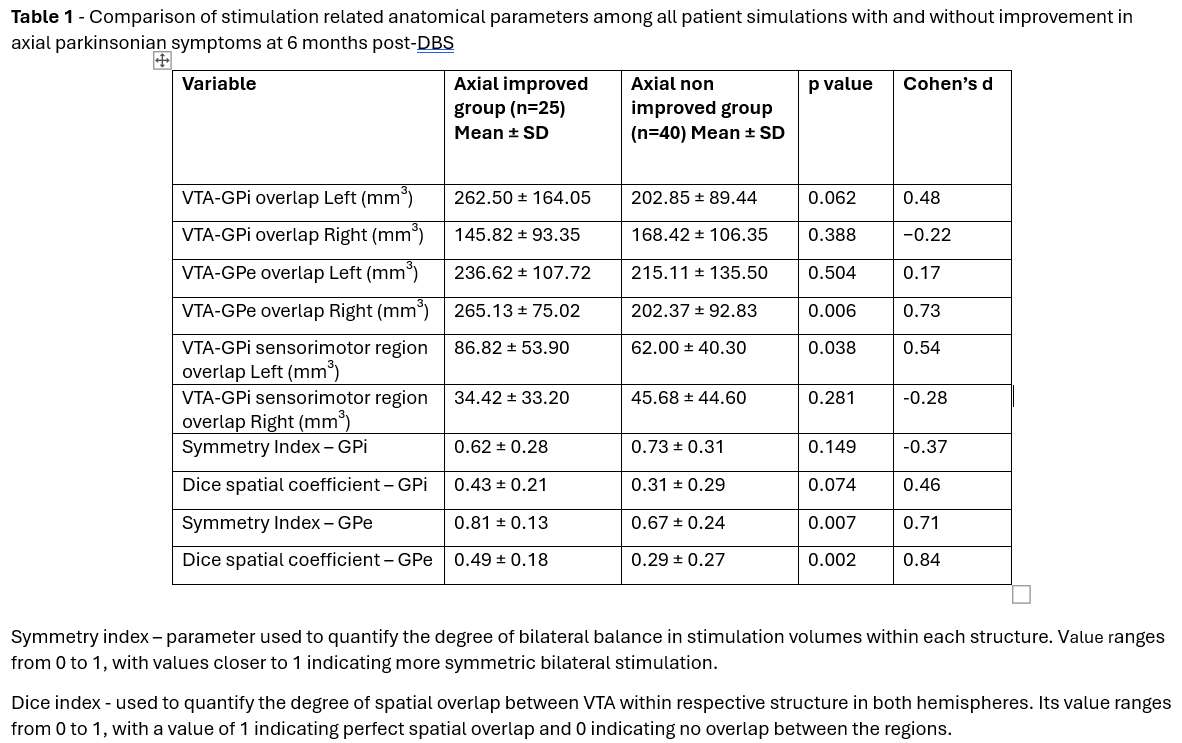
Table 1
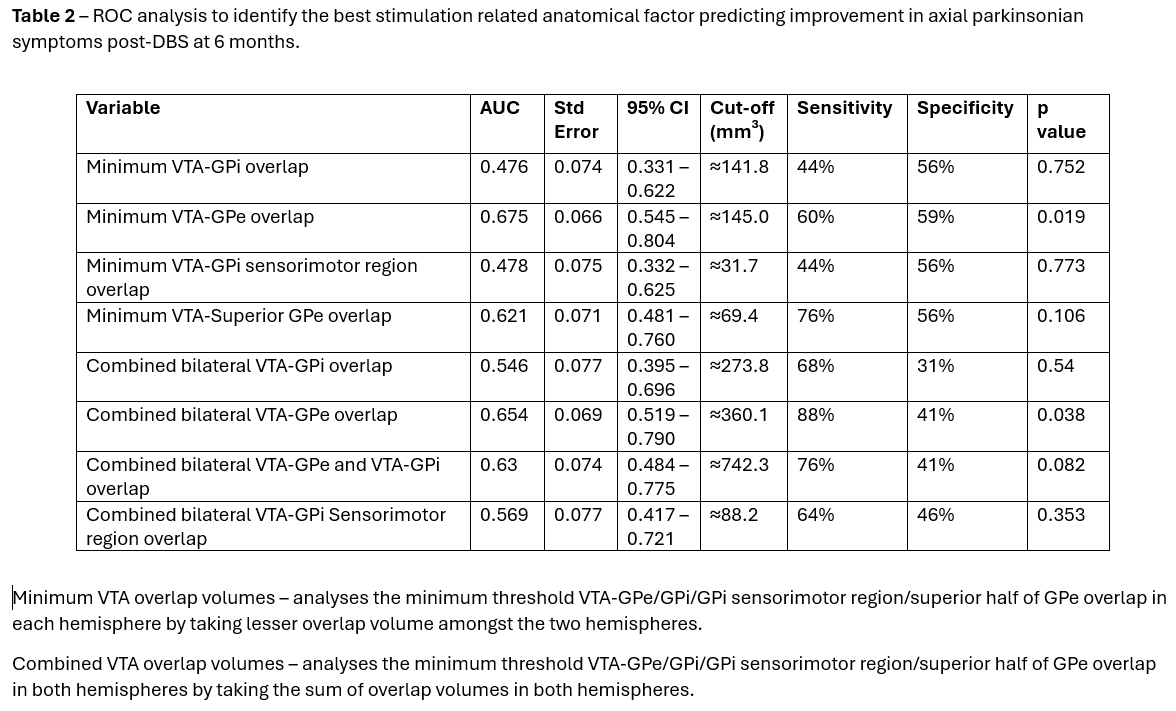
Table 2
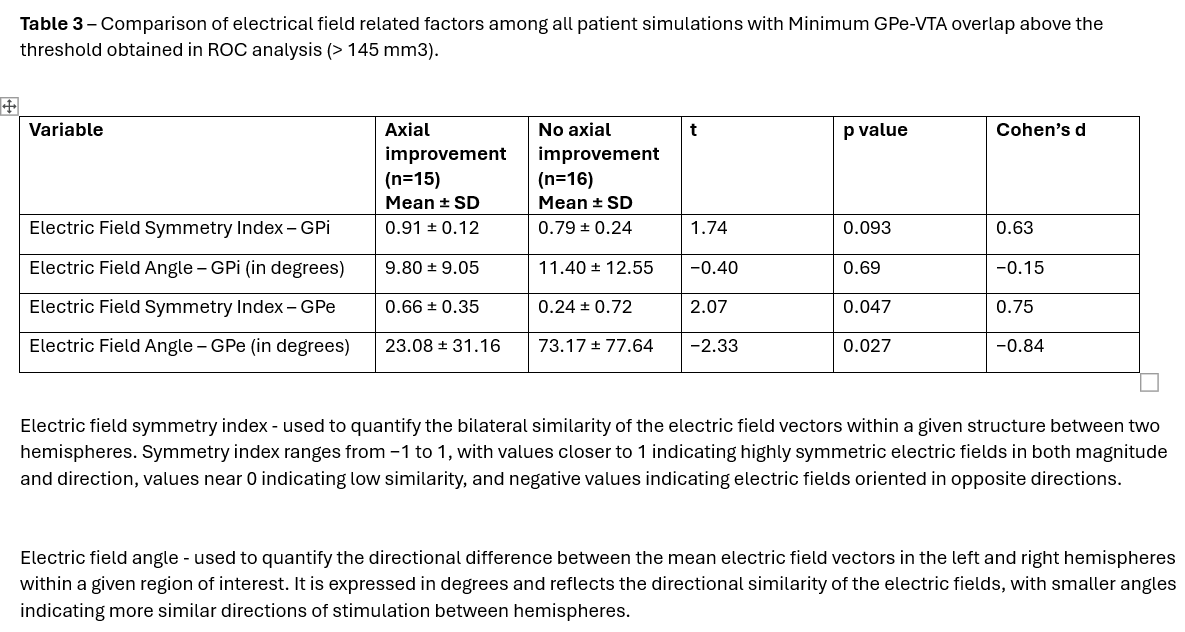
Table 3
To cite this abstract in AMA style:
M. Girija, C. Reddy, S. Joshua, A. Nair, A. Hynse, A. Kishore. Anatomical and electrical field determinants of axial motor outcome after bilateral GPi-DBS in Parkinson’s disease [abstract]. Mov Disord. 2026; 41 (suppl 1). https://www.mdsabstracts.org/abstract/anatomical-and-electrical-field-determinants-of-axial-motor-outcome-after-bilateral-gpi-dbs-in-parkinsons-disease/. Accessed October 1, 2026.« Back to 2026 International Congress
MDS Abstracts - https://www.mdsabstracts.org/abstract/anatomical-and-electrical-field-determinants-of-axial-motor-outcome-after-bilateral-gpi-dbs-in-parkinsons-disease/