
Category: Huntington's Disease
Objective: To evaluate the efficacy of antidepressants for depression in Huntington’s disease (HD).
Background: Depression is highly prevalent in HD. Despite frequent clinical use of antidepressants, evidence from trials remains limited and fragmented. A consolidated analysis of available trials data is needed to guide treatment decisions.
Method: PubMed was searched for trials evaluating antidepressant drugs in HD. The primary endpoint was depression using the Hamilton Depression Rating Scale (HAM-D). Secondary endpoints included Self-Rating Anxiety Scale (SAS), Unified Huntington’s Disease Rating Scale (UHDRS) Total Motor Score (TMS), Mini-Mental State Examination (MMSE), Neuropsychiatric Inventory (NPI), UHDRS Total Functional Capacity (TFC) (UHDRS‑TFC), executive function (Trails‑B), and adverse events. Mean differences (MDs) were synthesized using inverse‑variance models, and SMD with REML.
Results: A total of 4 trials studying fluoxetine, venlafaxine, citalopram, and bupropion were found. For bupropion, only data about side effects were available. Antidepressants significantly improved depression versus control (MD −4.52, 95% CI −8.85 to −0.20; I² = 86%) [Figure 1]. Effect sizes varied by medication (fluoxetine MD −2.87; venlafaxine MD −9.08; citalopram MD -1.90). Anxiety improved modestly (SMD −0.62, 95% CI −1.17 to −0.08) [Figure 2]. No significant effects were observed for functional (MD –0.27, 95% CI –1.37 to 0.82) [Figure 3], executive (SMD -0.12, 95% CI –1.11 to 0.88), motor (SMD –0.37, 95% CI –0.91 to 0.17), or cognitive (SMD –0.21, 95% CI –0.75 to 0.32) outcomes. Adverse event rates were similar between antidepressant and placebo groups (RR 1.86, 95% CI 0.73–4.75). Agitation (RR 0.71, 95% CI 0.17–3.01), hypomania (RR 0.95, 95% CI 0.25–3.65), fatigue (RR 0.31, 95% CI 0.01–6.85), and weight loss (RR 2.77, 95% CI 0.12–61.65) occurred at comparable frequencies.
Conclusion: Evidence indicates antidepressants yield a modest yet significant reduction in depressive symptoms in HD, though, not surprisingly, effects differ by drug class. Benefits seem confined to mood outcomes, with no consistent improvement in motor, cognitive, or functional measures. Larger, adequately powered trials are needed to guide optimal treatment strategies.
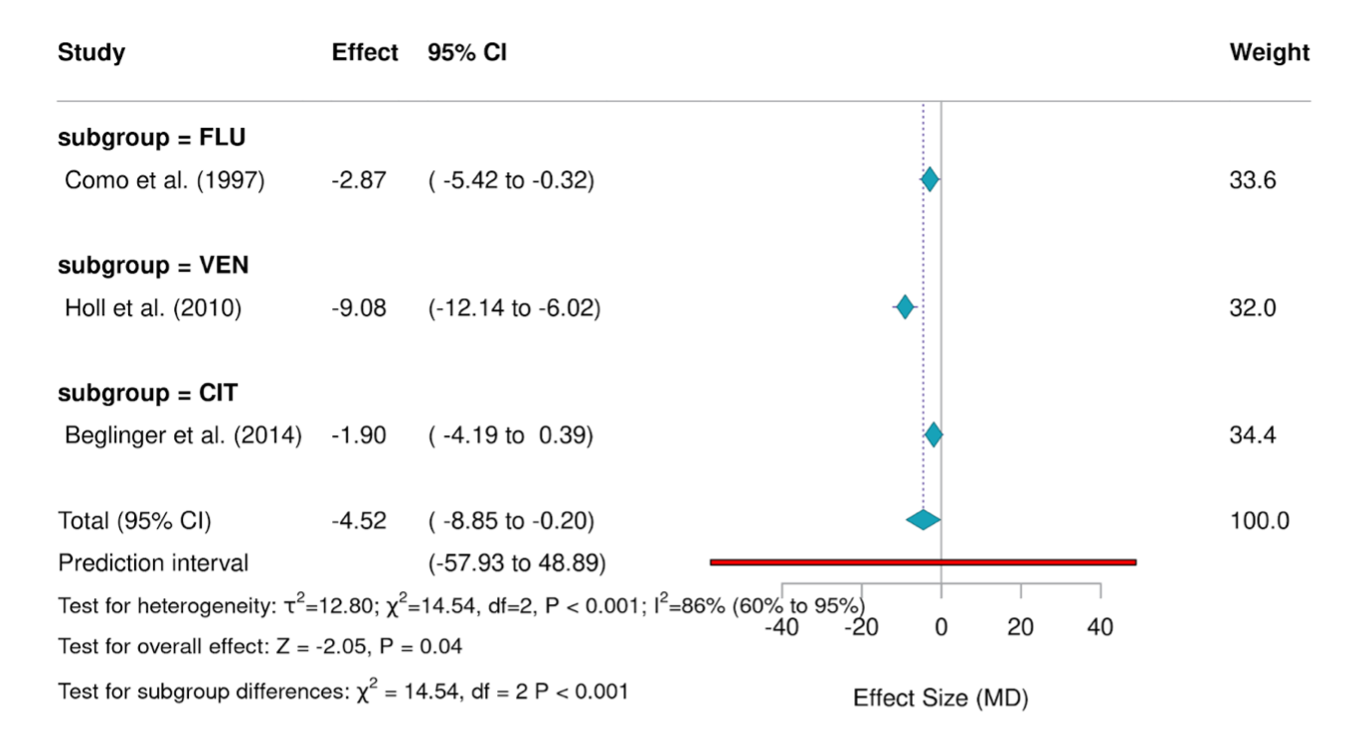
Figure 1
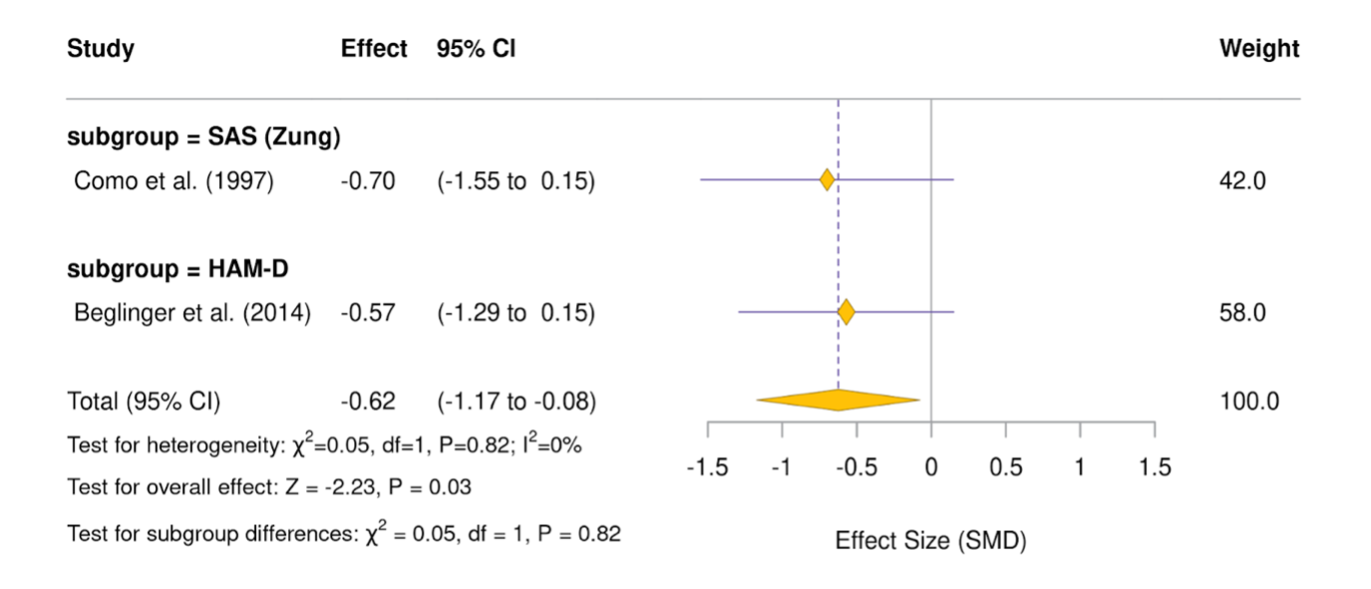
Figure 2
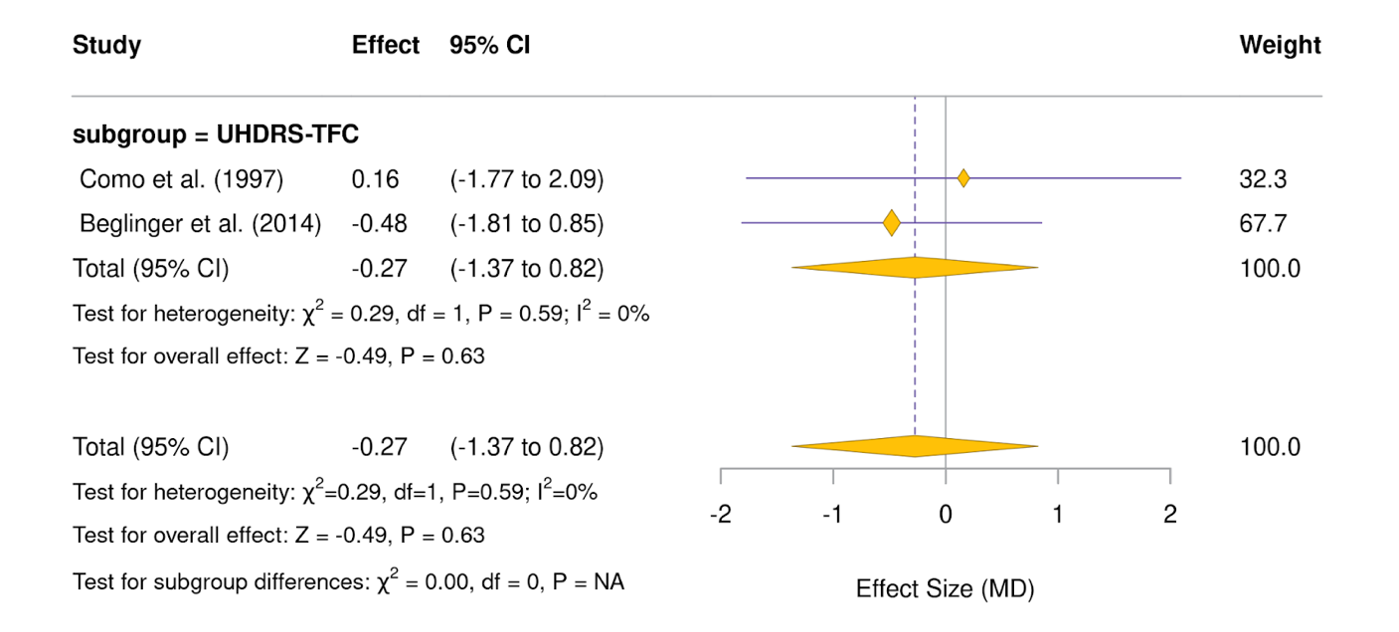
Figure 3
To cite this abstract in AMA style:
J. Patino, J. Pitton Rissardo, A. Fornari Caprara, A. Mcgarry, I. Walker, N. Rocha, A. Duker, E. Furr Stimming. Antidepressants in Huntington’s Disease: A Meta Analysis of Mood and Motor Outcomes with Placebo-controlled Trials [abstract]. Mov Disord. 2026; 41 (suppl 1). https://www.mdsabstracts.org/abstract/antidepressants-in-huntingtons-disease-a-meta-analysis-of-mood-and-motor-outcomes-with-placebo-controlled-trials/. Accessed October 1, 2026.« Back to 2026 International Congress
MDS Abstracts - https://www.mdsabstracts.org/abstract/antidepressants-in-huntingtons-disease-a-meta-analysis-of-mood-and-motor-outcomes-with-placebo-controlled-trials/