
Category: MSA, PSP, CBS (Other)
Objective: To evaluate the feasibility of app-based speech assessment in Parkinson’s disease (PD) and progressive supranuclear palsy (PSP), and to explore group differences in speech measures.
Background: Speech impairment is common in PD and PSP and reflects broader motor system dysfunction. Digital speech measures may sensitively capture disease-related change and provide clinically meaningful markers of functional communication deficits, including intelligibility.
Method: Italian-speaking participants were consecutively enrolled from the outpatient clinic of the Center for Neurodegenerative Diseases (CEMAND), University of Salerno. Speech was recorded in-clinic using the Mili mobile app and the ki:elements SB-M protocol, including maximum phonation /a/, sustained vowels /i, a, u/, DDK of /pataka/ and kakaka/, reading, and picture description. We analyzed 35 healthy controls (HC), 14 PD, and 18 PSP [table 1]. PSP and PD were diagnosed according to established MDS criteria [1,2]. Participants rated app usability (1–5 scale; higher is better). Speech samples were processed with SIGMA, ki:elements speech processing pipeline to compute the SB-M intelligibility score from reading (lower = less intelligible) [3] and to extract acoustic features. Group differences were assessed.
Results: Usability was high across groups, with most ratings ranging between 4 and 5 (HC: 4.44 ± 0.72; PD: 4.17 ± 0.94; PSP: 4.00 ± 1.03). Intelligibility was reduced in pathological groups and was worse in PSP than PD (HC: 0.944 ± 0.069; PD: 0.874 ± 0.105; PSP: 0.613 ± 0.266). Acoustic measures further differentiated groups: PSP showed overall slowness (reduced DDK and reading rates), more pauses during reading and shorter maximum phonation time (consistent with reduced breath support), as well as increased DDK cycle-to-cycle variability and greater pitch variation during sustained /a/ (reduced phonatory stability) [table 2].
Conclusion: App-based speech assessment is feasible in PD and PSP and detects objective speech impairment, with more severe intelligibility reduction in PSP than PD. These findings support scalable speech monitoring for disease tracking, patient stratification, and differential characterization.
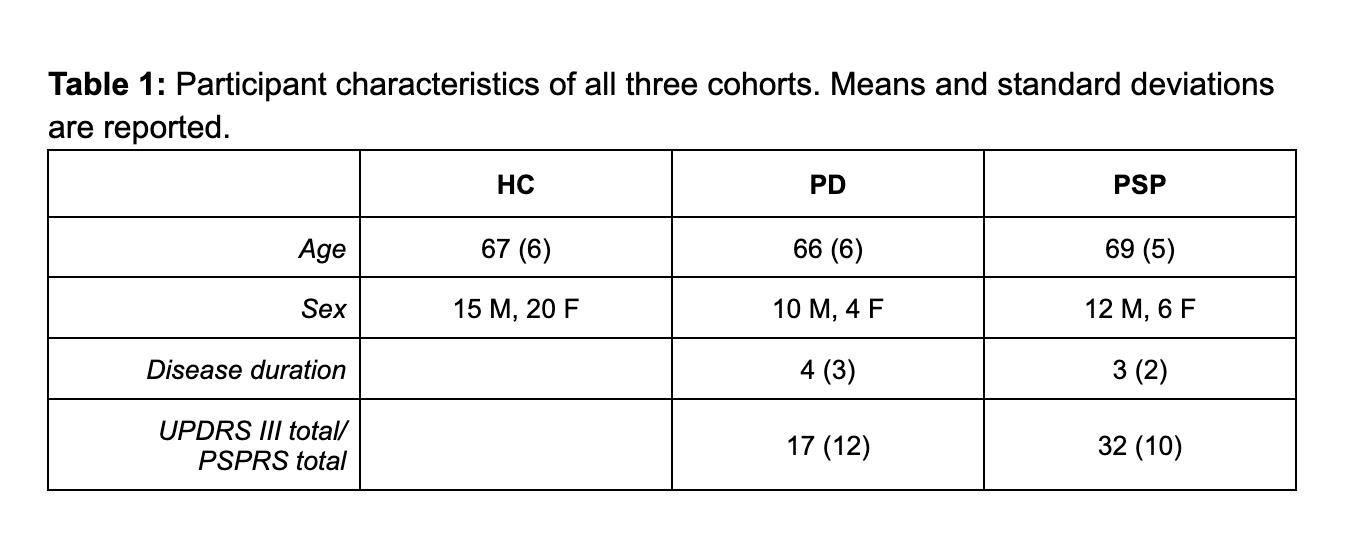
Table 1
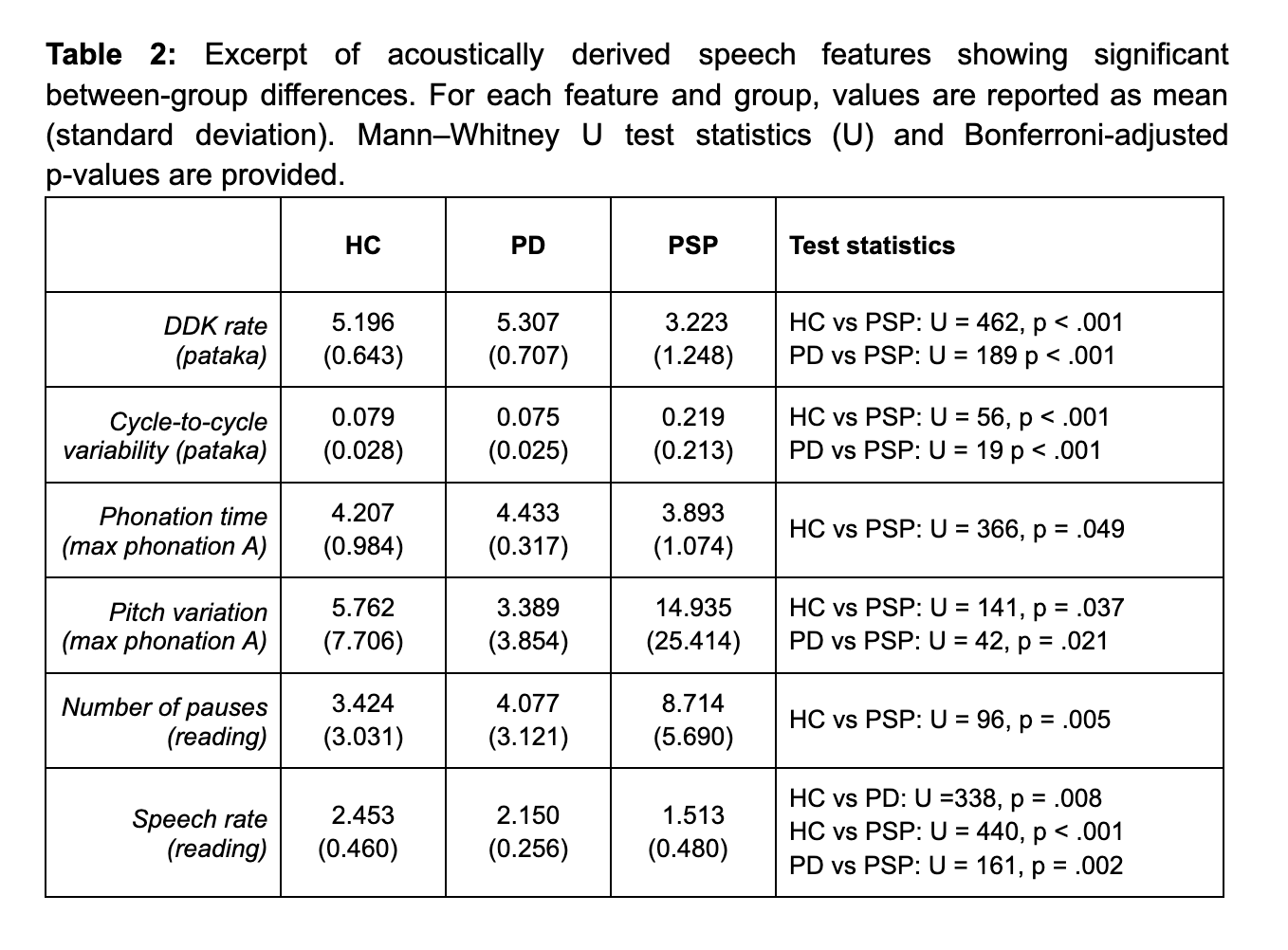
Table 2
References: [1] Höglinger et al. (2017). Clinical diagnosis of progressive supranuclear palsy: the movement disorder society criteria. Movement disorders, 32(6), 853-864.
[2] Berg et al. (2018). Movement disorder society criteria for clinically established early Parkinson’s disease. Movement Disorders, 33(10), 1643-1646.
[3] Tröger et al. (2024). An automatic measure for speech intelligibility in dysarthrias—validation across multiple languages and neurological disorders. Frontiers in Digital Health, 6, 1440986.
To cite this abstract in AMA style:
T. Thies, S. Cuoco, M. Autuori, A. Sahay, J. Tröger, M. Picillo. App-Based Speech Assessment Differentiates PD and PSP: A Feasibility Study in Italian Speakers [abstract]. Mov Disord. 2026; 41 (suppl 1). https://www.mdsabstracts.org/abstract/app-based-speech-assessment-differentiates-pd-and-psp-a-feasibility-study-in-italian-speakers/. Accessed October 1, 2026.« Back to 2026 International Congress
MDS Abstracts - https://www.mdsabstracts.org/abstract/app-based-speech-assessment-differentiates-pd-and-psp-a-feasibility-study-in-italian-speakers/