
Category: Parkinson's disease: Neuroimaging
Objective: To develop an automated deep learning framework for robust midbrain segmentation in MRI data of Parkinson’s disease patients.
Background: Structural alterations in the midbrain are closely associated with neurodegeneration in Parkinson’s disease (PD). Accurate segmentation of the midbrain from magnetic resonance imaging (MRI) is therefore essential for developing quantitative imaging biomarkers [1]. However, conventional segmentation methods often fail because of low contrast, noise, and anatomical variability [2].
Method: T2-weighted axial MRI scans from the Parkinson’s Progression Markers Initiative dataset were used, including 151 PD subjects and 100 healthy controls. Thirty expert-annotated scans were used for supervised model training. An Attention-Enhanced U-Net architecture was implemented, incorporating attention gates within skip connections to improve spatial feature selection. MRI images were preprocessed using center cropping, normalization to the range [−1,1], and resizing to 256×256 pixels. The model was trained using the Adam optimizer and binary cross-entropy loss for up to 50 epochs with early stopping. Performance was evaluated using accuracy, Dice coefficient, F1 score, and mean Intersection-over-Union.
Results: The proposed model achieved 84.2% segmentation accuracy, with a Dice coefficient of 0.82 and mean IoU of 0.78, outperforming baseline convolutional neural network models. Visual analysis shows close agreement between predicted segmentation masks and expert annotations, highlighting the model’s ability to isolate the midbrain region effectively. Figure 1 shows the Visual Comparison of Input, Ground Truth, and Predicted Segmentation
Conclusion: Attention-enhanced deep learning enables accurate automated midbrain segmentation and may support the development of MRI-based biomarkers for early detection and monitoring of Parkinson’s disease.
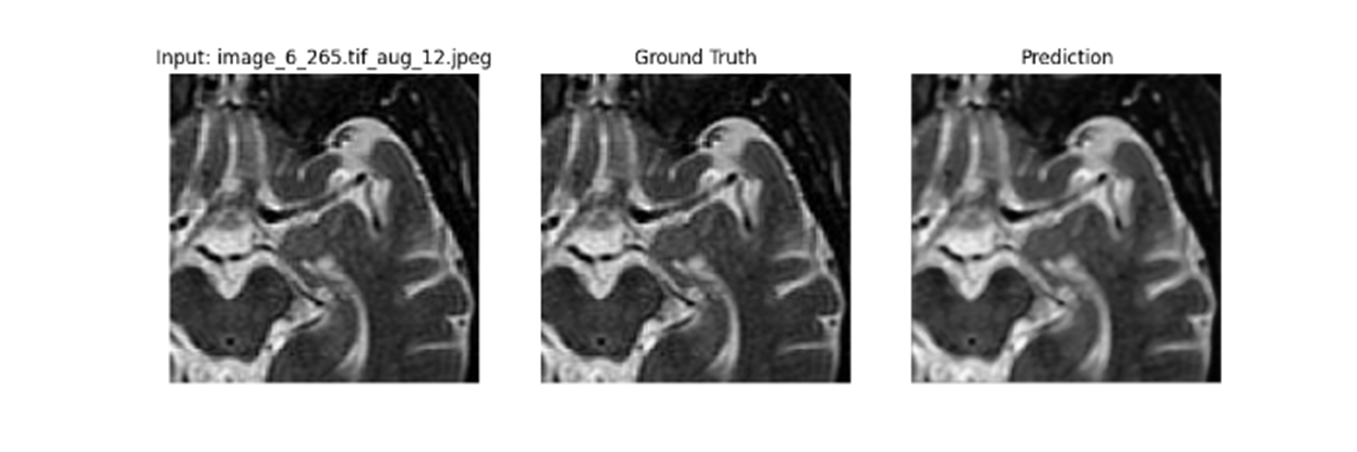
Figure 1
References: 1. Mahapatra C., Manchanda R. Computational assessment of calcium channel effects on subthalamic nucleus neuronal cells: abnormal bursting patterns in Parkinson’s disease. Movement Disorders. 2016.
2. Wang W. et al. Early detection of Parkinson’s disease using deep learning approaches. IEEE Access. 2020.
To cite this abstract in AMA style:
C. Mahapatra, S. Swain. Attention-Enhanced Deep Learning for Midbrain MRI Segmentation in Parkinson’s Disease [abstract]. Mov Disord. 2026; 41 (suppl 1). https://www.mdsabstracts.org/abstract/attention-enhanced-deep-learning-for-midbrain-mri-segmentation-in-parkinsons-disease/. Accessed October 1, 2026.« Back to 2026 International Congress
MDS Abstracts - https://www.mdsabstracts.org/abstract/attention-enhanced-deep-learning-for-midbrain-mri-segmentation-in-parkinsons-disease/