
Objective: To develop and validate a robust, video-based framework for automatic detection of freezing of gait (FOG) from conventional, simple 2D video recordings in clinically realistic environments.
Background: FOG is among the most disabling motor manifestations of Parkinson’s disease (PD), characterized by brief, episodic arrests of forward progression during walking. Despite its clinical importance, FOG remains difficult to quantify objectively. Wearable sensors provide some utility but face compliance and ecological validity limitations. Advances in markerless pose estimation and graph convolutional networks offer a complementary, non-invasive approach, yet most studies are limited to single cohorts and lack external validation. Here, we present an ST-GCN-based pipeline trained on a large cohort and externally validated on an independent dataset.
Method: Videos from 35 participants with PD and FOG who performed the Ziegler FOG-provoking protocol were used for model development. Each frame was processed with YOLOv11 for person detection, StrongSORT for participant tracking, and RTMPose for 2D skeletal keypoint extraction. Keypoint sequences were fed into a spatio-temporal graph convolutional network (ST-GCN) with attention mechanisms. Performance was evaluated using Leave-One-Participant-Out (LOPO) cross-validation. External validation was performed on 14 participants with PD and FOG from a transcranial direct current stimulation pilot study who also performed the Ziegler protocol.
Results: A baseline GCN model yielded an accuracy of 0.52, AUC of 0.82, and F1 of 0.59. The proposed ST-GCN substantially improved performance. In LOPO evaluation (n=35), mean per-subject AUC was 0.85 ± 0.10, F1-macro 0.78 ± 0.10, and accuracy 0.79 ± 0.09. Global pooled AUC was 0.80, FOG-class precision 0.87, recall 0.82, and F1 0.85 [figure1]. On the external validation dataset (n=14), mean per-subject AUC was 0.81 ± 0.10, F1-macro 0.63 ± 0.07, and accuracy 0.67 ± 0.10. Global pooled AUC was 0.77 [figure2].
Conclusion: The proposed pipeline reliably detects FOG from conventional, 2D video recordings and generalizes to an independent external cohort. The cross-dataset performance drop highlights cohort-dependent variability and motivates domain adaptation work. This approach may facilitate scalable, objective FOG assessment in clinical and home settings.
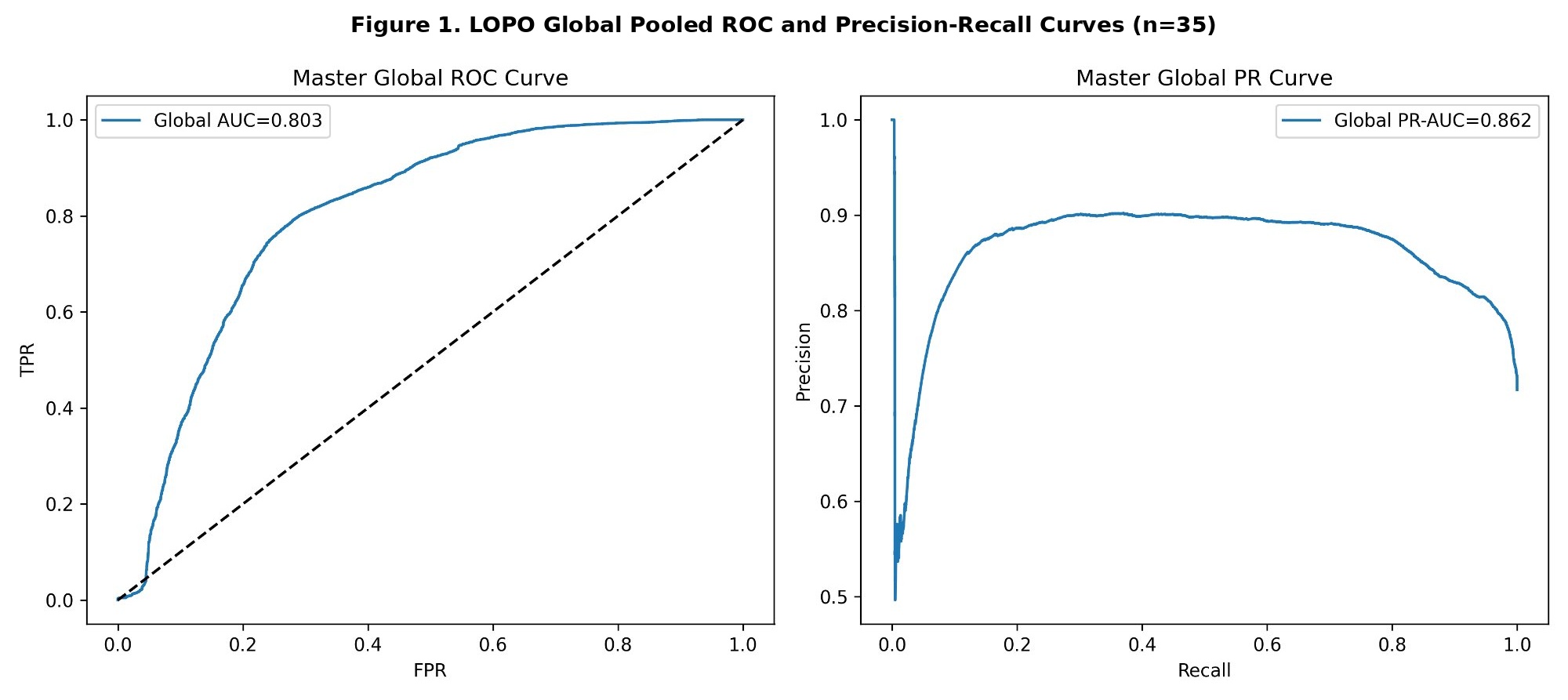
Figure 1
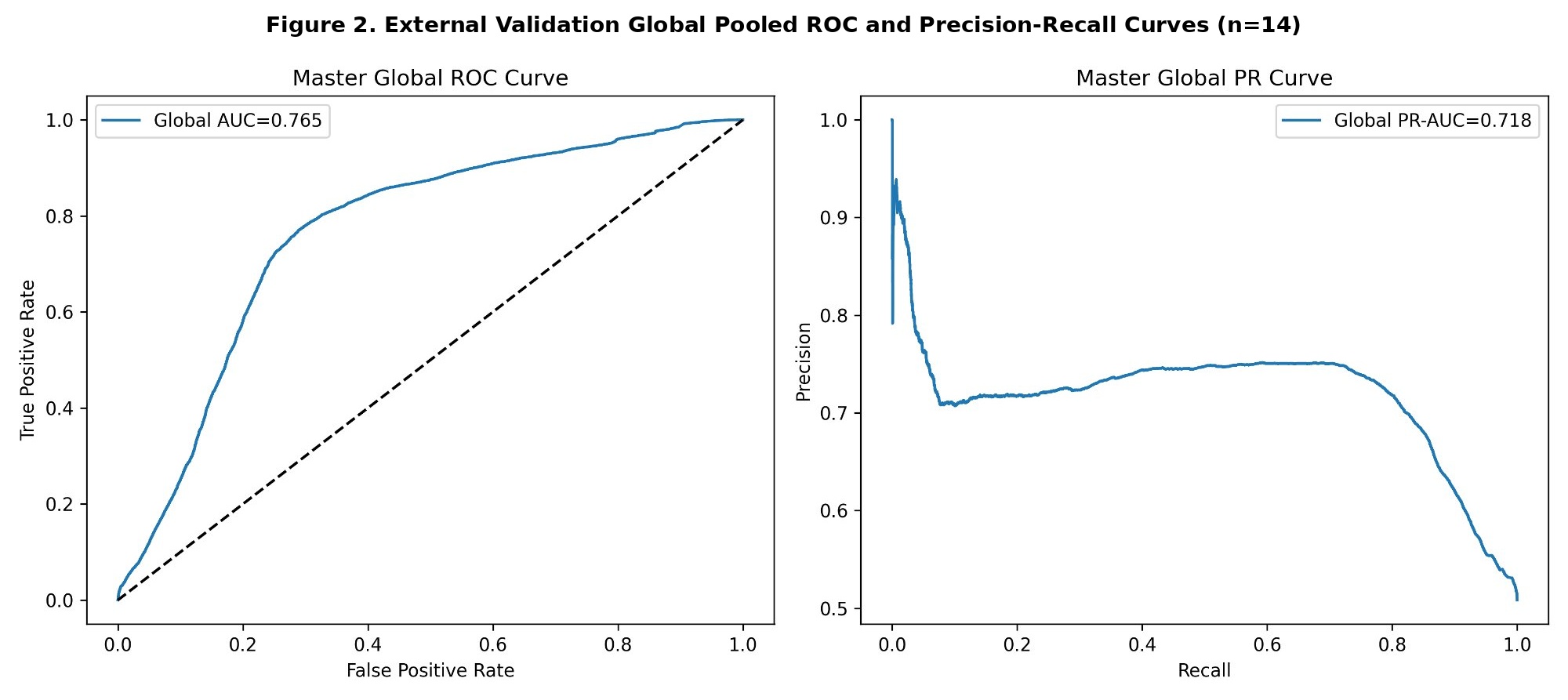
Figure 2
To cite this abstract in AMA style:
A. Shakolnikov, O. Perlman, J. Hausdorff. Automatic Detection of Freezing of Gait from Simple, 2D Video Recordings in Complex Clinical Environments [abstract]. Mov Disord. 2026; 41 (suppl 1). https://www.mdsabstracts.org/abstract/automatic-detection-of-freezing-of-gait-from-simple-2d-video-recordings-in-complex-clinical-environments/. Accessed October 1, 2026.« Back to 2026 International Congress
MDS Abstracts - https://www.mdsabstracts.org/abstract/automatic-detection-of-freezing-of-gait-from-simple-2d-video-recordings-in-complex-clinical-environments/