
Category: Myoclonus/Tics/Stereotypies
Objective: To report the efficacy and safety of bilateral globus pallidus internus deep brain stimulation (GPi-DBS) in a patient with variant ataxia-telangiectasia (A-T) presenting with predominant myoclonus-dystonia
Background: Variant A-T is a rare autosomal recessive disorder characterized by milder phenotypes compared to classic A-T, often presenting with extrapyramidal manifestations including myoclonus and dystonia despite minimal or absent ataxia. Deep brain stimulation for movement disorders in variant A-T has rarely been reported.
Method: We describe a 20-year-old female with compound heterozygous ATM mutations (c.6154G>A and c.6087+1G>A) who presented with cervical and trunk dystonia, myoclonic jerks of the upper limbs and neck, and extensor dystonic posturing. Symptoms began at age 9 years and progressed despite treatment with levodopa, trihexyphenidyl, clonazepam, and baclofen. The patient underwent bilateral GPi-DBS implantation. Motor outcomes were assessed preoperatively and at initial programming (15 days post-surgery) using the Unified Myoclonus Rating Scale (UMRS), Burke-Fahn-Marsden Dystonia Rating Scale (BFMDRS), and Gait Dystonia Rating Scale (GDRS).
Results: Preoperatively, the patient had marked myoclonus-dystonia (UMRS: 124; BFMDRS: 52.5) with normal ataxia scores (SARA: 0/40). At initial programming (15 days post-surgery) with stimulation parameters of right GPi (C+ 3-, 2.0V, 90μs, 180Hz) and left GPi (C+ 6-, 2.5V, 90μs, 180Hz), substantial improvements were observed in myoclonus (UMRS improvement: 36.4-100% across subscales) and dystonia (BFMDRS movement score: 79.4% improvement; disability scale: 61.5% improvement). Gait dystonia also improved (GDRS: 63.6% improvement). No adverse effects were reported.
Conclusion: Bilateral GPi-DBS appears to be a safe and effective treatment for drug-refractory myoclonus-dystonia in variant A-T. This case expands the therapeutic options for this rare movement disorder phenotype and highlights the importance of considering variant A-T in patients with myoclonus-dystonia.
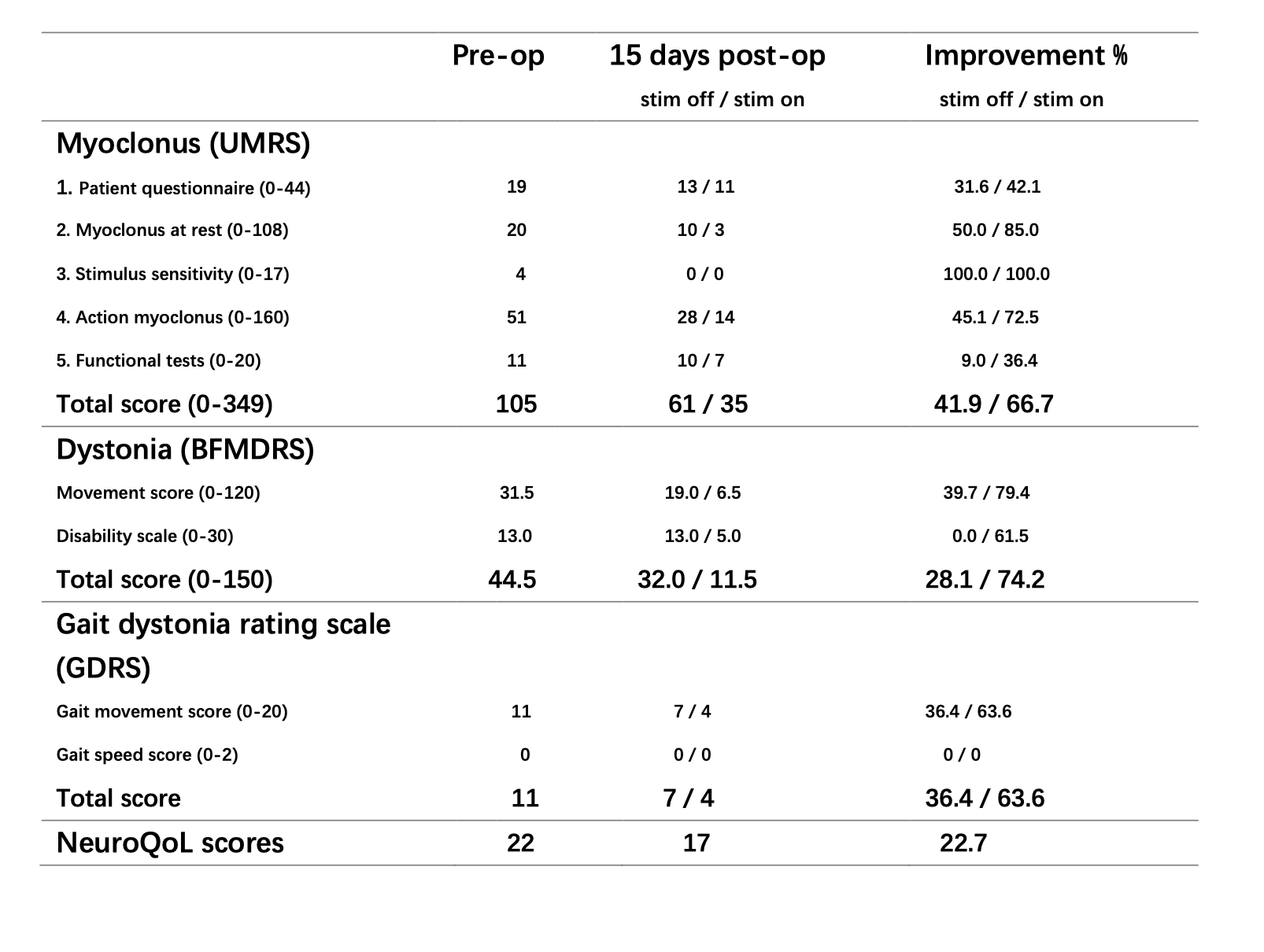
Results of the UMRS and BFMDRS for the patient
To cite this abstract in AMA style:
S. Liang, Y. Shao, Y. Yu, J. Wu, F. Wu, T. Zhang, X. Hu, Q. Wang. Bilateral Globus Pallidus Internus Deep Brain Stimulation for Myoclonus-Dystonia in Variant Ataxia-Telangiectasia: A Case Report [abstract]. Mov Disord. 2026; 41 (suppl 1). https://www.mdsabstracts.org/abstract/bilateral-globus-pallidus-internus-deep-brain-stimulation-for-myoclonus-dystonia-in-variant-ataxia-telangiectasia-a-case-report/. Accessed October 1, 2026.« Back to 2026 International Congress
MDS Abstracts - https://www.mdsabstracts.org/abstract/bilateral-globus-pallidus-internus-deep-brain-stimulation-for-myoclonus-dystonia-in-variant-ataxia-telangiectasia-a-case-report/