
Category: Parkinson's Disease (Other)
Objective: To quantify brain cell-type–specific biological aging across different movement disorders (MDS) and compare similarities and differences in cellular aging patterns among MDS.
Background: It remains unclear whether MDS exhibit common or disease-specific patterns of cellular aging in cortex. We have developed the Single-cell Brain Age Clocks (scBACs) to quantify biological age at cellular resolution and enable the identification of which cell populations initiate aging earliest, thereby uncovering the hierarchical trajectories of cellular vulnerability in pathological states.
Method: We collected postmortem cortical single-nucleus transcriptomic (snRNA-seq) datasets for five MDS, including Parkinson’s disease (PD), Huntington’s disease (HD), sporadic amyotrophic lateral sclerosis (sALS), progressive supranuclear palsy (PSP), and multiple system atrophy (MSA) from previous studies. After stringent quality control of the snRNA-seq data, we used scBACs to predict cellular biological age, calculated cell-level relative age acceleration (RAA), and inferred the subject-specific onset age for each cell type as the age at which RAA > 0.
Results: A total of 392,318 cells passed quality control and annotated. We found the inferred onset age of cellular aging exhibited pronounced cell-type-specific differences across MDS. Heterogeneity was observed within each disease, with distinct aging onset across cortical cell populations [Figure 1A]. PD showed delayed cellular aging relative to controls, with most cell types exhibiting later aging onset; pericytes, astrocytes, and microglia were delayed by 3–7 years. sALS displayed an accelerated profile, with most cell types exhibiting aging onset 5–10 years earlier, particularly excitatory neurons, endothelial cells, oligodendrocytes, microglia, and oligodendrocyte precursor cells. PSP showed a global shift, with microglia exhibiting slightly earlier onset of aging (2–3 years), whereas all other cell types were delayed by 8–15 years. MSA showed a pattern largely similar to controls, except for pericytes, which showed a marked delay of 7–10 years. HD was characterized by delayed neuronal aging, with inhibitory and excitatory neurons and oligodendrocytes showing aging onset 7–10 years later than controls [Figure 1B].
Conclusion: We reveal cortical cell-type–specific and disease-dependent differences in the timing of aging onset across MDS, offering cellular insights into the progression of MDS.
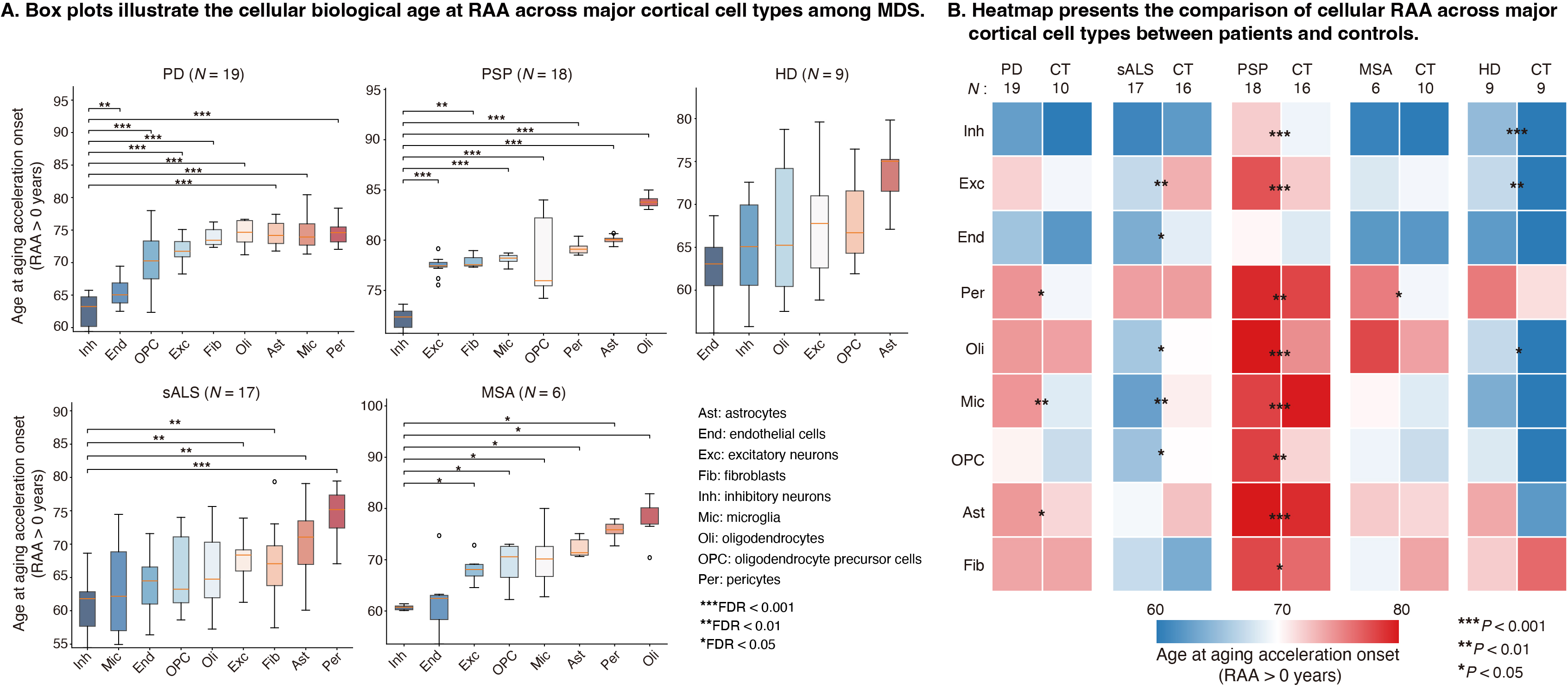
Figure1
References: 1. Luo J, Liu G, Tang Y. scBACs: Single Cell Brain Age Clocks. GitHub repository, 2025. Available at: https://github.com/sixguns1984/scBACs
2. Pineda SS, Lee H, Ulloa-Navas MJ, et al. Single-cell dissection of the human motor and prefrontal cortices in ALS and FTLD. Cell 2024; 187:1971-1989.e1916.
3. Pressl C, Mätlik K, Kus L, et al. Selective vulnerability of layer 5a corticostriatal neurons in Huntington’s disease. Neuron 2024; 112:924-941.e910.
4. Nido GS, Castelli M, Mostafavi S, et al. Single-nucleus transcriptomics reveals disease- and pathology-specific signatures in α-synucleinopathies. Brain 2025; 148:1588-1603.
To cite this abstract in AMA style:
X. Chen, W. Du, J. Luo, G. Liu. Cell-type-specific asynchronous aging acceleration across movement disorders [abstract]. Mov Disord. 2026; 41 (suppl 1). https://www.mdsabstracts.org/abstract/cell-type-specific-asynchronous-aging-acceleration-across-movement-disorders/. Accessed October 1, 2026.« Back to 2026 International Congress
MDS Abstracts - https://www.mdsabstracts.org/abstract/cell-type-specific-asynchronous-aging-acceleration-across-movement-disorders/