
Objective: To describethe clinical and neuroimaging features of a patient with the cerebellar variant of Progressive Supranuclear Palsy (PSP-C)
Background: Progressive supranuclear palsy (PSP)is a neurodegenerative tauopathy characterized by supranuclear gaze palsy, postural instability, and akinetic-rigid parkinsonism (1).PSP-C is a rare phenotype in which cerebellar manifestations may precede typical PSP features, often leading to diagnostic confusion with other cerebellar disorders(1,2).
Method: A 51-year-old right-handed man presented with a 2-year history of progressive gait instability and limb incoordination.Initial manifestations included imbalance, reduced arm swing, intention tremor,and left-sided sensory complaints,leading to an initial diagnosis of Parkinson’s disease without clinical benefit from levodopa.Over time he developed gait ataxia, scanning dysarthria, dysphagia to liquids, behavioral disinhibition, and cognitive slowing.Examination revealed supranuclear limitation of vertical gaze with vertical saccadic hypometria.Motor findings included asymmetric rigidity predominating on the left, bradykinesia, and generalized hyperreflexia with bilateral Babinski and Hoffmann signs.Cerebellar syndrome bilateral.Gait was broad-based and tandem walking was not possible.Brain MRI demonstrated selective midbrain atrophy with relative preservation of the pons, producing the hummingbird sign[figure1-2],and cerebellar atrophy[figure3]
Results: Early cerebellar ataxia followed by supranuclear vertical gaze impairment, progressive postural instability with falls, and parkinsonism poorly responsive to levodopa are consistent with thePSP-Cphenotype described in clinicopathological studies (2,4).According to Shimohata et al., the combination of progressive course, age >40 years, supranuclear gaze palsy, early cerebellar ataxia, and early postural instability fulfills criteria for probable PSP-C(3)
Conclusion: Early cerebellar ataxia followed by supranuclear vertical gaze impairment, progressive postural instability with falls, and parkinsonism poorly responsive to levodopa are consistent with the PSP-Cphenotype described in clinicopathological studies(2,4).According to Shimohata et al.,the combination of progressive course, age>40years, supranuclear gaze palsy, early cerebellar ataxia, and early postural instability fulfills criteria for probable PSP-C(3)
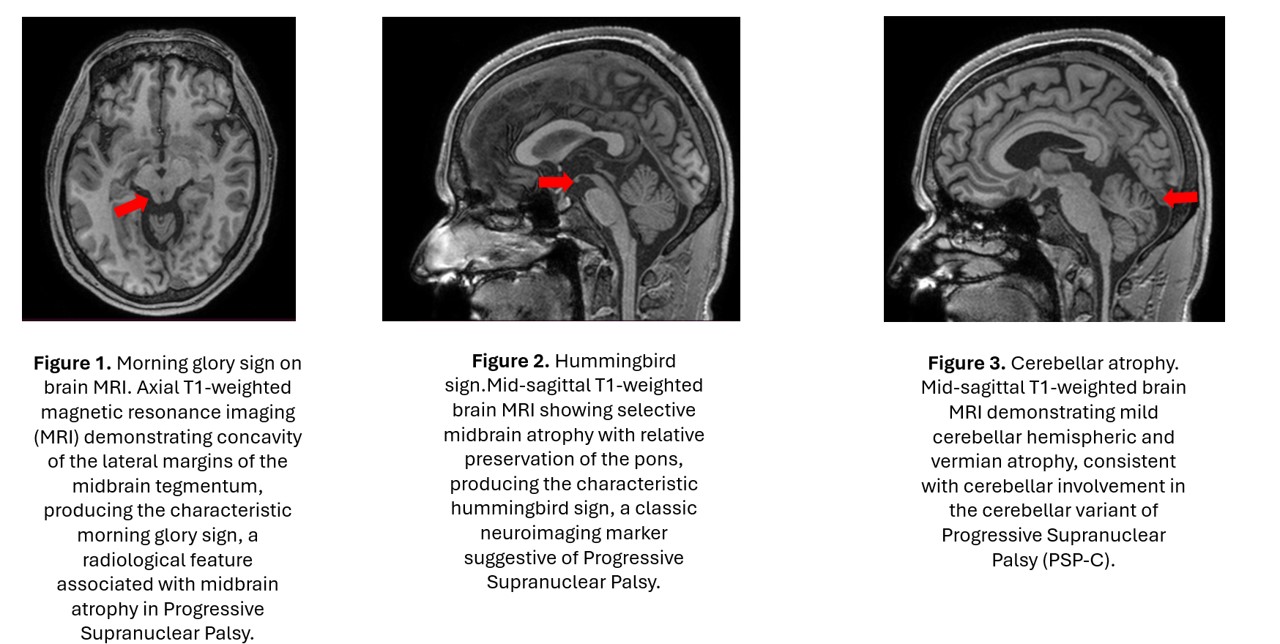
Figures 1, Figure 2, Figure 3
References: 1.Höglinger GU, Respondek G, Stamelou M, Kurz C, Josephs KA, Lang AE, et al. Clinical diagnosis of progressive supranuclear palsy: The Movement Disorder Society criteria. Mov Disord. 2017;32(6):853-864. doi:10.1002/mds.26987.
2.Koga S, Josephs KA, Ogaki K, Labbé C, Uitti RJ, Graff-Radford NR, et al. Cerebellar ataxia in progressive supranuclear palsy: an autopsy study of PSP-C. Mov Disord. 2016;31(5):653-662. doi:10.1002/mds.26499.
3.Shimohata T, Kanazawa M, Takahashi H, Nishizawa M. Clinical and pathological features of progressive supranuclear palsy with predominant cerebellar ataxia and proposed diagnostic criteria. Mov Disord. 2015;30(Suppl 1):847
4. Xu Z, Lim TCC, Au WL, Tan LCS. Progressive supranuclear gaze palsy with predominant cerebellar ataxia: a case series with videos. J Mov Disord. 2017;10(2):87-91. doi:10.14802/jmd.16059.
To cite this abstract in AMA style:
FA. Arroyo-Ramirez, M. Alvarado-Morales, J. Gutierrez-Arratia, B. Oporto-Arenas, L. Zelada-Rios, M. Vélez-Rojas, L. Torres-Ramirez. Cerebellar Variant of Progressive Supranuclear Palsy: First Case Report from Peru [abstract]. Mov Disord. 2026; 41 (suppl 1). https://www.mdsabstracts.org/abstract/cerebellar-variant-of-progressive-supranuclear-palsy-first-case-report-from-peru/. Accessed October 1, 2026.« Back to 2026 International Congress
MDS Abstracts - https://www.mdsabstracts.org/abstract/cerebellar-variant-of-progressive-supranuclear-palsy-first-case-report-from-peru/