
Objective: To determine whether cerebral small vessel disease (SVD) metrics contributes to cognitive impairment in Parkinson’s disease (PD) through microstructural damage to cholinergic projection pathways.
Background: Degeneration of cholinergic pathways is a key substrate of cognitive impairment in PD. Cerebral SVD has been proposed as an important contributor to cognitive decline, but its impact on cholinergic projection fibers and the resulting cognitive consequences remain unclear.
Method: In this single-center cross-sectional study, 213 patients with PD and 50 healthy controls (HC) were included. Probabilistic tractography was used to reconstruct cholinergic pathways: projections from the nucleus basalis of Meynert (NBM) to the cortex through external capsule (NBM-EC) and cingulum (NBM-CG) and projections from the pedunculopontine nucleus (PPN) to the thalamus. Free water (FW) imaging was applied to assess microstructural alterations within these pathways, as well as in the NBM and PPN regions. SVD burden was characterized using multiple markers, including white matter hyperintensities (WMH), perivascular spaces (PVS), lacunes, microbleeds, and peak width of skeletonized mean diffusivity (PSMD). In addition, WMH spatial overlap with cholinergic pathways was quantified.
Results: Patients with PD showed significantly higher WMH burden and PSMD compared with healthy controls, accompanied by elevated FW in the PPN-thalamus, NBM-EC, and NBM-CG pathways. Across PD patients, SVD markers were associated with increased FW in the NBM-EC and NBM-CG pathways. Random forest analysis identified PSMD and WMH overlap within these pathways as the strongest contributors to cholinergic microstructural alterations. Higher FW in the NBM-EC and NBM-CG pathways was significantly associated with worse memory performance, while WMH overlap within these pathways was linked to attentional deficits.
Conclusion: Cerebral SVD is closely linked to microstructural degeneration of cholinergic pathways in PD. Diffuse vascular injury, particularly reflected by PSMD and WMH burden within cholinergic tracts, appears to drive cholinergic pathway disruption and contribute to domain-specific cognitive impairment. These findings suggest that vascular pathology and cholinergic degeneration interact to exacerbate cognitive decline in PD.
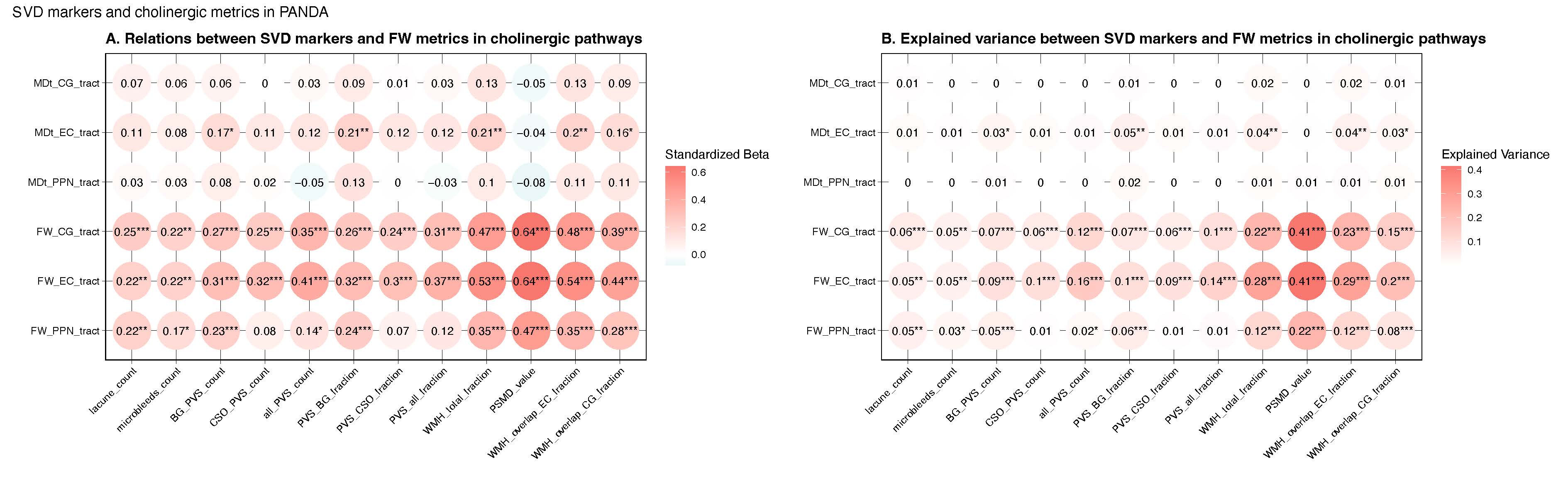
Figure 1
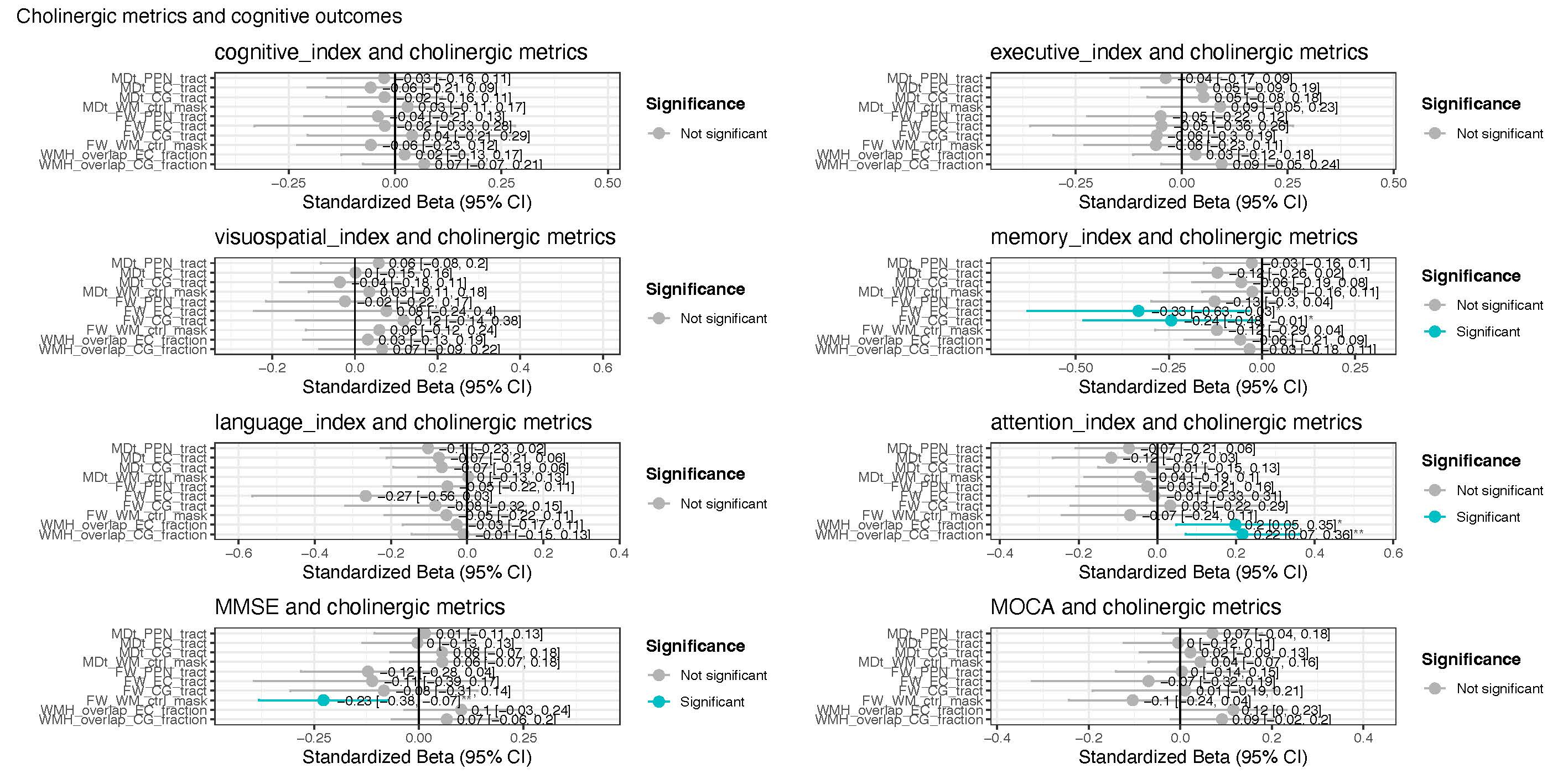
Figure 2
To cite this abstract in AMA style:
SM. Rong, XL. Cui, R. Yang, ZH. Li, YH. Zhang, MF. Cai. Cerebral Small Vessel Disease-Related Degeneration of Cholinergic Pathways Contributes to Cognitive Impairment in Parkinson’s Disease [abstract]. Mov Disord. 2026; 41 (suppl 1). https://www.mdsabstracts.org/abstract/cerebral-small-vessel-disease-related-degeneration-of-cholinergic-pathways-contributes-to-cognitive-impairment-in-parkinsons-disease/. Accessed October 1, 2026.« Back to 2026 International Congress
MDS Abstracts - https://www.mdsabstracts.org/abstract/cerebral-small-vessel-disease-related-degeneration-of-cholinergic-pathways-contributes-to-cognitive-impairment-in-parkinsons-disease/