
Category: Parkinson’s Disease: Clinical Trials
Objective: To evaluate motor states throughout the waking day when tavapadon is added to oral carbidopa/levodopa in adults with Parkinson’s disease (PD) experiencing motor fluctuations.
Background: Long-term treatment with oral levodopa has been associated with decreasing symptomatic benefit that may impair daily activities and reduce quality of life for patients, thus highlighting the need for adjunctive therapies to oral levodopa. In the TEMPO-3 trial (NCT04542499), enrolled patients on a stable baseline minimum daily dose of 400-mg carbidopa/levodopa were randomized to receive adjunctive tavapadon, an oral, once-daily, selective D1/D5 agonist, or placebo. Adding tavapadon significantly increased total daily ON time without troublesome dyskinesia and reduced daily OFF time. Changes in continuous motor states across the waking day have not yet been evaluated.
Method: Changes in motor states (Best ON time [ON time without dyskinesia], Good ON time [ON time without dyskinesia + ON time with nontroublesome dyskinesia], ON time with troublesome dyskinesia, and OFF time) across the waking day were evaluated at baseline and week 26 using the Hauser diary. The analysis comparing changes in motor states with tavapadon (5-15 mg once daily) versus placebo used a mixed-effects repeated measures model. The association between improvement in duration of Good ON time and Parkinson’s Disease Questionnaire-39 (PDQ-39) scores was measured via chi-square test.
Results: More participants reported improvements in Good ON time at week 26 with tavapadon (77.1% [118/242]) versus placebo (57.2% [115/245]; least-squares mean difference [standard error], −0.94 [0.27]) [figure 1]. A similar finding was observed for Best ON time. Change from baseline in mean continuous Good ON time significantly increased with tavapadon versus placebo (2.7 vs 1.8 h; P=0.022) [figure 2]. Tavapadon provided a significant increase of 0.7 hours in mean continuous Best ON time versus placebo (2.3 vs 1.6 h; P=0.043). Improvements in continuous ON time with tavapadon were associated with improvements in health-related quality of life, as assessed by the PDQ-39 total score (Good ON time P=0.036; Best ON time P=0.040).
Conclusion: Tavapadon provided improvements in continuous ON time that were associated with improved quality of life when used adjunctive to levodopa in people with PD.
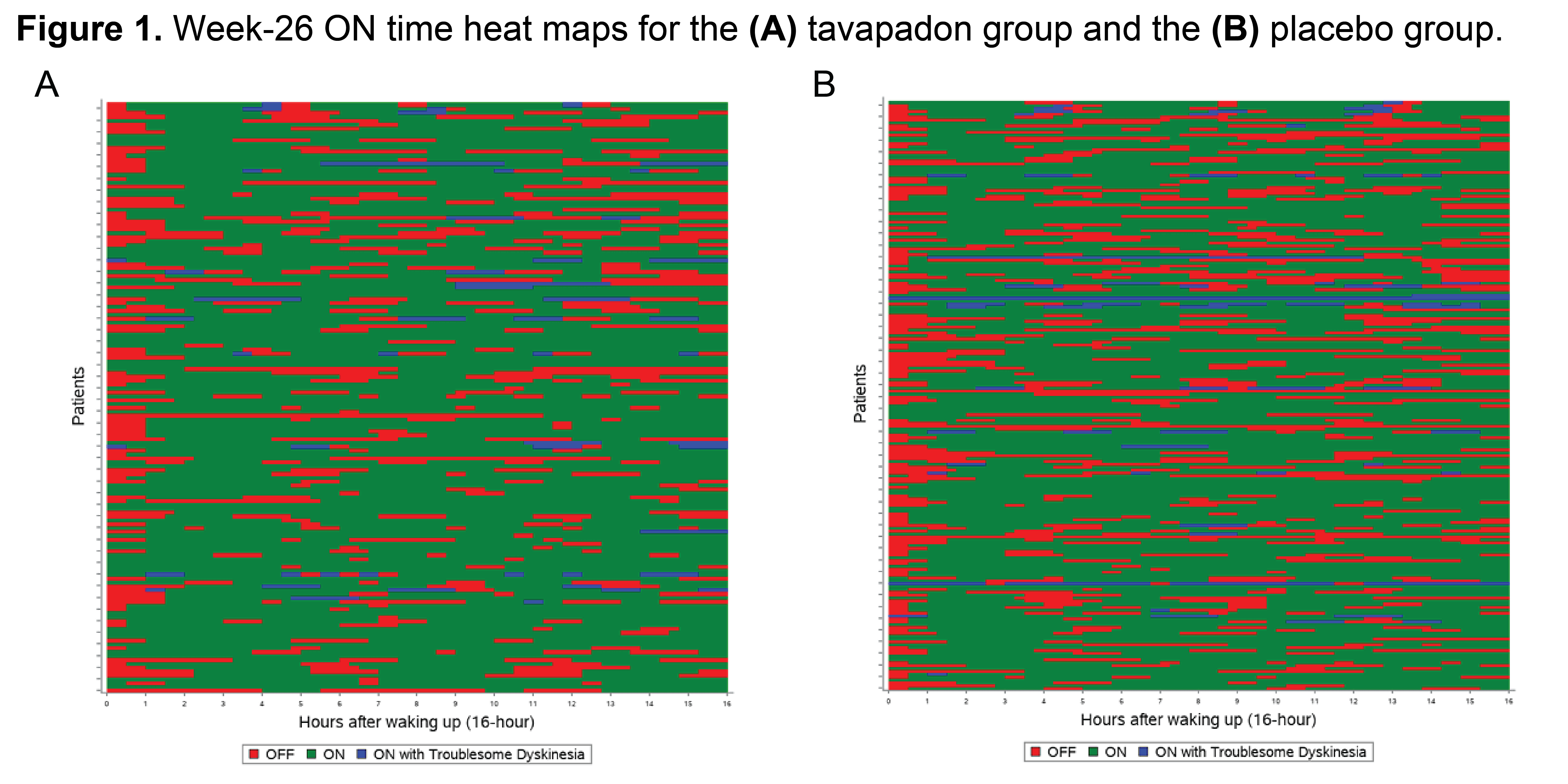
Figure 1
To cite this abstract in AMA style:
R. Hauser, R. Dhall, D. Kremens, L. Harmer, K. Chan, J. Ma. Changes in Continuous Good ON and Best ON Time During the Waking Day With Tavapadon in People With Parkinson’s Disease [abstract]. Mov Disord. 2026; 41 (suppl 1). https://www.mdsabstracts.org/abstract/changes-in-continuous-good-on-and-best-on-time-during-the-waking-day-with-tavapadon-in-people-with-parkinsons-disease/. Accessed October 1, 2026.« Back to 2026 International Congress
MDS Abstracts - https://www.mdsabstracts.org/abstract/changes-in-continuous-good-on-and-best-on-time-during-the-waking-day-with-tavapadon-in-people-with-parkinsons-disease/