
Objective: To investigate the role of local field potential (LFP) recordings as biomarkers of dystonia severity in patients with pallidal deep brain stimulation (DBS) systems capable of chronic sensing.
Background: Dystonia is a movement disorder characterized by involuntary muscle contractions [1], affecting ~16/100,000 individuals globally [2]. DBS can significantly reduce dystonia symptoms, yet absence of an established biomarker limits programming and clinical management [3-6]. LFP features recorded through commercial DBS systems could potentially represent informative biomarkers of dystonia severity [7-15] and guide DBS programming and clinical decision making.
Method: Globus pallidus internus (GPi) LFP recordings were collected in 2 modalities from 10 patients with early-onset dystonia and analyzed retrospectively after informed consent. BrainSense Survey (90s, stimulation OFF) data were collected from 10 individuals assessed using the Burke–Fahn–Marsden Dystonia Rating Scale (BFMDRS) Movement subscale. Survey spectra were compared with 6 pediatric non-Huntington’s-chorea (GPi DBS) and 5 adult Parkinson Disease (PD) cases [16] to compare differences in power spectral density (PSD) across distinct movement disorders. BrainSense Timeline (chronic sensing, stimulation ON) were analyzed in 5 cases with clinically meaningful (≥16.6%; denoting minimum BFM-based clinically important changes [17]) dystonia severity reductions between sessions. Data were analyzed using custom MATLAB(2023b) scripts.
Results: Survey analyses of dystonia cases reveal increased LFP PSDs in the theta, alpha, and low beta frequencies [figure1]. However, PSD magnitude and pattern across frequency bands differ from chorea(p=0.017, KS test) and PD(p=0.03). Comparing Survey with BFMDRS suggests correlation between power across canonical frequency bands and dystonia severity [figure2](median q=0.0290, BH FDR). However, cross-session Survey data showed no consistent correlation with severity scores (data not shown). Timeline data enabled longitudinal assessment of delayed clinical responses to programming not captured by Surveys [figure3]. Decreased LFP power aligned with lower dystonia severity in 9/10 instances, paralleling clinical improvements between sessions.
Conclusion: Together, these findings show that distinct GPi LFP features putatively reflect dystonia severity across sensing modalities and over time, supporting their potential ability to guide dystonia DBS programming.
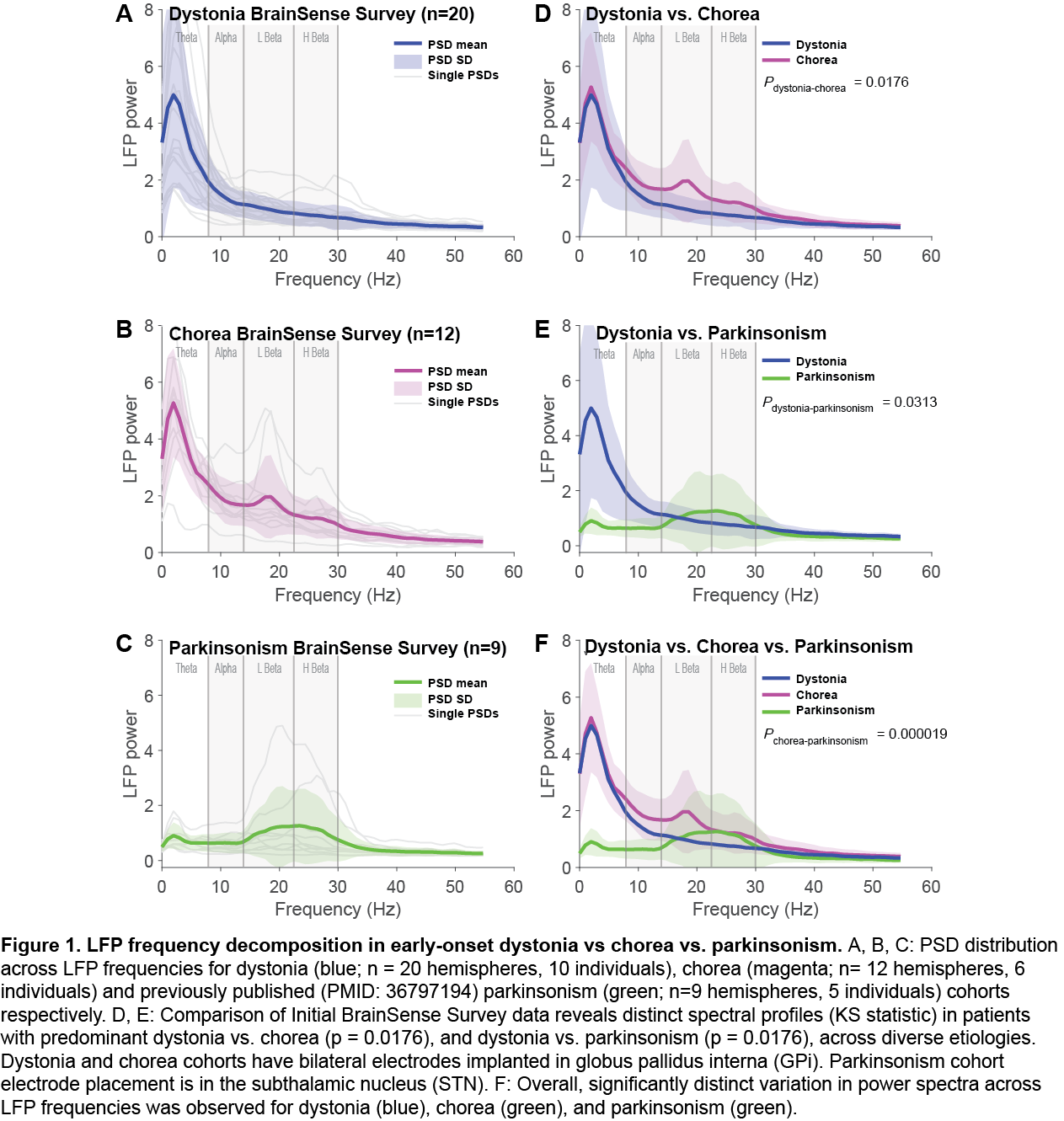
Figure1
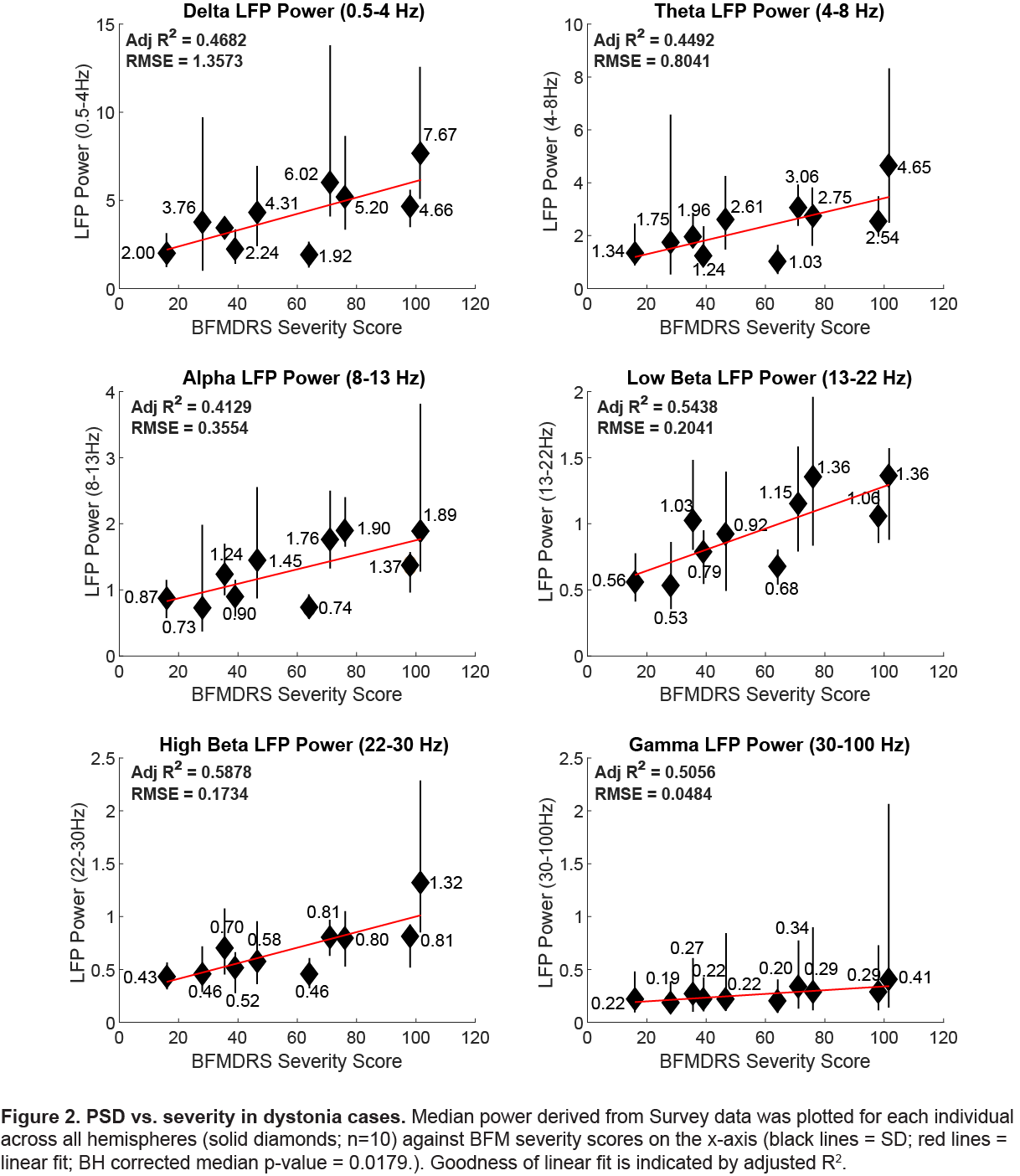
Figure2
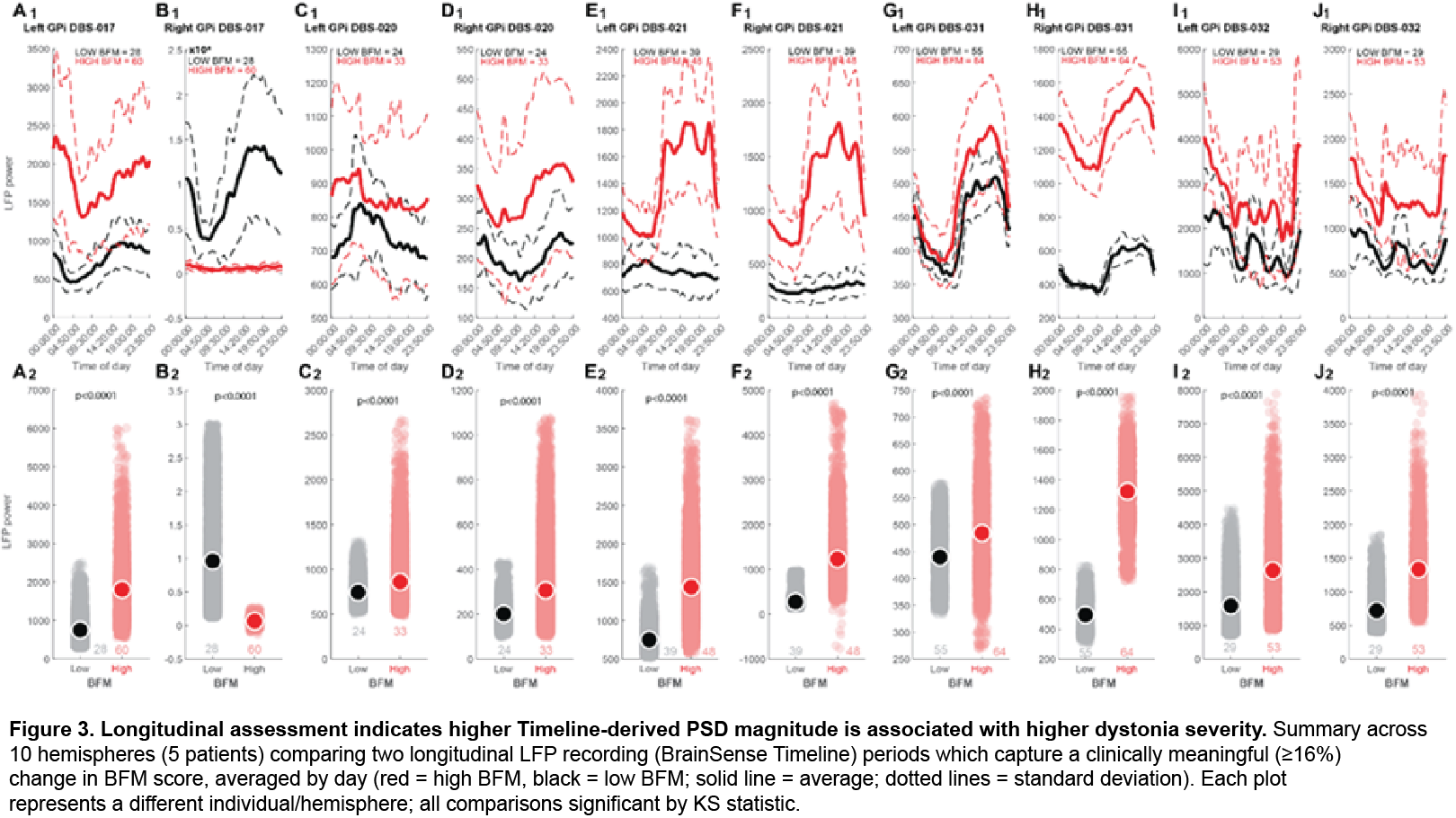
Figure3
References: 1. Sanger TD, Chen D, Fehlings DL, Hallett M, Lang AE, Mink JW, et al. Definition and classification of hyperkinetic movements in childhood. Mov Disord. 2010;25(11):1538-49. doi: 10.1002/mds.23088. PubMed PMID: 20589866; PubMed Central PMCID: PMC2929378.
2. Steeves TD, Day L, Dykeman J, Jette N, Pringsheim T. The prevalence of primary dystonia: a systematic review and meta-analysis. Mov Disord. 2012;27(14):1789-96. Epub 20121031. doi: 10.1002/mds.25244. PubMed PMID: 23114997.
3. Vidailhet M, Vercueil L, Houeto JL, Krystkowiak P, Benabid AL, Cornu P, et al. Bilateral deep-brain stimulation of the globus pallidus in primary generalized dystonia. N Engl J Med. 2005;352(5):459-67. doi: 10.1056/NEJMoa042187. PubMed PMID: 15689584.
4. Mulroy E, Vijiaratnam N, De Roquemaurel A, Bhatia KP, Zrinzo L, Foltynie T, et al. A practical guide to troubleshooting pallidal deep brain stimulation issues in patients with dystonia. Parkinsonism Relat Disord. 2021;87:142-54. Epub 20210524. doi: 10.1016/j.parkreldis.2021.05.017. PubMed PMID: 34074583.
5. Ruge D, Tisch S, Hariz MI, Zrinzo L, Bhatia KP, Quinn NP, et al. Deep brain stimulation effects in dystonia: time course of electrophysiological changes in early treatment. Mov Disord. 2011;26(10):1913-21. Epub 20110505. doi: 10.1002/mds.23731. PubMed PMID: 21547950; PubMed Central PMCID: PMC3174341.
6. Merchant SHI, Wu T, Hallett M. Diagnostic Neurophysiologic Biomarkers for Task-Specific Dystonia. Mov Disord Clin Pract. 2022;9(4):468-72. Epub 20220414. doi: 10.1002/mdc3.13448. PubMed PMID: 35586528; PubMed Central PMCID: PMC9092748.
7. Jimenez-Shahed J. Device profile of the percept PC deep brain stimulation system for the treatment of Parkinson’s disease and related disorders. Expert Rev Med Devices. 2021;18(4):319-32. Epub 20210405. doi: 10.1080/17434440.2021.1909471. PubMed PMID: 33765395.
8. Silberstein P, Kuhn AA, Kupsch A, Trottenberg T, Krauss JK, Wohrle JC, et al. Patterning of globus pallidus local field potentials differs between Parkinson’s disease and dystonia. Brain. 2003;126(Pt 12):2597-608. Epub 20030822. doi: 10.1093/brain/awg267. PubMed PMID: 12937079.
9. Sharott A, Grosse P, Kuhn AA, Salih F, Engel AK, Kupsch A, et al. Is the synchronization between pallidal and muscle activity in primary dystonia due to peripheral afferance or a motor drive? Brain. 2008;131(Pt 2):473-84. Epub 20080104. doi: 10.1093/brain/awm324. PubMed PMID: 18178569.
10. Neumann WJ, Horn A, Ewert S, Huebl J, Brucke C, Slentz C, et al. A localized pallidal physiomarker in cervical dystonia. Ann Neurol. 2017;82(6):912-24. Epub 20171205. doi: 10.1002/ana.25095. PubMed PMID: 29130551.
11. Scheller U, Lofredi R, van Wijk BCM, Saryyeva A, Krauss JK, Schneider GH, et al. Pallidal low-frequency activity in dystonia after cessation of long-term deep brain stimulation. Mov Disord. 2019;34(11):1734-9. Epub 20190904. doi: 10.1002/mds.27838. PubMed PMID: 31483903.
12. Geng X, Quan Z, Zhang R, Zhu G, Nie Y, Wang S, et al. Subthalamic and pallidal oscillations and their couplings reflect dystonia severity and improvements by deep brain stimulation. Neurobiol Dis. 2024;199:106581. Epub 20240625. doi: 10.1016/j.nbd.2024.106581. PubMed PMID: 38936434.
13. Lofredi R, Feldmann LK, Krause P, Scheller U, Neumann WJ, Krauss JK, et al. Striato-pallidal oscillatory connectivity correlates with symptom severity in dystonia patients. Nat Commun. 2024;15(1):8475. Epub 20241001. doi: 10.1038/s41467-024-52814-4. PubMed PMID: 39349466; PubMed Central PMCID: PMC11442513
14. Zhang R, Nie Y, Dai W, Wang S, Geng X. Balance between pallidal neural oscillations correlated with dystonic activity and severity. Neurobiol Dis. 2023;183:106178. Epub 20230601. doi: 10.1016/j.nbd.2023.106178. PubMed PMID: 37268239.
15. Balachandar A, Vogt LM, Mithani K, Coleman SC, Ebden M, Leblanc-Miller A, et al. Status dystonicus is a distinct state characterized by pallidal beta-band activity. Nat Commun. 2025;16(1):9352. Epub 20251022. doi: 10.1038/s41467-025-64416-9. PubMed PMID: 41125573; PubMed Central PMCID: PMC12546768.
16. Lewis S, Radcliffe E, Ojemann S, Kramer DR, Hirt L, Case M, et al. Pilot Study to Investigate the Use of In-Clinic Sensing to Identify Optimal Stimulation Parameters for Deep Brain Stimulation Therapy in Parkinson’s Disease. Neuromodulation. 2024;27(3):509-19. Epub 20230214. doi: 10.1016/j.neurom.2023.01.006. PubMed PMID: 36797194.
17. Pinter D, Janszky J, Kovacs N. Minimal Clinically Important Differences for Burke-Fahn-Marsden Dystonia Rating Scale and 36-Item Short-Form Health Survey. Mov Disord. 2020;35(7):1218-23. Epub 20200522. doi: 10.1002/mds.28057. PubMed PMID: 32441447.
To cite this abstract in AMA style:
P. Bisarad, A. Shrestha, K. Shivaram, H. Magee, R. Gelineau-Morel, C. Gorodetsky, S. Hallgren, A. Hewitt, G. Ibrahim, J. Kelbert, T. Larsh, N. Lucente, J. O'Malley, M. Pascual, S. Wu, F. Ponce, J. Hauptman, D. Kern, J. Thompson, M. Kruer. Characterizing Local Field Potentials in Early-Onset Dystonia [abstract]. Mov Disord. 2026; 41 (suppl 1). https://www.mdsabstracts.org/abstract/characterizing-local-field-potentials-in-early-onset-dystonia/. Accessed October 1, 2026.« Back to 2026 International Congress
MDS Abstracts - https://www.mdsabstracts.org/abstract/characterizing-local-field-potentials-in-early-onset-dystonia/