
Category: Parkinson’s Disease: Clinical Trials
Objective: To compare therapeutic directional versus ring stimulation effects on clinical and objective mobility outcomes and beta band in people with Parkinson’s disease (PD) undergoing globus pallidus (GP) Deep Brain Stimulation (GP-DBS).
Background: Exaggerated beta-band (13–30 Hz) oscillations are a hallmark of PD. STN-DBS improves gait and reduces beta-burst duration [1] but has limited effects on balance and may cause side effects. Prior results [2, 3] suggest more dorsal stimulation (Medial Intermedullary Lamina), may optimally improve motor symptoms but no studies have evaluated the impact of directional versus ring stimulation of this GP location on clinical and mobility outcomes. We hypothesize that directional stimulation would improve balance and gait in GP-DBS. In a pilot randomized clinical trial, we compare directional and ring stimulation effects on clinical and mobility outcomes, and beta band activity during mobility tasks.
Method: 10 consecutive participants with PD were recruited. Post DBS implantation, local field potentials (LFPs) were recorded, along with clinical and objective mobility outcomes using 6 body worn inertial sensors. Participants were randomized to ring or directional mode for 3 months, then crossed over. Paired effect sizes compared objective measures across stimulation modes.
Results: 13 out of 14 active contacts (n=6 patients) were in the GP. Clinical scores (MDS-UPDRS) improved in both stimulation modes versus Pre-DBS, with the greatest improvement in Ring mode [table 1]. Gait speed increased and turn velocity reduced versus Pre-DBS, with the most pronounced effects in Directional mode. In contrast, postural sway decreased only in Ring mode during post-DBS assessment [Fig 1]. Among participants with no ECG artifact (n=3) in the most impaired hemisphere, peak burst power during gait and turning was lower in Directional mode. Average burst duration (>100 ms) was shorter in Ring mode across most mobility tasks.
Conclusion: GP-DBS improves motor symptoms in both modes, with greater clinical benefit and shorter burst duration in Ring mode. Directional stimulation, however, improved gait speed and suppressed beta peak power more effectively. Reduced turn velocity may reflect cautious movement strategies that could contribute to fall prevention. Further studies are needed to better understand the clinical benefits of both modes and optimize directional programming in GP.
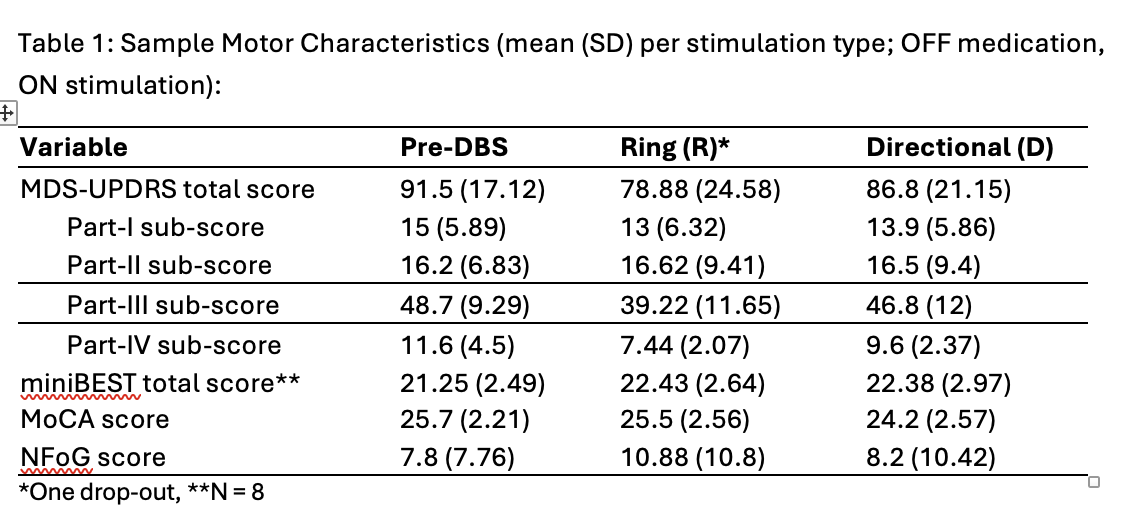
Sample Motor Characteristics (mean (SD))
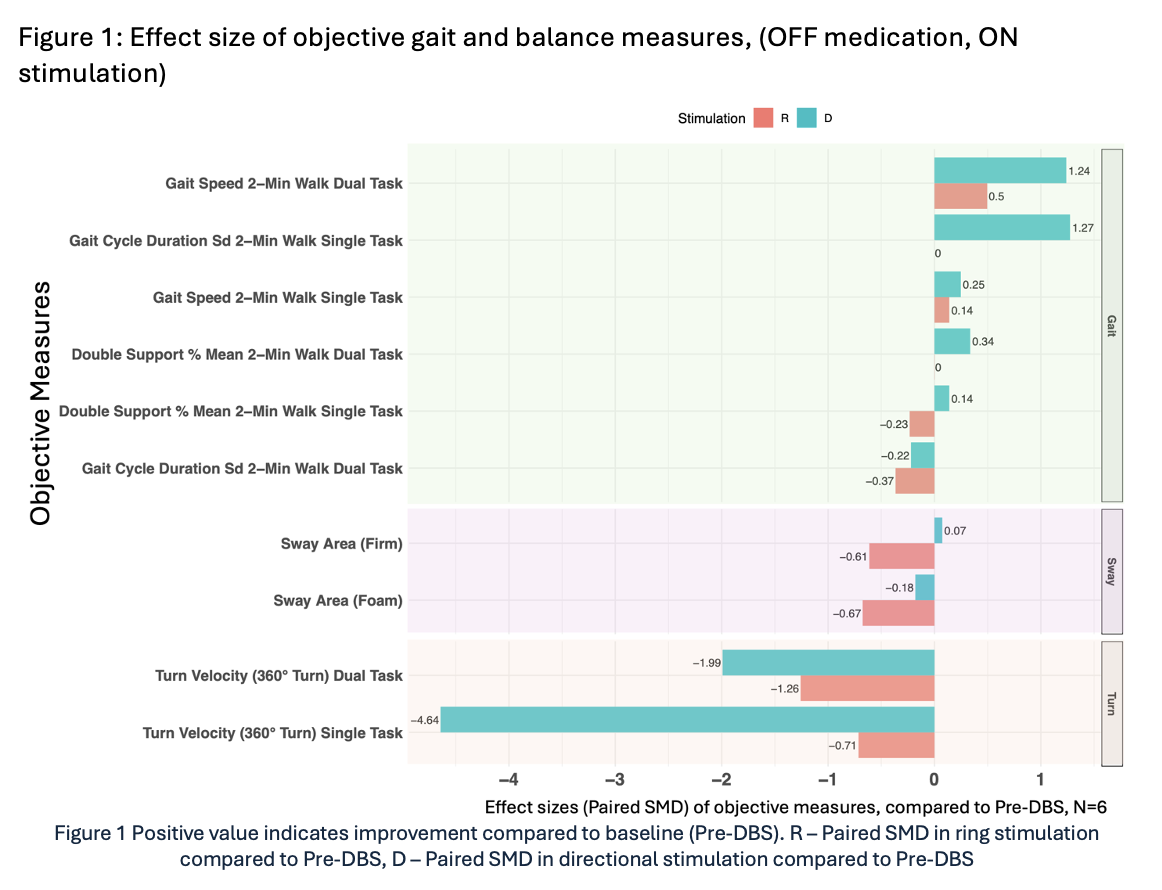
Effect size of objective gait and balance measures
References: [1] Anidi C, O’Day JJ, Anderson RW, et al. Neuromodulation targets pathological not physiological beta bursts during gait in Parkinson’s disease. Neurobiol Dis 2018; 120: 107-17.
[2] Holland MT, Jiao J, Mantovani A, Anderson S, Mitchell KA, Safarpour D, BURCHIEL KJ. Identifying the therapeutic zone in globus pallidus deep brain stimulation for Parkinson’s disease. J Neurosurg. 2022 Jul 22;138(2):329-336. doi: 10.3171/2022.5.JNS22152. Print 2023 Feb 1. PMID: 35901683
[3] Johnson MD, Zhang J, Ghosh D, McIntyre CC, Vitek JL. Neural targets for relieving parkinsonian rigidity and bradykinesia with pallidal deep brain stimulation. J Neurophysiol 2012; 108(2): 567-77
To cite this abstract in AMA style:
A. Ragothaman, J. Lee, V. Massicotte, G. Harker, P. Carlson-Kuhta, L. Neilson, C. Zarns, M. Case, R. Vigh, A. Becker, R. Raike, K. Burchiel, M. Mancini, D. Safarpour. Clinical and Mobility Outcome with Ring versus Directional Globus Pallidus Stimulation in Parkinson’s Disease [abstract]. Mov Disord. 2026; 41 (suppl 1). https://www.mdsabstracts.org/abstract/clinical-and-mobility-outcome-with-ring-versus-directional-globus-pallidus-stimulation-in-parkinsons-disease/. Accessed October 1, 2026.« Back to 2026 International Congress
MDS Abstracts - https://www.mdsabstracts.org/abstract/clinical-and-mobility-outcome-with-ring-versus-directional-globus-pallidus-stimulation-in-parkinsons-disease/