
Objective: To explore clinical and patient-reported outcomes in patients with and without severe sensor-measured bradykinesia in patients with Parkinson’s disease (PD).
Background: Parkinson’s disease (PD) is highly variable between patients, and regular assessments are needed to adjust symptomatic treatment. Wearable sensor measurements can complement clinical examinations and patient-reported outcome measures in the management of PD, but their clinical usefulness is yet to be established. We have shown that sensor measurements reflect clinical outcomes [1], with an “uncontrolled” bradykinesia score (BKS; >25 [2]) being associated with mortality within eight years.
Method: We used data from our previous study, where population-representative patients with PD performed six-day measurements with a validated, wrist-worn, accelerometry-based sensor, in parallel with collection of clinical and patient-reported data, including Clinical Impression of Severity Index (CISI-PD), EuroQoL Five-Dimension Five-Level Scale (EQ-5D-5L), Eight-Item Parkinson’s Disease Questionnaire (PDQ8), and Patient-Reported Outcomes in Parkinson’s Disease (PRO-PD). Clinical and patient-reported variables were explored in relation to severity of bradykinesia as measured with the wearable sensor, dichotomized as severe (BKS > 25) or not severe (BKS ≤ 25).
Results: The study included 286 patients with a median age of 73 years and a median time since diagnosis of five years. Successful sensor recordings were obtained from 281 patients, of whom 206 (73%) had BKS > 25. Patients with BKS > 25 were more often men but otherwise demographically similar to patients with BKS ≤ 25. Time since diagnosis was slightly shorter in patients with BKS > 25 and levodopa equivalent daily dose (LEDD) was lower. While clinical outcome measures (CISI-PD) differed between the two groups, the differences did not remain significant after correction for multiple analyses. Three patient-reported outcome measures remained significant: the disability items in EQ-5D-5L and PDQ8 (worse scores in BKS > 25) and the dyskinesia item in PRO-PD (lower scores in BKS > 25) [table1].
Conclusion: Patients with sensor-detected severe bradykinesia scored significantly worse in patient-reported outcomes reflecting disability, supporting the validity of such tools for identifying insufficient treatment effect.
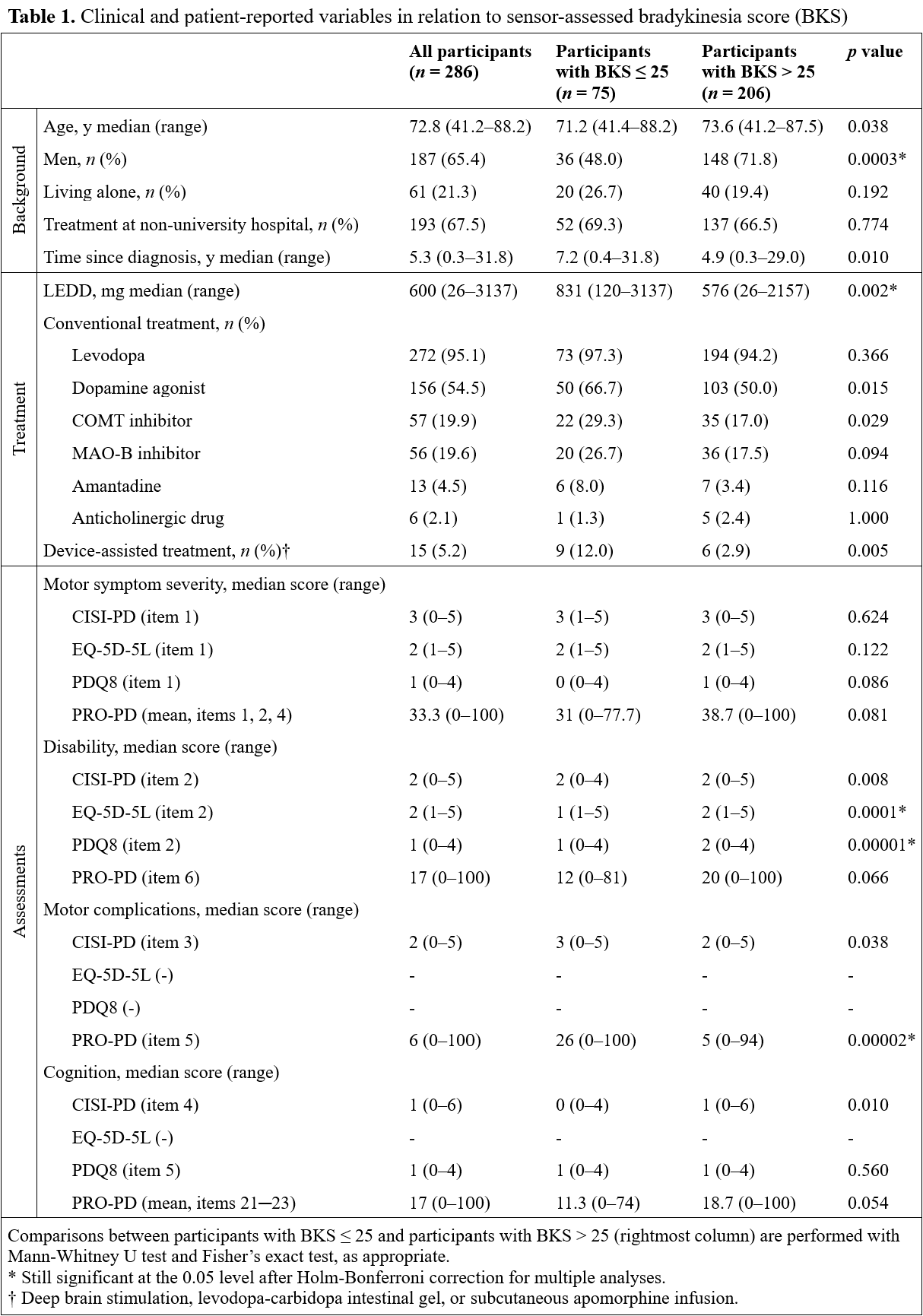
table1
References: [1] von Below, D., Wallerstedt, S. M., & Bergquist, F. (2026). Wearable sensor measurements in relation to clinical characteristics and mortality in patients with Parkinson’s disease. Neurological Research and Practice, 8, 14.
[2] Odin, P., Chaudhuri, K. R., Volkmann, J., Antonini, A., Storch, A., Dietrichs, E., Pirtošek, Z., Henriksen, T., Horne, M., Devos, D., & Bergquist, F. (2018). Viewpoint and practical recommendations from a movement disorder specialist panel on objective measurement in the clinical management of Parkinson’s disease. NPJ Parkinson’s Disease, 4, 14.
To cite this abstract in AMA style:
D. von Below, S. Wallerstedt, F. Bergquist. Clinical and Patient-Reported Outcomes in Patients With and Without Severe Bradykinesia According to Sensor Measurements [abstract]. Mov Disord. 2026; 41 (suppl 1). https://www.mdsabstracts.org/abstract/clinical-and-patient-reported-outcomes-in-patients-with-and-without-severe-bradykinesia-according-to-sensor-measurements/. Accessed October 1, 2026.« Back to 2026 International Congress
MDS Abstracts - https://www.mdsabstracts.org/abstract/clinical-and-patient-reported-outcomes-in-patients-with-and-without-severe-bradykinesia-according-to-sensor-measurements/