
Objective: To determine whether early clinical instability, quantified through combined motor and non-motor fluctuations, predicts a more severe longitudinal disease course in Parkinson’s disease.
Background: To determine whether early clinical instability, quantified through combined motor and non-motor fluctuations, predicts a more severe longitudinal disease course in Parkinson’s disease.
Method: A longitudinal analysis was conducted including patients with PD and ≥3 study visits . A “early window” (first 3 visits) was defined to quantify clinical instability using the Clinical Instability Index (CII). The CII is a standardized composite index integrating intra-individual variability (RMSSD) of MDS-UPDRS III and NMS scores. Disease progression was evaluated using linear mixed-effects models with random slopes and intercepts, adjusting for age, sex, and LEDD.
Results: A total of 537 patients were analyzed.For every one-unit increase in the CII, the baseline MDS-UPDRS III score increased significantly by 9.57 points (beta=9.57; p<0.001). While the cohort showed a natural progression rate of 0.83 points per visit (beta=0.83; p<0.001), a significant negative interaction was observed between time and instability (beta=-0.80; p=0.003). This suggests that patients with high early instability exhibit a high-severity phenotype from the onset and maintain a higher level of disability throughout follow-up, whereas stable patients show a slower but constant upward progression. Age was also independently associated with greater motor severity (beta=0.29; p<0.001).
Conclusion: These findings identify the Clinical Instability Index (CII) as an early red flag in Parkinson’s disease. Motor and non-motor instability in the first years of follow-up appears to reflect a higher disease burden rather than random variability. Patients with high early instability show a persistent high-severity phenotype, with greater motor impairment from early stages that remains throughout follow-up. Early recognition of this phenotype may support closer monitoring and more intensive therapeutic optimization.
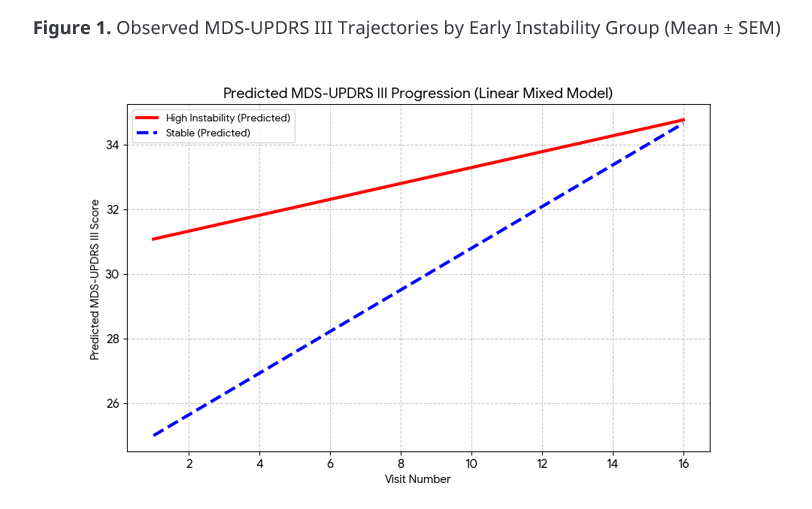
Figure 1.Observed MDS-UPDRS III
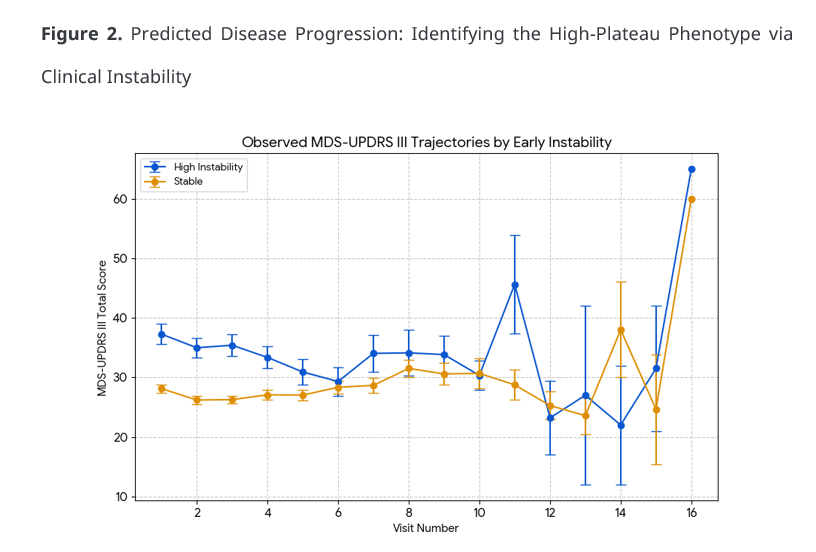
Figure 2.Predicted Disease Progression
To cite this abstract in AMA style:
A. Beltrán-Torres, M. Rocha-de-León, K. Sánchez-Ramírez, N. Sánchez-Lorenzo, A. Cervantes-Arriaga, M. Rodríguez-Violante. Clinical instability and fluctuations as an early marker of accelerated progression [abstract]. Mov Disord. 2026; 41 (suppl 1). https://www.mdsabstracts.org/abstract/clinical-instability-and-fluctuations-as-an-early-marker-of-accelerated-progression/. Accessed October 1, 2026.« Back to 2026 International Congress
MDS Abstracts - https://www.mdsabstracts.org/abstract/clinical-instability-and-fluctuations-as-an-early-marker-of-accelerated-progression/