
Category: Parkinson's disease: Neuroimaging
Objective: To evaluate diffusion MRI-derived extracellular free water (isotropic diffusion [ISO]) in subcortical motor regions and compare data-driven ISO-based subtypes with clinically defined tremor-dominant (TD), postural instability/gait difficulty (PIGD), and indeterminate (IND) motor subtypes in Parkinson’s disease (PD).
Background: Traditional PD motor subtyping (TD, PIGD, IND) is based on symptom profiles and may not reflect underlying neurobiology. Data-driven stratification using neuro-imaging features may better capture biological heterogeneity relevant to motor severity and disease mechanisms.
Method: Baseline diffusion MRI and MDS-UPDRS-III (total and subscores for rigidity, bradykinesia, tremor, and PIGD) were analyzed in 156 de novo PD participants from the Parkinson’s Progression Markers Initiative. ISO values were extracted from 12 subcortical motor regions implicated in PD pathology, including bilateral substantia nigra, subthalamic nucleus, red nucleus, striatum, and globus pallidus externa and interna. Clinical TD, PIGD, and IND subtypes were assigned using the Stebbins method [1]. Data-driven subtypes were derived using hierarchical clustering of regional ISO measures [2]. Group differences in regional ISO and motor outcomes were assessed using analysis of variance or two-sample t-tests as appropriate. False discovery rate (FDR) correction was applied across regional comparisons.
Results: Clinically defined subtypes did not show significant differences in regional ISO values across subcortical motor regions (Table 1). In contrast, data-driven clustering of ISO measures identified two neuroimaging-defined subtypes that showed significant differences in ISO across all regions. The subtype characterized by higher ISO values demonstrated increased rigidity and bradykinesia (Table 2).
Conclusion: These findings suggest that diffusion MRI-based stratification may provide additional insight into the biologically meaningful heterogeneity in early PD beyond traditional clinical motor subtyping, potentially enabling better patient stratification for clinical trials, identification of individuals at risk for more severe motor progression, and the development of targeted interventions based on underlying neurobiology.
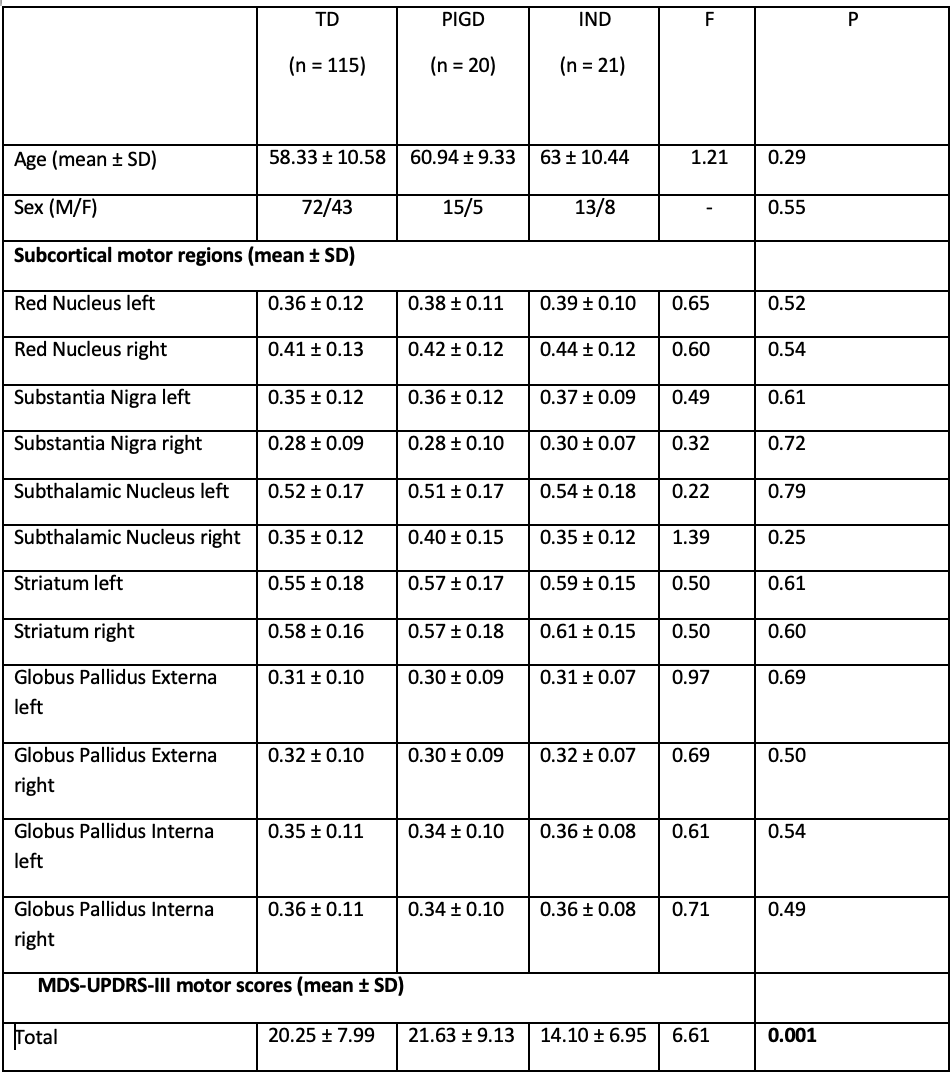
Table 1
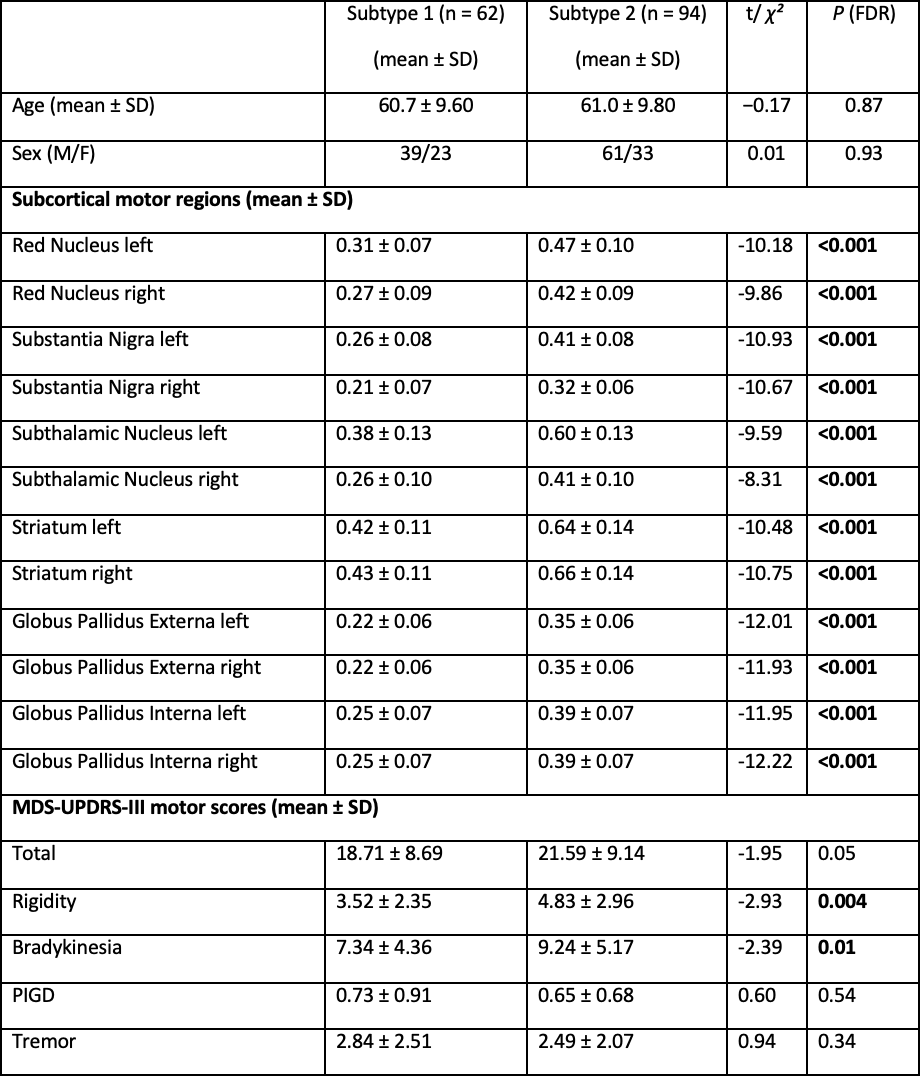
Table 2
References: 1. Stebbins GT, et al. (2013) How to identify tremor dominant and postural instability/gait difficulty groups with the movement disorder society unified Parkinson’s disease rating scale: comparison with the unified Parkinson’s disease rating scale. Mov Disord 28:668-70. https://doi.org/10.1002/mds.25383
2. Vijayakumari AA, Sakaie KE, Teixeira-Dos-Santos D, Fernandez HH, Walter BL (2026) Data-driven neurobiological subtyping of Parkinson’s disease using diffusion MRI-derived isotropic diffusion. Neuroradiology https://doi.org/10.1007/s00234-026-03939-4
To cite this abstract in AMA style:
L. Saadatpour, A. Vijayakumari, K. Sakaei, D. Teixeira-Dos-Santos, H. Fernandez, B. Walter. Comparison of Neuroimaging-Derived and Clinical Motor Subtypes in Early Parkinson’s Disease [abstract]. Mov Disord. 2026; 41 (suppl 1). https://www.mdsabstracts.org/abstract/comparison-of-neuroimaging-derived-and-clinical-motor-subtypes-in-early-parkinsons-disease/. Accessed October 1, 2026.« Back to 2026 International Congress
MDS Abstracts - https://www.mdsabstracts.org/abstract/comparison-of-neuroimaging-derived-and-clinical-motor-subtypes-in-early-parkinsons-disease/