
Category: Parkinson’s Disease: Clinical Trials
Objective: To report safety and clinical outcomes in participants with Parkinson’s disease (PD), 4 years after receiving bemdaneprocel.
Background: Bemdaneprocel is an investigational cell therapy composed of embryonic stem cell-derived midbrain dopaminergic neuron progenitors, under development for the treatment of PD.
Method: In exPDite (NCT04802733), a Phase 1 open-label trial, 12 participants [table1] with PD received low-dose (n=5; 0.9 million cells/putamen) or high-dose (n=7; 2.7 million cells/putamen) bemdaneprocel injected bilaterally into the postcommissural putamen in a single surgical session. A 1-year immunosuppression regimen began immediately preoperatively. Following trial completion, all participants enrolled in a continued-evaluation study through 5 years post transplantation (NCT05897957).
Results: Predefined safety, tolerability, and feasibility criteria were met at 1 year; trends toward improvement or stability in clinical assessments were observed through 2 years. Through 3 years post transplantation, adverse events (AEs) were mostly mild or moderate in severity; none were related to bemdaneprocel. Eight treatment-emergent serious AEs occurred, all unrelated to bemdaneprocel. There were no deaths or graft-induced dyskinesias. No intracerebral hemorrhages or mass lesions were observed by MRI. Antiparkinsonian medication use was generally stable for most participants when compared with baseline. At 3 years post transplantation [table2], mean (SD) changes from baseline in MDS-UPDRS Part III ON scores were −5.7 points (7.5) in the high-dose and −2.0 points (14.3) in the low-dose group; OFF scores were −17.9 points (8.5) in the high-dose and −13.5 points (23.0) in the low-dose group. Mean (SD) changes from baseline in patient-reported ON times without troublesome dyskinesia were +2.1 hrs (3.2) in the high-dose and +0.2 hrs (3.7) in the low-dose group; OFF times were −2.0 hrs (3.2) in the high-dose and −1.2 hrs (0.6) in the low-dose group. Results through 4 years will be presented at MDS 2026.
Conclusion: Overall, bemdaneprocel demonstrated a favorable safety profile and maintained improvements or stability across clinical assessments through 3 years. Bemdaneprocel is currently being evaluated in exPDite-2, a Phase 3, multicenter, randomized, double-blind, sham surgery-controlled trial (NCT06944522).
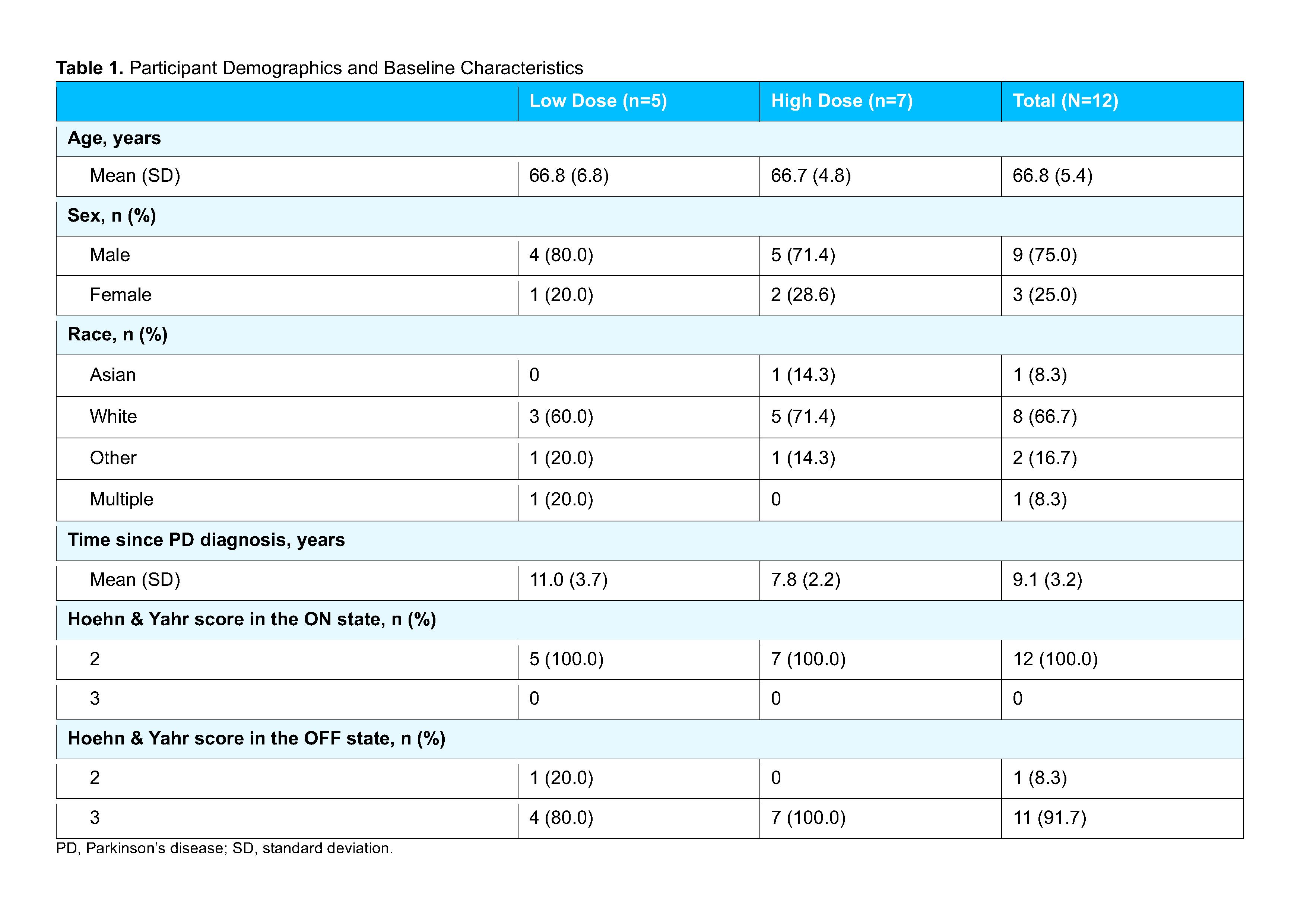
Table 1
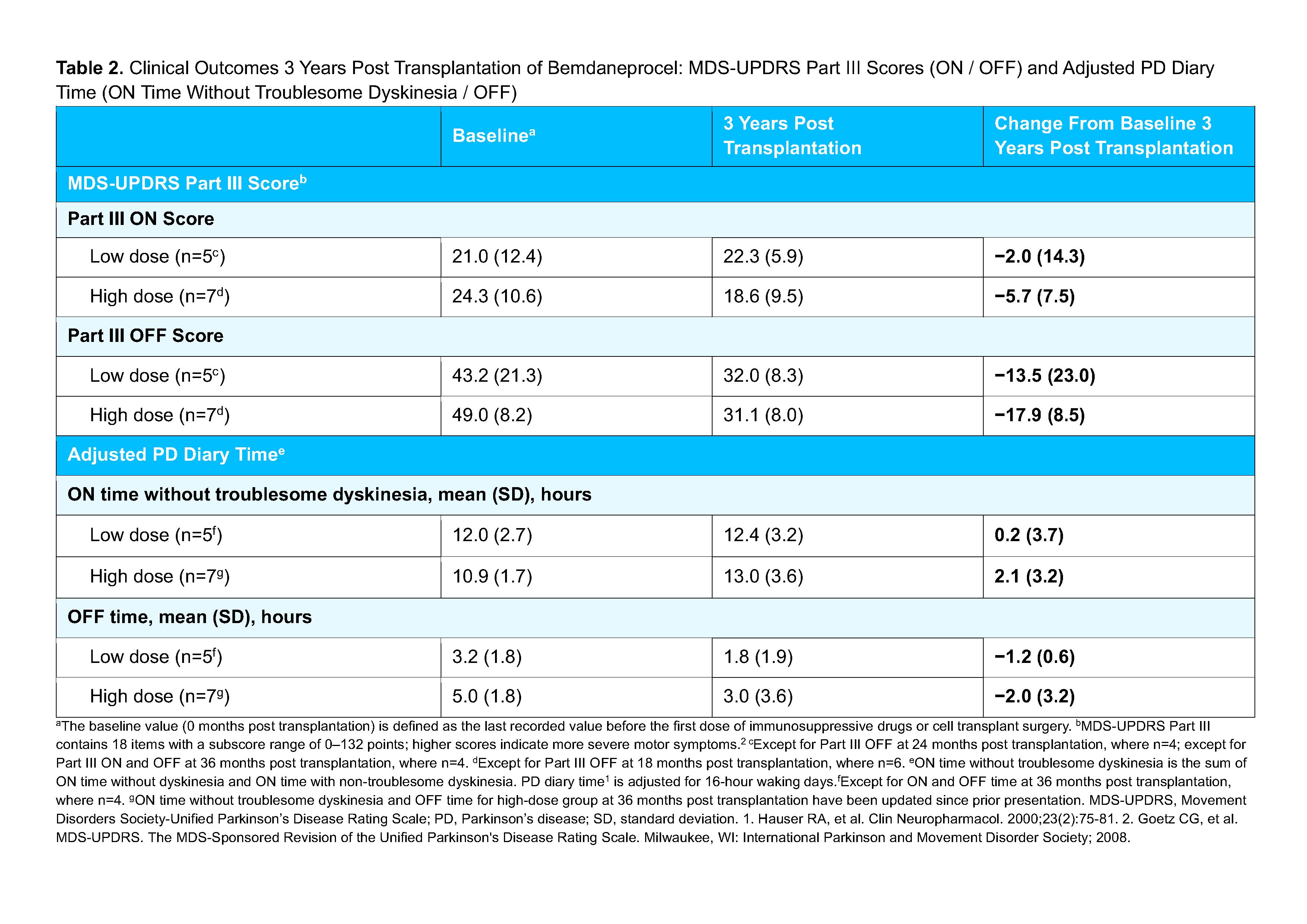
Table 2
To cite this abstract in AMA style:
C. Henchcliffe, H. Sarva, A. Fasano, A. Lozano, S. Kalia, KKH. Yu, C. Brennan, M. Louie-Gao, N. Floro, G. Belfort, V. Tabar. Continued Evaluation of Clinical Outcomes in Participants With Parkinson’s Disease Through 4 Years After Bemdaneprocel Administration [abstract]. Mov Disord. 2026; 41 (suppl 1). https://www.mdsabstracts.org/abstract/continued-evaluation-of-clinical-outcomes-in-participants-with-parkinsons-disease-through-4-years-after-bemdaneprocel-administration/. Accessed October 1, 2026.« Back to 2026 International Congress
MDS Abstracts - https://www.mdsabstracts.org/abstract/continued-evaluation-of-clinical-outcomes-in-participants-with-parkinsons-disease-through-4-years-after-bemdaneprocel-administration/