
Objective: To compare the characteristics of FMDs in children and adults
Background: Functional movement disorders (FMDs) exhibit notable differences in phenomenology and treatment responses between pediatric and adult populations
Method: The study included 15 children (9 girls) and 24 adults (16 females). Diagnosis of FMD was based on Fahn and Williams criteria. Data included phenomenology, socioeconomic background, electrophysiology, associated psychosocial stressors and imaging.
Results: The prevalence of FMDs was higher in females in both the groups. All children had an acute to subacute presentation (all < 3 months) while in adults >75 % had a chronic presentation. In children, FMDs were precipitated by acute stressors or dysfunctional family while in adult’s comorbid psychiatric conditions namely depression and anxiety were more prevalent. A significant number of adults had functional tremor (79%) followed by functional gait. The most common phenomenology among children were myoclonus (38%), followed by tremor (30%), dystonia (23%), and abnormal gait (15%) (figure 1). Clues to suggest a psychogenic etiology were, isolated or predominant involvement of the dominant upper limb, distractibility, entrainment in case of tremor and pain involving the extremity affected by FMD. Children were more amenable to cognitive behavioural therapy (CBT) and psychotherapy leading to disease remission in 73% (11/15) while outcomes were less optimum in adults 54% (13/24).
Conclusion: Prompt identification of FMDs and the precipitating stressors in children is important as the disease will go into early remission as they are more amenable to CBT.
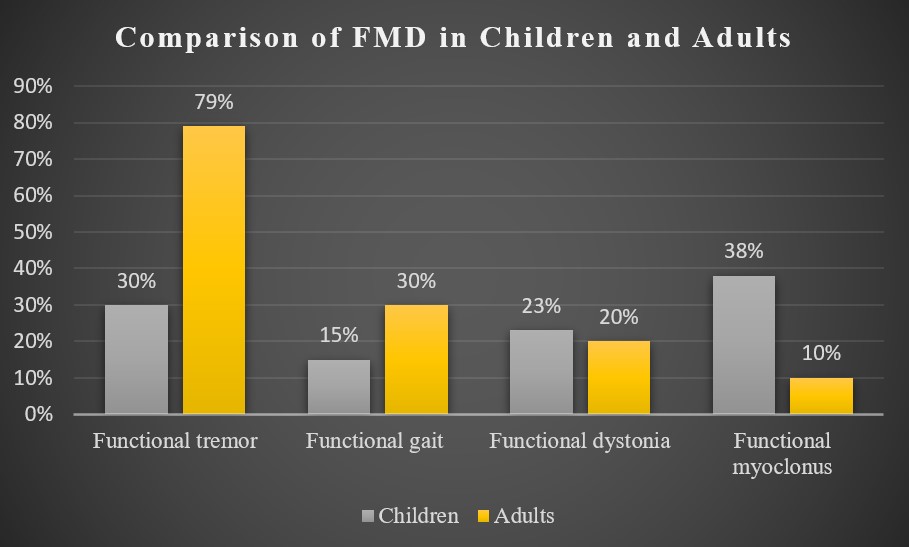
Comparison of FMD in Children and Adults
References: 1. Park J. E. (2024). Functional Movement Disorders: Updates and Clinical Overview. Journal of movement disorders, 17(3), 251–261. https://doi.org/10.14802/jmd.24126
To cite this abstract in AMA style:
D. Kalikavil Puthanveedu, A. Cherian. Deciphering differences in Functional Movement Disorders between Children and Adults [abstract]. Mov Disord. 2025; 40 (suppl 1). https://www.mdsabstracts.org/abstract/deciphering-differences-in-functional-movement-disorders-between-children-and-adults/. Accessed October 6, 2026.« Back to 2025 International Congress
MDS Abstracts - https://www.mdsabstracts.org/abstract/deciphering-differences-in-functional-movement-disorders-between-children-and-adults/