
Objective: To determine whether the improvement in levodopa-induced dyskinesias after deep brain stimulation is primarily associated with reduction in dopaminergic medication or with a direct neuromodulatory effect.
Background: Levodopa-induced dyskinesias are a major complication in Parkinson’s disease. Deep brain stimulation of the subthalamic nucleus reduces dyskinesias and motor fluctuations, possibly through modulation of pathological basal ganglia network activity and abnormal beta oscillations. However, it remains unclear whether this improvement is primarily driven by postoperative reduction in dopaminergic medication or by direct neuromodulation of basal ganglia circuits.
Method: WeWe conducted a retrospective observational study including patients with Parkinson’s disease who underwent bilateral subthalamic nucleus deep brain stimulation. Motor complications were assessed using part IV of the Movement Disorder Society–Unified Parkinson’s Disease Rating Scale (MDS-UPDRS). Levodopa equivalent daily dose (LEDD) was calculated before surgery and at six months of follow-up. Pearson correlation and linear regression analyses were performed to evaluate the relationship between LEDD reduction and improvement in dyskinesias.
Results: Forty-five patients with Parkinson’s disease who underwent bilateral subthalamic nucleus deep brain stimulation were included. At six months, dyskinesia severity decreased in MDS-UPDRS part IV scores (Figure 1). Median levodopa equivalent daily dose was also reduced (Figure 2). However, regression analysis showed that reduction in dopaminergic medication explained only a minor proportion of the improvement in dyskinesia scores. Improvements were also observed in time with dyskinesia, functional impact of dyskinesia, motor fluctuations, and off-state dystonia (Figure 3).
Conclusion: Bilateral subthalamic nucleus deep brain stimulation significantly improves levodopa-induced dyskinesias in Parkinson’s disease. The limited contribution of medication reduction suggests that neuromodulation itself plays a substantial role in improving motor complications and supports the hypothesis that DBS directly modulates pathological basal ganglia network activity involved in dyskinesia generation.
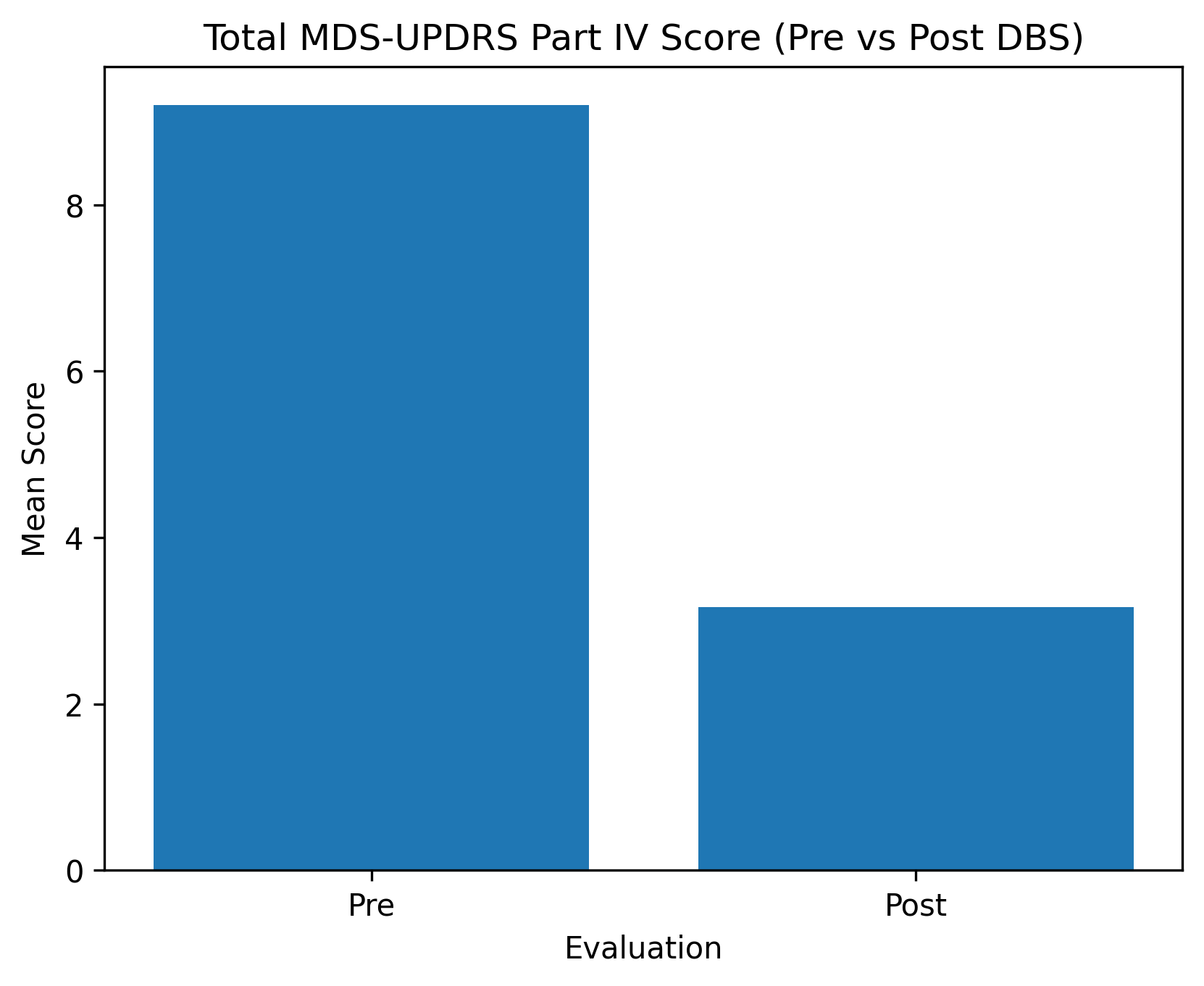
Total MDS-UPDRS Part IV Score (Pre vs Post DBS)
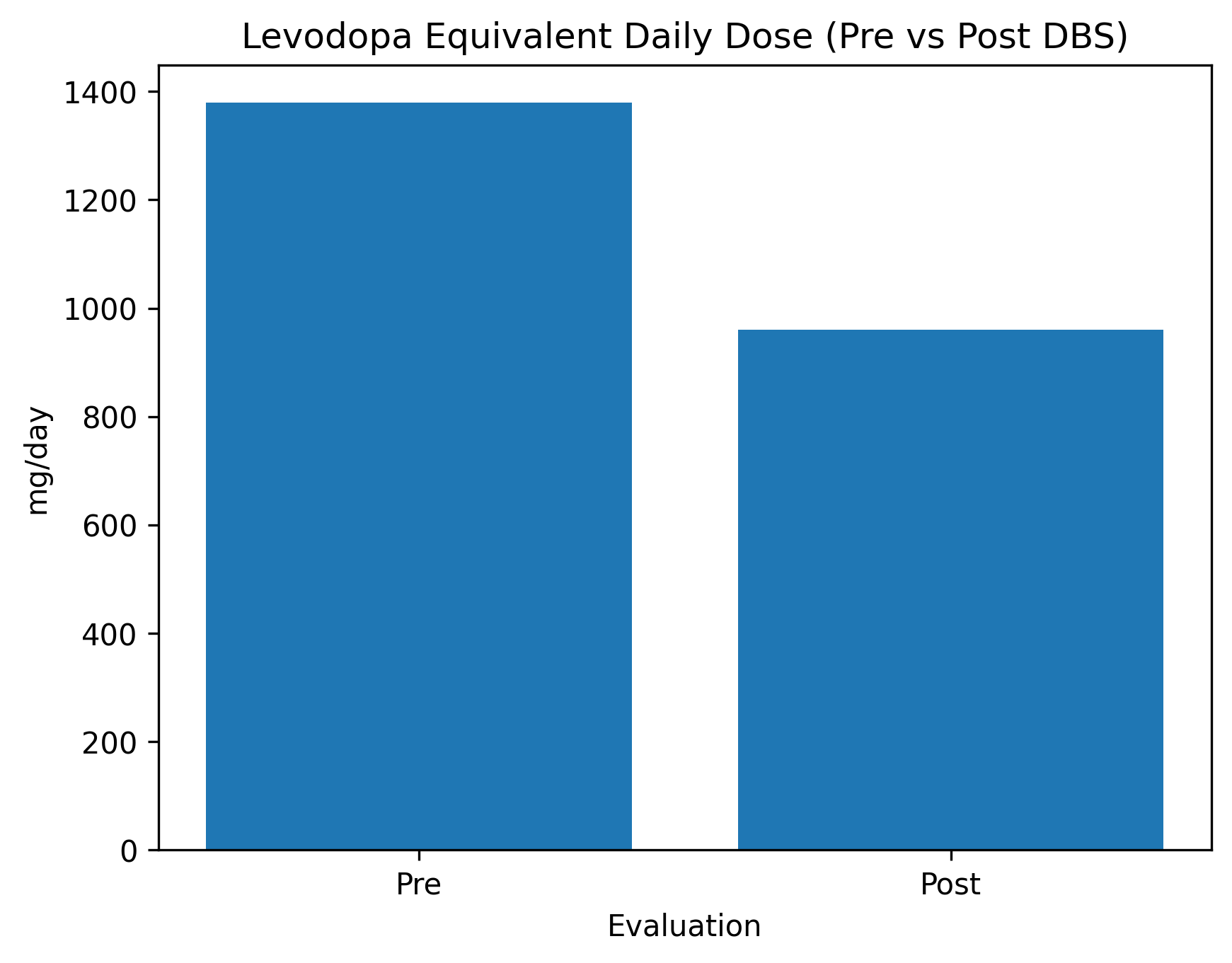
Levodopa Equivalent Daily Dose (Pre vs Post DBS)
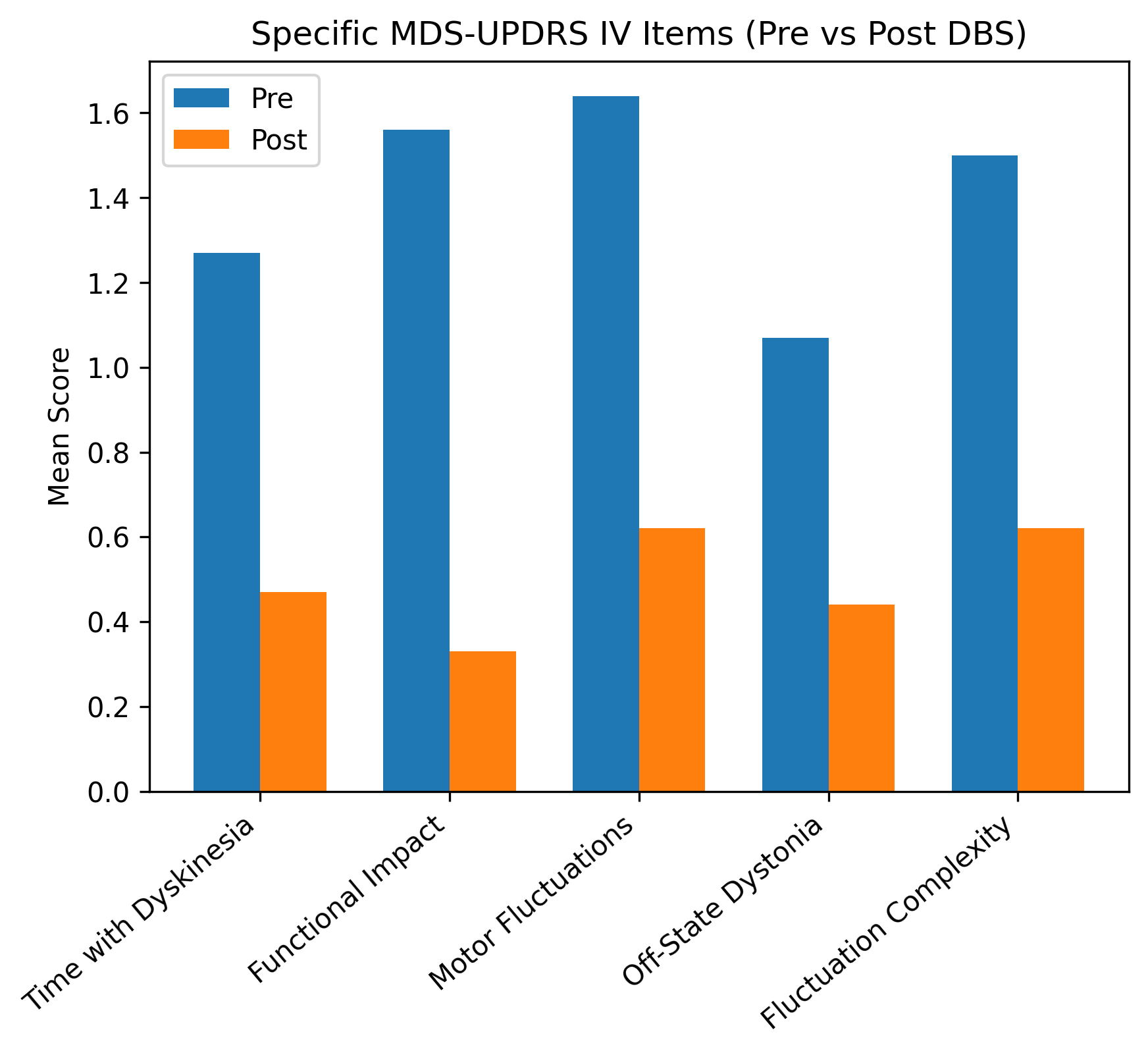
Specific MDS-UPDRS IV Items (Pre vs Post DBS)
References: 1. Follett KA. Comparison of pallidal and subthalamic deep brain stimulation for the treatment of levodopa-induced dyskinesias. Neurosurg Focus. 2004;17(1):E3.
2. Fabbrini G, Brotchie JM, Grandas F, Nomoto M, Goetz CG. Levodopa-induced dyskinesias. Mov Disord. 2007;22(10):1379–89.
3. Manson AJ, Schrag A, Lees AJ. Levodopa-induced dyskinesias: clinical features, incidence, risk factors, management and impact on quality of life. J Neurol Neurosurg Psychiatry. 2012;83(9):908–17.
4. Lozano AM, Lipsman N. Probing and regulating dysfunctional circuits using deep brain stimulation. Neuron. 2013;77(3):406–24.
5. Cenci MA. Presynaptic mechanisms of l-DOPA-induced dyskinesia: the findings, the debate, and the therapeutic implications. Front Neurol. 2014;5:242.
6. Deuschl G, et al. A randomized trial of deep-brain stimulation for Parkinson’s disease. N Engl J Med. 2006;355(9):896–908.
7. Kleiner-Fisman G, et al. Subthalamic nucleus deep brain stimulation: summary and meta-analysis of outcomes. Mov Disord. 2006;21 Suppl 14:S290–304.
8. Goetz CG, et al. Movement Disorder Society-sponsored revision of the Unified Parkinson’s Disease Rating Scale (MDS-UPDRS): Scale presentation and clinimetric testing results. Mov Disord. 2008;23(15):2129–70.
9. Okun MS. Deep-brain stimulation for Parkinson’s disease. N Engl J Med. 2012;367(16):1529–38.
10. Schnitzler A, Gross J. Normal and pathological oscillatory communication in the brain. Nat Rev Neurosci. 2005;6(4):285–96.
11. Eusebio A, Brown P. Synchronisation in the beta frequency-band—the bad boy of parkinsonism? Curr Opin Neurol. 2009;22(6):631–5.
12. Volkmann J, et al. Safety and efficacy of pallidal or subthalamic stimulation in Parkinson’s disease. Neurology. 2001;56(4):548–51.
13. Benabid AL, et al. Deep brain stimulation of the subthalamic nucleus for the treatment of Parkinson’s disease. Lancet Neurol. 2002;1(8):473–81.
14. Wu T, Hallett M. The cerebellum in Parkinson’s disease. Brain. 2013;136(3):696–709.
15. Anderson VC, et al. Pallidal vs subthalamic nucleus deep brain stimulation in Parkinson disease. Arch Neurol. 2005;62(4):554–60.
16. Obeso JA, et al. Missing pieces in the Parkinson’s disease puzzle. Nat Med. 2010;16(6):653–61
17. Halpern CH, et al. Deep brain stimulation for neurological disorders: current status and future directions. Nat Rev Neurol. 2010;6(9):487–98.
18. Rodriguez-Oroz MC, et al. Bilateral deep brain stimulation in Parkinson’s disease: a multicentre study with 4 years follow-up. Brain. 2005;128(10):2240–9.
19. Schuepbach WM, et al. Neurostimulation for Parkinson’s disease with early motor complications. N Engl J Med. 2013;368(7):610–22.
20. Cerasa A, et al. Neuroanatomical correlates of levodopa-induced dyskinesias in Parkinson’s disease: a magnetic resonance imaging study. Mov Disord. 2011;26(6):1004–7.
21. Kalia LV, Lang AE. Parkinson’s disease. Lancet. 2015;386(9996):896–912.
22. Zhang et als. STN versus GPi deep brain stimulation for dyskinesia improvement in advanced Parkinson’s disease: A meta-analysis of randomized controlled trials. Clinical Neurology and Neurosurgery 201 (2021) 106450.
To cite this abstract in AMA style:
C. Reyes, C. Martínez, J. Fonseca, F. Castro, A. Calderón, L. Reyes, C. Ramírez. Deep brain stimulation improves levodopa-induced dyskinesias beyond medication reduction in Parkinson’s disease [abstract]. Mov Disord. 2026; 41 (suppl 1). https://www.mdsabstracts.org/abstract/deep-brain-stimulation-improves-levodopa-induced-dyskinesias-beyond-medication-reduction-in-parkinsons-disease/. Accessed October 1, 2026.« Back to 2026 International Congress
MDS Abstracts - https://www.mdsabstracts.org/abstract/deep-brain-stimulation-improves-levodopa-induced-dyskinesias-beyond-medication-reduction-in-parkinsons-disease/