
Category: Parkinson's Disease: Surgical Therapy
Objective: To compare clinical, stimulation-related, and anatomical determinants of tremor outcome after GPi DBS, between PD patients with severe and mild-moderate tremor.
Background: Parkinson’s disease (PD) tremor is heterogeneous in severity. Effect of PD tremor severity in determining tremor outcomes after globus pallidus internus (GPi) deep brain stimulation (DBS) is not well defined.
Method: In this prospective, single-centre, cohort study, consecutive PD patients undergoing bilateral GPi DBS and completed follow up at 6 months post-DBS were included. Tremor severity was assessed using the UPDRS part III tremor sub-score (sum of items 20 and 21) pre-DBS in drug-OFF and 6 months post-DBS in Stimulation-ON, Drug-OFF state. Patients were stratified into severe and mild-moderate tremor groups based on UPDRS III tremor sub-score. Clinical features, programming characteristics, and lead localization related factors were compared between the two subgroups. Lead localization related anatomical factors were derived using Lead DBS v2.5.3 with MATLAB 2019b.
Results: 42 patients (24 males, mean age – 63 years, mean disease duration – 12 years) were included in the study. Severe tremor group included 14 patients and mild-moderate tremor group included 28 patients. GPi DBS produced marked tremor improvement (mean UPDRS III tremor sub-score – 88%) at 6 months post DBS, with comparable suppression in both severity-based groups (88% in both), despite lower levodopa responsiveness in severe tremor group. Severe tremor was associated with longer time to achieve stable tremor response (2.7 v/s 1.6 months, p-value = 0.001), fewer effective contacts per lead, and a higher prevalence of true tremor window phenomena (57.14% v/s 3.57%, p-value = <0.001). Lead group analysis done in patients with severe tremor showed location of effective active contacts near lateral GPi.
Conclusion: Bilateral GPi DBS provided robust, and stable tremor control in PD, independent of pre-DBS tremor severity and dopaminergic response. In PD patients with severe tremor, based on the finding of lesser number of effective contacts per lead and clustering of effective contacts in a small region of lateral GPi, we propose a spatially restricted tremor responsive zone within GPi in this group. Further, tremor window phenomenon suggests that this region is responsive only to a narrow range of electrical field intensity.
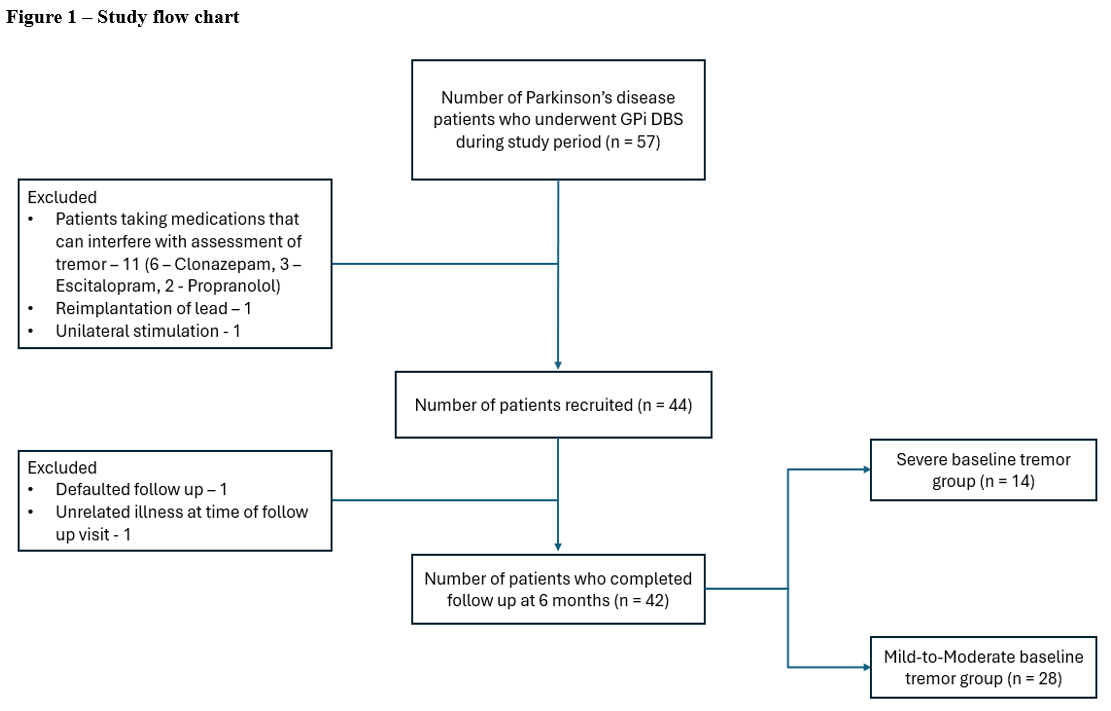
Figure 1
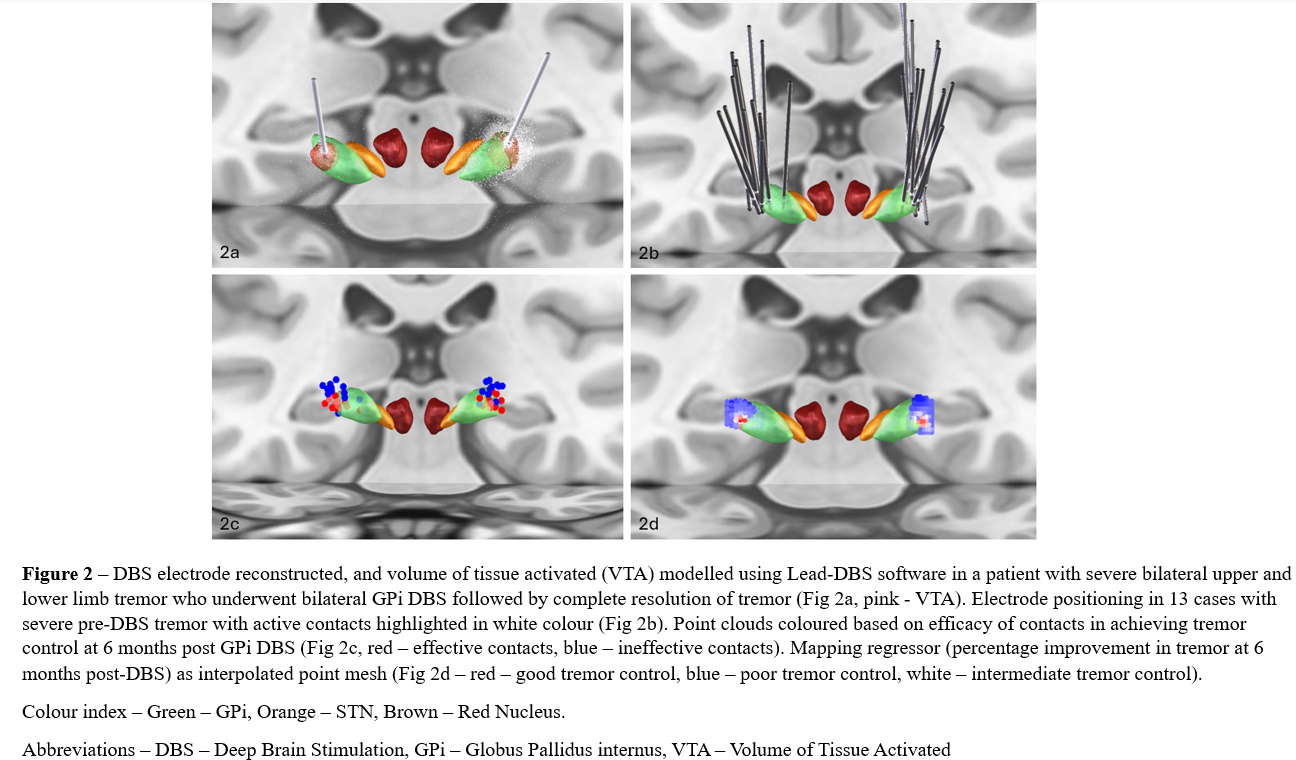
Figure 2
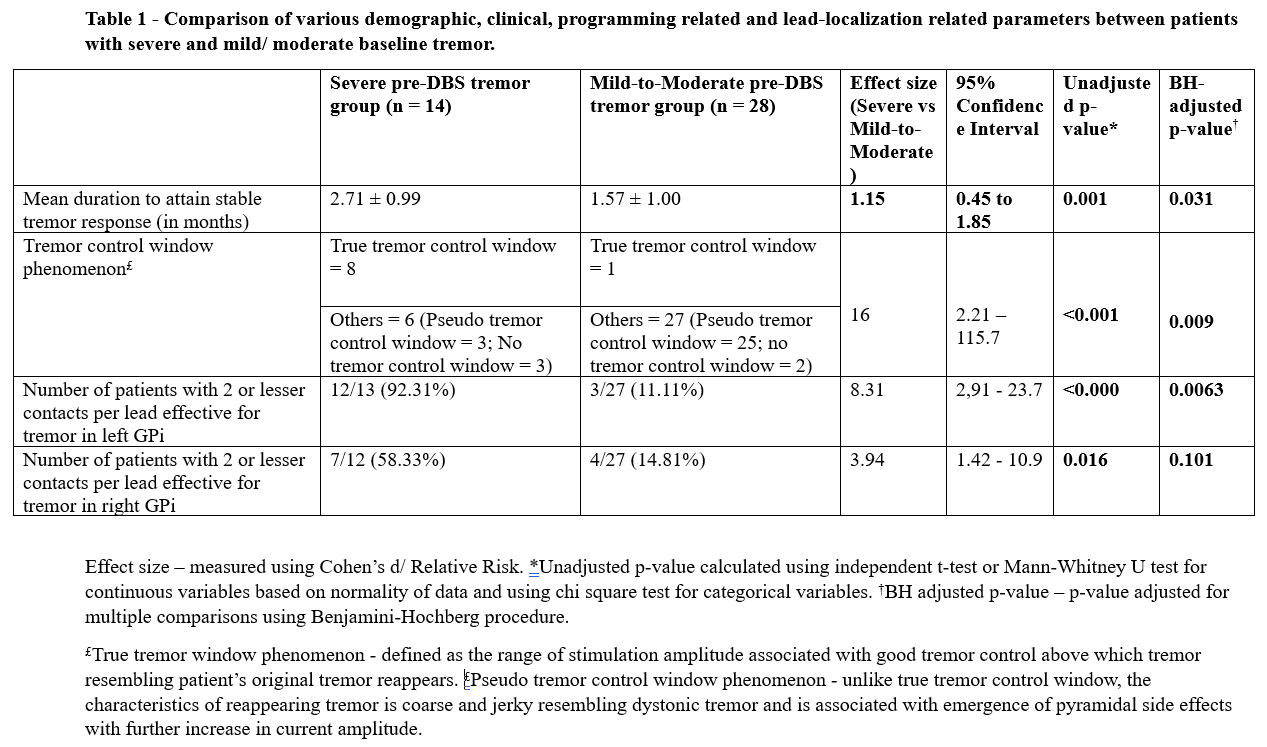
Table 1
To cite this abstract in AMA style:
M. Girija, T. Bhaskar, A. Prabhu, S. Joshua, A. Nair, A. Hynse, A. Kishore. Determinants of Tremor Control Across Severity Levels Following GPi-Deep Brain Stimulation in Parkinson’s Disease [abstract]. Mov Disord. 2026; 41 (suppl 1). https://www.mdsabstracts.org/abstract/determinants-of-tremor-control-across-severity-levels-following-gpi-deep-brain-stimulation-in-parkinsons-disease/. Accessed October 1, 2026.« Back to 2026 International Congress
MDS Abstracts - https://www.mdsabstracts.org/abstract/determinants-of-tremor-control-across-severity-levels-following-gpi-deep-brain-stimulation-in-parkinsons-disease/