
Objective: To evaluate the impact on health-related quality of life (HRQoL) of treatment with device-aided therapies (DAT) in younger patients earlier within advanced Parkinson’s disease (aPD) compared with other patients treated with a DAT.
Background: A recent post hoc analysis of a randomized trial found that fLD/fCD was associated with significantly greater improvements in motor function and sleep vs. orally administered levodopa/carbidopa in younger patients earlier within aPD, with a trend towards statistical significance (p=0.0534) in HRQoL (Antonini et al. Neurol Ther 2026;15:309-324).
Method: Data collected in the DATs-PD GETM Spanish Registry until October 30, 2025, were used. This is a descriptive, observational, prospective, multicenter clinical registry with progressive inclusion of PwP treated with a DAT in more than 40 centers in Spain (Santos-García. PLoS One 2025; 20:e0316052). Patients treated with a DAT were classified in 2 groups: 1) younger patients (≤ 65 years) earlier within aPD (Hoehn and Yahr stage ≤ 2 during the “On” state [H&Y-ON], ≤ 5 years since motor fluctuations started) (yeaPD); 2) without previous criteria (non-yeaPD). HRQoL was assessed with the 39-item PD Questionnaire expressed as a Summary Index (PDQ-39SI).
Results: 214 out of 510 patients (42%) were ≤ 65 years old, whereas 402 (78.8%) and 352 (69%) had a H&Y-ON ≤ 2 and ≤ 5 years since motor fluctuations started, respectively. A total of 133 out of 510 patients (26.1%) were classified as having yeaPD. At baseline, yeaPD patients had a lesser motor and non-motor symptoms burden and a greater autonomy for activities of daily living than non-yeaPD patients (Table 1). HRQoL was better at baseline in yeaPD patients (p=0.001) (Table 1). From baseline to follow-up visit (188.6 ± 72.9 days), the PDQ39SI decreased significantly more in yeaPD than in non-yeaPD patients (30.9% vs. 9.6%; p=0.032) (Figure 1A). By domains, significant differences in the change of mobility (p=0.001), stigmatization (p<0.0001), and communication (p=0.030) between both groups were detected (Figure 1B and Table 2).
Conclusion: Device-aided therapies were associated with significantly greater improvement in HRQoL in younger patients earlier within advanced Parkinson’s disease.
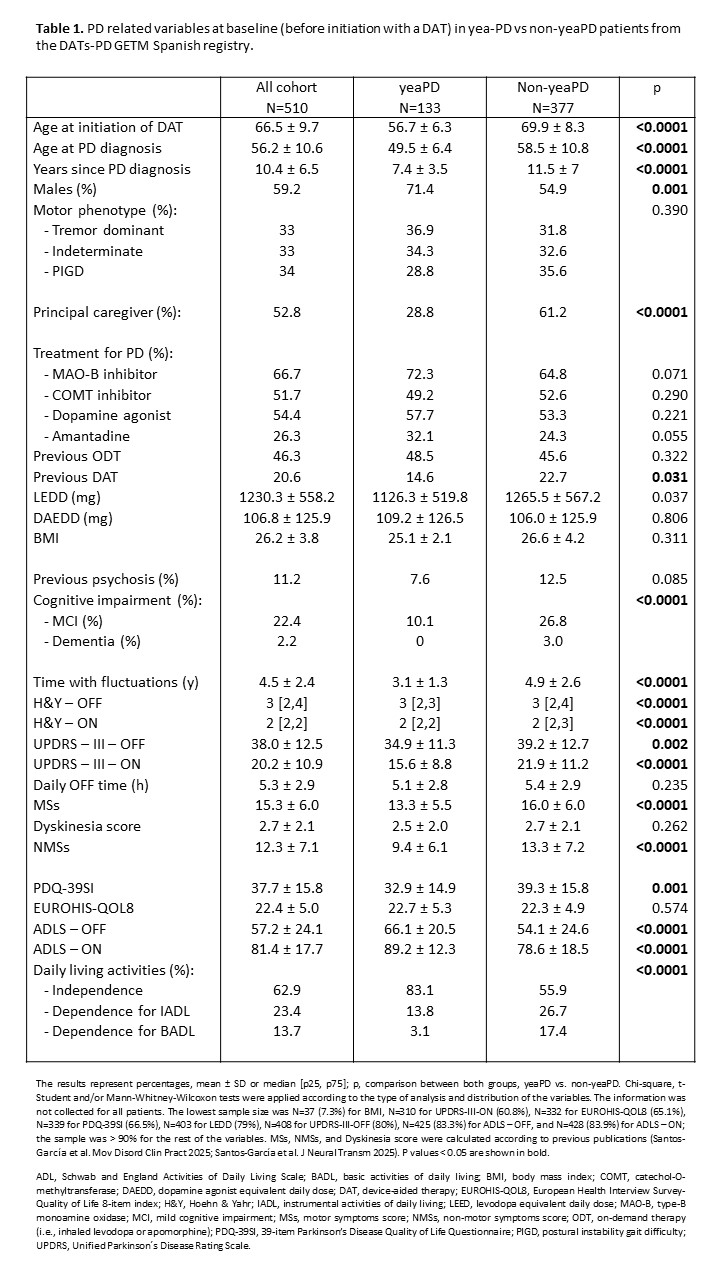
Table 1
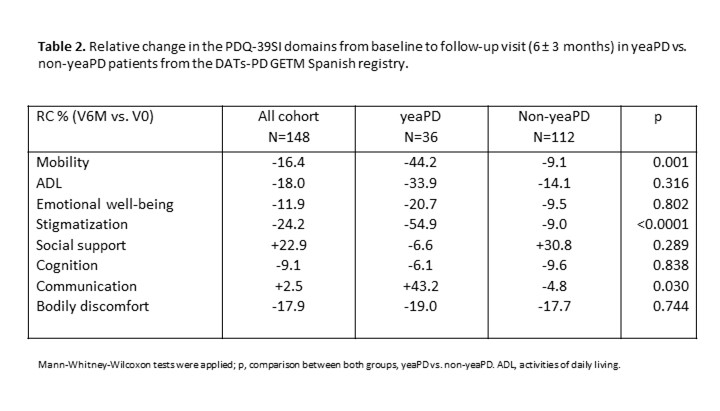
Table 2
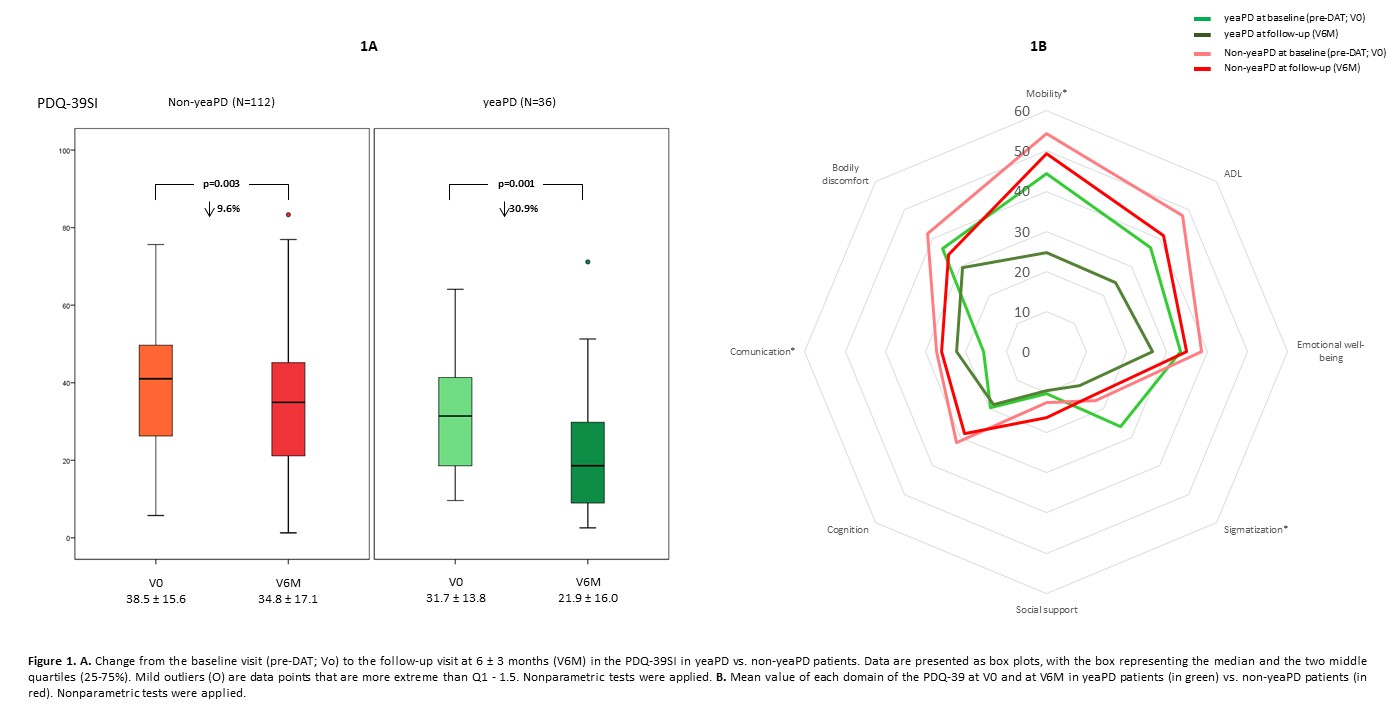
Figure 1
References: Antonini A, Bergmans B, Kern DS, Gandor F, Nishikawa N, Standaert DG, Fritz B, Gupta R, Nozaki T, Shah MB, Bergmann L, Kimber T. Foslevodopa/Foscarbidopa in Younger Patients Earlier Within Advanced Parkinson’s Disease: Post Hoc Analysis of a Randomized Trial. Neurol Ther. 2026 Feb;15(1):309-324. doi: 10.1007/s40120-025-00856-1.
Santos-García D, González-Ortega G, Sánchez-Alonso P, Planas-Ballvé A, García-Ramos R, Cabo I, Blázquez-Estrada M, Sánchez-Ferro Á; DATs-P. D. GETM Spanish Registry Group. Device-aided therapies (DATs) in Parkinson’s disease (PD). The DATs-PD GETM Spanish Registry Protocol Study. PLoS One. 2025 Mar 31;20(3):e0316052. doi: 10.1371/journal.pone.0316052.
To cite this abstract in AMA style:
D. Santos García, á. Solleiro Vidal, L. López Manzanares, S. Martí Matínez, J. González Ardura, J. Gómez Esteban, T. Delgado, G. González Ortega, E. Cubo, B. Solano, AB. Perona-Moratalla, S. Escalante, á. Monterde Ortega, MP. Gil Martín, R. López Blanco, C. Borrué Fernández, I. Martínez Torres, P. García Ruíz, I. Pareés Moreno, C. Delgado Suárez. Device-aided Therapies are Associated with Significantly Greater Improvement in Quality of Life in Younger Patients Earlier Within Advanced Parkinson’s Disease [abstract]. Mov Disord. 2026; 41 (suppl 1). https://www.mdsabstracts.org/abstract/device-aided-therapies-are-associated-with-significantly-greater-improvement-in-quality-of-life-in-younger-patients-earlier-within-advanced-parkinsons-disease/. Accessed October 1, 2026.« Back to 2026 International Congress
MDS Abstracts - https://www.mdsabstracts.org/abstract/device-aided-therapies-are-associated-with-significantly-greater-improvement-in-quality-of-life-in-younger-patients-earlier-within-advanced-parkinsons-disease/