
Category: Technology
Objective: To assess whether novel digital gait biomarkers can predict incident Parkinson’s disease (PD) in a large cohort of middle-aged and older adults; and (ii) to determine how far in advance it is possible to detect changes in real-world gait associated with the risk of PD.
Background: PD has a long prodromal phase characterised by non-motor symptoms and subtle motor dysfunctions, including gait abnormalities. While prior studies have evaluated gait in high-risk individuals, little is known about its predictive utility in general population cohorts using real-world data. Thus, we aimed to investigate whether digital gait biomarkers derived from wrist-worn accelerometers can predict incident PD.
Method: We analysed accelerometry data from 73,413 UK Biobank participants. Seventeen digital gait biomarkers representing gait quantity, speed, quality, walk length, and hand positions were extracted. Participants were classified into prevalent PD (n=119), incident PD (n=314), or controls (n=72,980). Cox regression and analysis of variance were used to assess associations between gait metrics and PD onset.
Results: Compared to controls, incident PD participants displayed significantly reduced step count, slower usual and maximum speed, lower proportion of long walking bouts, and hands held static in front of the chest (reduced arm-swing and hands looking like carrying a shoulder bag) up to five years before diagnosis [Table 1]. Five gait biomarkers, including daily step count, maximum gait speed, step regularity, proportion of long walking bouts, and static hand positions, independently predicted PD onset (p<0.001).
Conclusion: This study confirms the existence of a distinct gait-related motor prodrome in idiopathic PD and the potential of population-level digital gait biomarkers to identify individuals at risk of PD up to 5 years before diagnosis. Future research combining motor and non-motor prodromal markers could help usher in a new era of early intervention and disease-modifying therapies for PD.
This study was presented at the International Society of Posture and Gait Research World Congress on June 30, 2025, in Maastricht, the Netherlands.
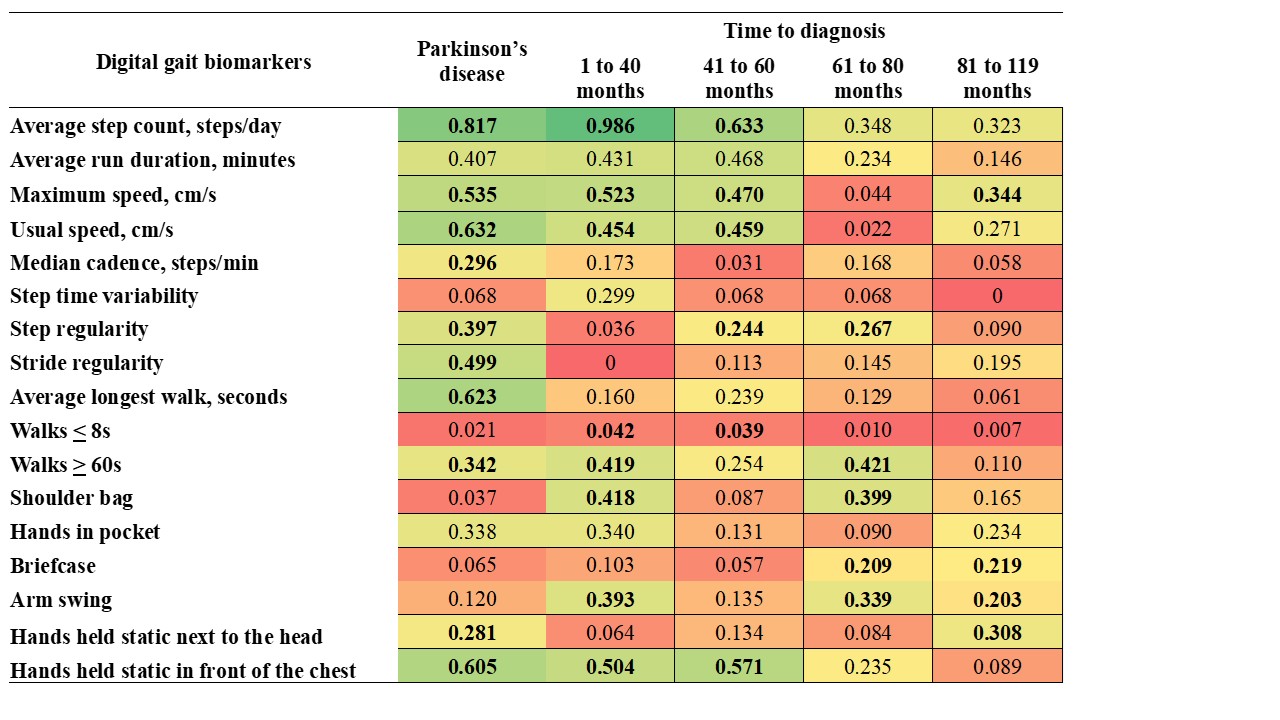
Table 1
To cite this abstract in AMA style:
P. Pelicioni, S. Waller, L. Chan, A. Krishnan, S. Lord, M. Brodie. Digital Gait Biomarkers Reveal a Distinct Motor Prodrome Up to Five Years Before Parkinson’s Disease Diagnosis in the General Population [abstract]. Mov Disord. 2026; 41 (suppl 1). https://www.mdsabstracts.org/abstract/digital-gait-biomarkers-reveal-a-distinct-motor-prodrome-up-to-five-years-before-parkinsons-disease-diagnosis-in-the-general-population/. Accessed October 1, 2026.« Back to 2026 International Congress
MDS Abstracts - https://www.mdsabstracts.org/abstract/digital-gait-biomarkers-reveal-a-distinct-motor-prodrome-up-to-five-years-before-parkinsons-disease-diagnosis-in-the-general-population/