
Category: Parkinson's Disease: Surgical Therapy
Objective: To evaluate the long-term effects of subthalamic nucleus (STN) deep brain stimulation (DBS) on postural abnormalities in patients with advanced Parkinson’s disease (PD).
Background: Postural abnormalities, including camptocormia and Pisa syndrome, are among the most disabling and treatment-refractory features of advanced PD. While DBS reliably improves tremor, bradykinesia, and rigidity, its long-term effects on posture remain uncertain.
Method: INTREPID was a multicenter trial of PD patients who underwent bilateral STN DBS using the Vercise system and were prospectively followed for five years. Our study was a subset analysis of the broader INTREPID cohort in patients with a baseline off medication UPDRS Part 3.28 Posture score ≥2 ‘Moderately stooped posture, definitely abnormal; can be slightly leaning to one side’ prior to surgery’. All UPDRS 3.28 Posture scores were in off-medication state. Microsoft Co-Pilot (Analyst agent) was used to analyze data from INTREPID cohort.
Results: Eighty-seven patients (mean age 60 ± 7.46 years; 72% male; disease duration 11.27 ± 4.45 years) were included. Among patients with ‘moderately stooped posture’ preoperatively with mean UPDRS 3.28 Posture score 2.17, two-thirds demonstrated significant and sustained improvement after DBS. Mean UPDRS 3.28 Posture scores improved to 1.30 at Year 1 (40%) and remained stable through Year 4 (41%), consistent with ‘mildly stooped or age-appropriate posture’. At Year 5, partial attenuation was observed (mean score 1.48), though improvement from baseline persisted (32%) Table A. Annual responder rates ranged from 62% to 69%. In a subgroup analysis of patients with severely stooped posture (screening ≥3; n=15), posture scores improved from 3.00 to 1.54 at Year 1 (49%) and remained improved through Year 4, with reduced benefit at Year 5 (Table B, Figure 1).
Conclusion: Bilateral STN DBS is associated with clinically meaningful and durable improvement in postural abnormalities in PD, sustained for up to four years with partial loss of effect by Year 5.
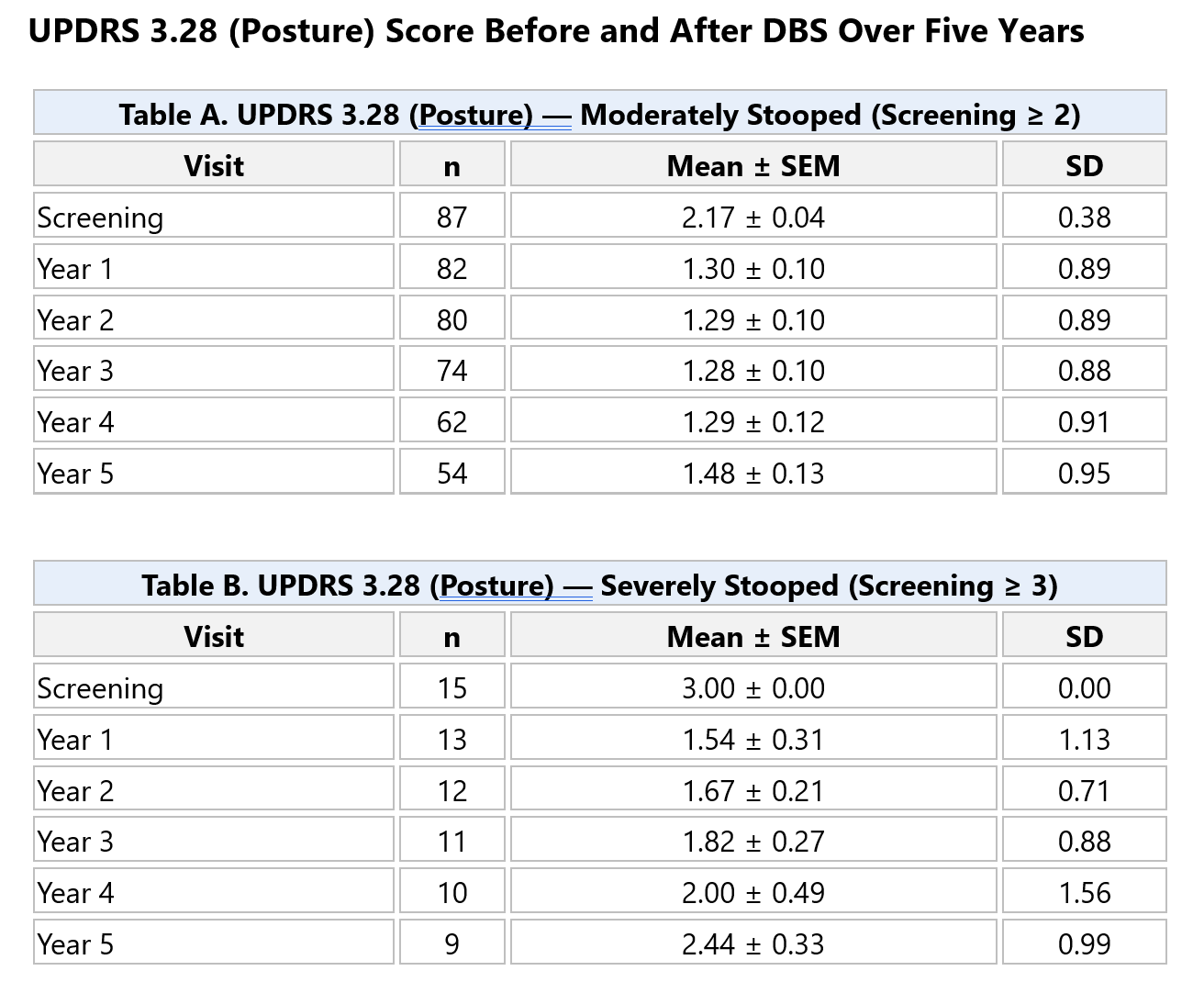
Table A and Table B
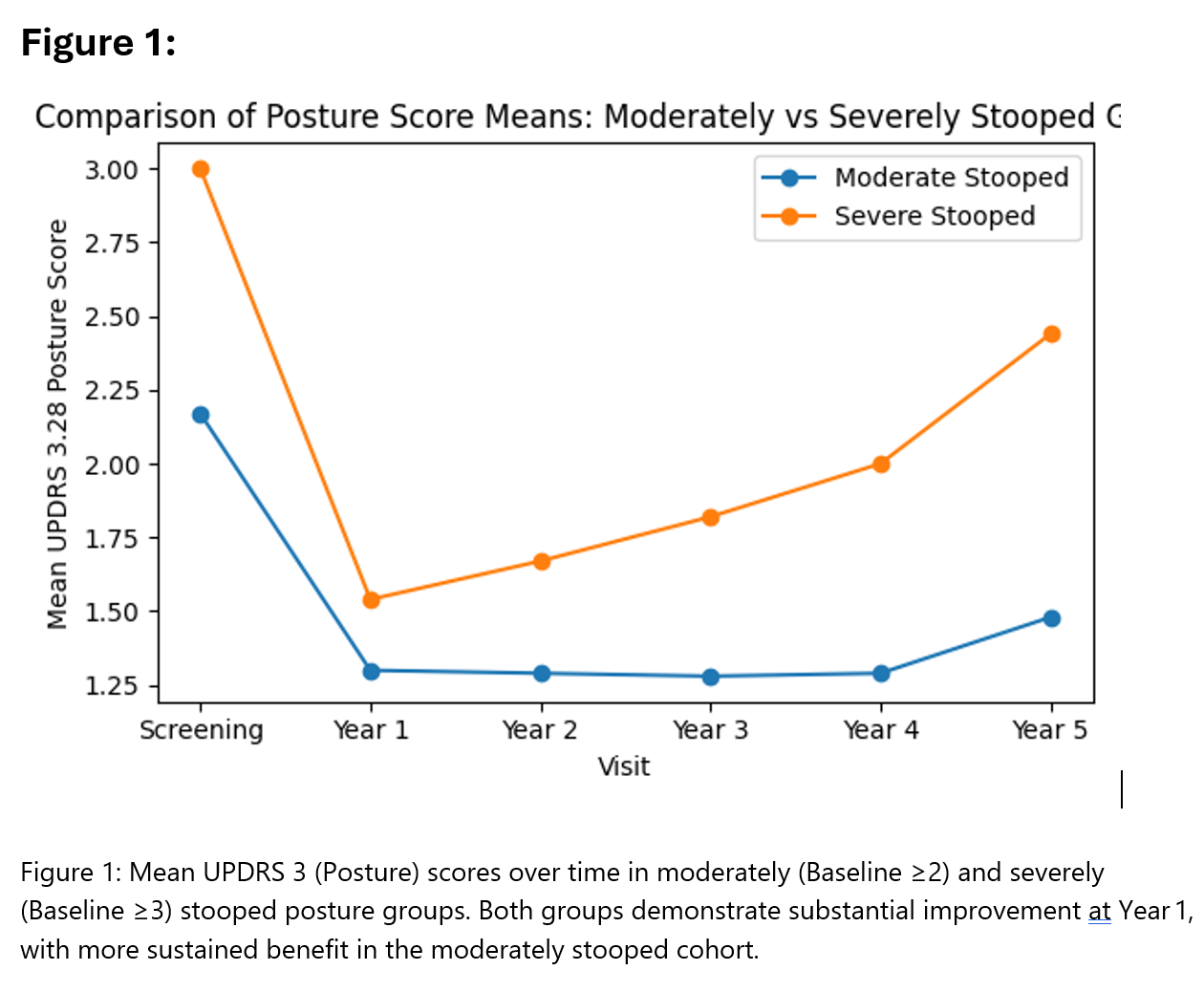
Figure 1
References: Starr PA, Shivacharan RS, Goldberg E, Tröster AI, House PA, Giroux ML, Hebb AO, Whiting DM, Leichliter TA, Ostrem JL, Metman LV, Sani S, Karl JA, Siddiqui MS, Tatter SB, Haq IU, Machado AG, Gostkowski M, Tagliati M, Mamelak AN, Okun MS, Foote KD, Moguel-Cobos G, Ponce FA, Pahwa R, Lyons K, Buetefisch CM, Gross RE, Luca CC, Jagid JR, Revuelta GJ, Takacs I, Pourfar MH, Mogilner AY, Duker AP, Mandybur GT, Rosenow JM, Zadikoff C, Khandhar SM, Sedrak M, Phibbs FT, Neimat J, Durphy J, Ramirez-Zamora A, Pilitsis JG, Uitti RJ, Wharen R, Park MC, Vitek JL; INTREPID Study Group. Five-Year Outcomes from Deep Brain Stimulation of the Subthalamic Nucleus for Parkinson Disease. JAMA Neurol. 2025 Nov 1;82(11):1181-1190. PMID: 40952750; PMCID: PMC12439180.
To cite this abstract in AMA style:
M. Siddiqui, R. Shivacharan. Does Subthalamic Nucleus DBS Produce Sustained Improvement in Postural Abnormalities? A 5 Year Prospective Study [abstract]. Mov Disord. 2026; 41 (suppl 1). https://www.mdsabstracts.org/abstract/does-subthalamic-nucleus-dbs-produce-sustained-improvement-in-postural-abnormalities-a-5-year-prospective-study/. Accessed October 1, 2026.« Back to 2026 International Congress
MDS Abstracts - https://www.mdsabstracts.org/abstract/does-subthalamic-nucleus-dbs-produce-sustained-improvement-in-postural-abnormalities-a-5-year-prospective-study/