
Session Information
Date: Thursday, June 8, 2017
Session Title: Parkinson’s Disease: Clinical Trials, Pharmacology And Treatment
Session Time: 1:15pm-2:45pm
Location: Exhibit Hall C
Objective: To assess the association between motor and non-motor symptoms of Parkinson’s Disease (PD) and side of onset considering hand dominance.
Background: PD motor symptoms are asymmetric at onset, and some level of asymmetry persists throughout the disease. There are few studies exploring the relationship between symptoms and side of onset, and even fewer considering hand dominance.
Methods: This was a cross sectional study. We included 80 PD patients and classified them into two groups according to side of onset. All patients underwent a standardized questionnaire including information about: sex, PD clinical information and familiar and medical historic. Patients were also assessed by
Scales for Outcomes in Parkinson’s Disease-Cognition (SCOPA-COG), non-motor symptoms scale (NMSS) and Unified Parkinson’s Disease Rating Scale (UPDRS).
A general linear model (GLM) was applied to assess the relation between scales scores from SCOPA, UPDRS and NMSS and side of onset as the independent controlling for age, sex, time of disease and hand dominance (p<0.05). However, since there were only 7 left-handed subjects, we performed a second GLM only including the right-handed ones (table 1).
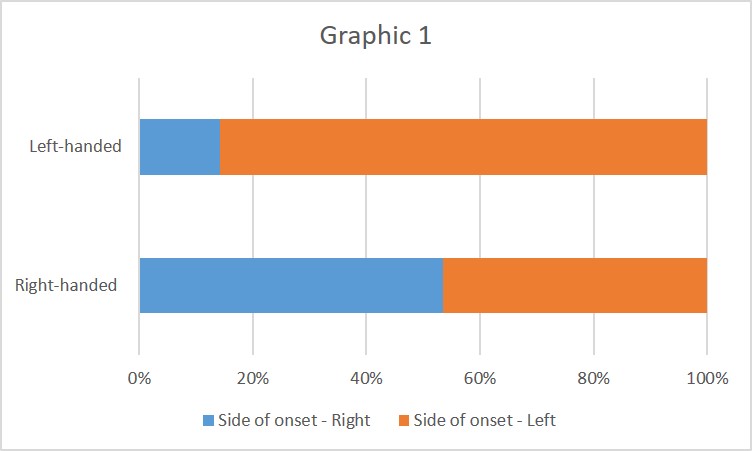
Results: Sixty-seven percent (67.6%) of patients were men. Mean age was 62.7 ± 9.4 years and mean time of disease was 10.48 ± 7.41 years. Forty patients presented the first symptom at right, and 40 at left. Among the right-handed (N=73), 39 (53,4%) patients had the first symptoms in the right side, while only one (14,3%) of the left-handed had the first symptom on the right side.
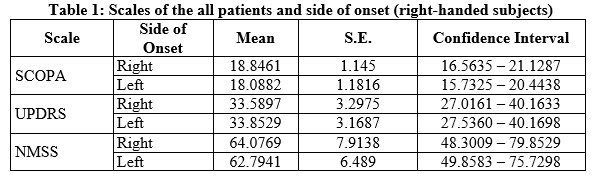
Conclusions: The side-of-onset did not seem to influence PD symptoms, motor, cognitive and non-motor, in right-handed subjects. This lack of association is unclear in left-handed ones. Future studies, should strive to include more left-handed subjects and to perform a longitudinal evaluation taking in account side of onset and hand dominance.
To cite this abstract in AMA style:
J. Silva, A. D'Abreu. Does the side of onset affect motor and non-motor symptoms in Parkinson’s disease? [abstract]. Mov Disord. 2017; 32 (suppl 2). https://www.mdsabstracts.org/abstract/does-the-side-of-onset-affect-motor-and-non-motor-symptoms-in-parkinsons-disease/. Accessed October 14, 2026.« Back to 2017 International Congress
MDS Abstracts - https://www.mdsabstracts.org/abstract/does-the-side-of-onset-affect-motor-and-non-motor-symptoms-in-parkinsons-disease/