
Category: Parkinson's Disease: Surgical Therapy
Objective: To describe the clinical outcomes of sequential STN–GPi neuromodulation in patients with advanced Parkinson’s disease who developed refractory dyskinesia or dystonia after an initially successful STN-DBS course.
Background: Subthalamic nucleus (STN) deep brain stimulation (DBS) is an established therapy for advanced Parkinson’s disease (PD), with durable effects on bradykinesia and rigidity. However, a subset of patients may develop disabling dyskinesia or dystonia years after an initially successful STN-DBS course, despite optimized programming and medical therapy. In this setting, additional globus pallidus internus (GPi) stimulation may represent a rescue strategy.
Method: We retrospectively analyzed four patients with idiopathic PD and prior bilateral STN-DBS who developed disabling dyskinesia or dystonia several years after implantation and underwent GPi-DBS as rescue neuromodulation, while STN stimulation remained active throughout follow-up. Clinical evaluation included UPDRS Part III in the OFF medication/ON stimulation and ON medication/ON stimulation conditions, UPDRS Part IV, and PDQ-39 at baseline and longitudinal follow-up (6 months, 1 year, and 2 years).
Results: Following GPi implantation, mean UPDRS-III scores in the OFF medication/ON stimulation condition improved from 33.3 at baseline to 21.5 at 6 months, corresponding to an approximately 35% improvement, and remained relatively stable at 1 year (22.8) and 2 years (24.8). Dyskinesia severity showed a marked reduction, with mean UPDRS-IV decreasing from 16.8 to 5.5, corresponding to an approximately 67% improvement. Quality of life also improved, with mean PDQ-39 scores decreasing from 76.3 to 48.8. Overall, the clinical pattern was characterized by preservation of motor benefit together with substantial suppression of dyskinesia. STN
Conclusion: In this rescue series, sequential STN-GPi neuromodulation was associated with sustained clinical benefit in patients with advanced PD who experienced delayed worsening after an initially successful STN-DBS course. The combination of preserved motor improvement, marked reduction in dyskinesia, and better quality of life suggests that GPi rescue stimulation may be a useful therapeutic option in selected cases.
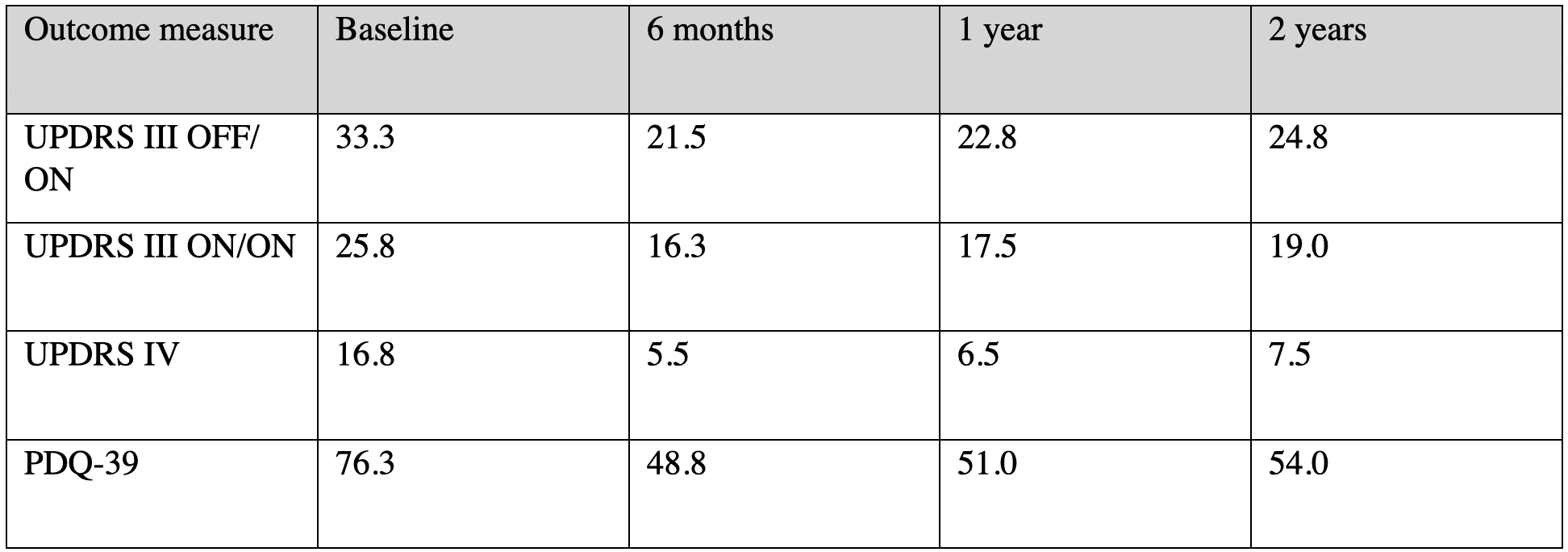
Table 1
References: • Zhang J, Li J, Chen F, Liu X, Jiang C, Hu X, et al. STN versus GPi deep brain stimulation for dyskinesia improvement in advanced Parkinson’s disease: A meta-analysis of randomized controlled trials. Clin Neurol Neurosurg. 2021;201:106450. doi:10.1016/j.clineuro.2020.106450.
• Wagle Shukla A, Bange M, Muthuraman M. Patient, target, device, and program selection for DBS in Parkinson’s disease: advancing toward precision care. NPJ Parkinsons Dis. 2025;11(1):195. doi:10.1038/s41531-025-01015-x.
To cite this abstract in AMA style:
J. Brainer Lima, P. Brainer Lima, M. Notaro Cavalcanti, A. Brainer Lima, M. Sales, G. Brainer Britto, P. Brainer Lima. Dual-Node Neuromodulation of the Basal Ganglia Motor Circuit: Sequential STN–GPi Stimulation in Advanced Parkinson’s Disease [abstract]. Mov Disord. 2026; 41 (suppl 1). https://www.mdsabstracts.org/abstract/dual-node-neuromodulation-of-the-basal-ganglia-motor-circuit-sequential-stn-gpi-stimulation-in-advanced-parkinsons-disease/. Accessed October 1, 2026.« Back to 2026 International Congress
MDS Abstracts - https://www.mdsabstracts.org/abstract/dual-node-neuromodulation-of-the-basal-ganglia-motor-circuit-sequential-stn-gpi-stimulation-in-advanced-parkinsons-disease/