
Objective:
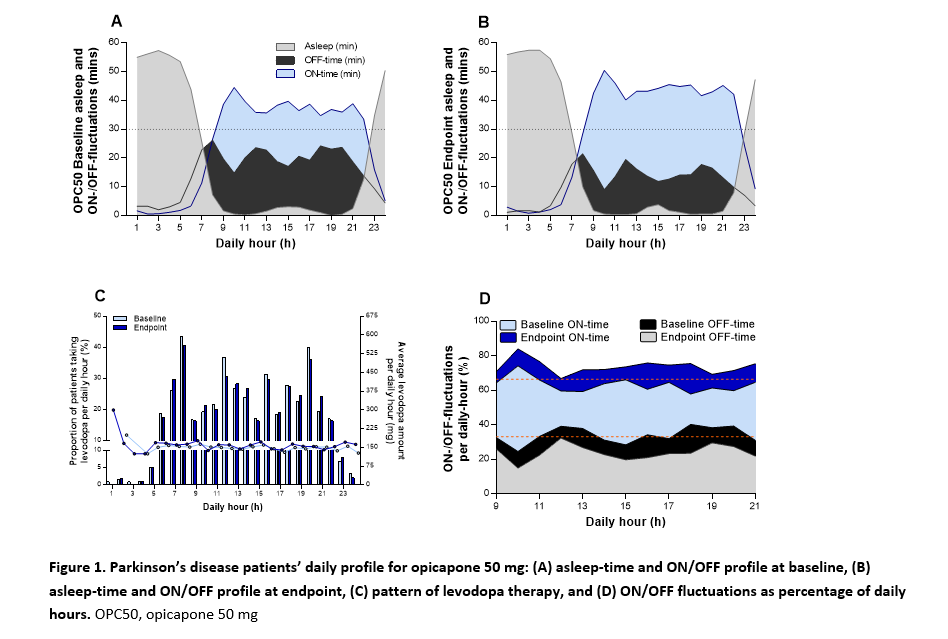
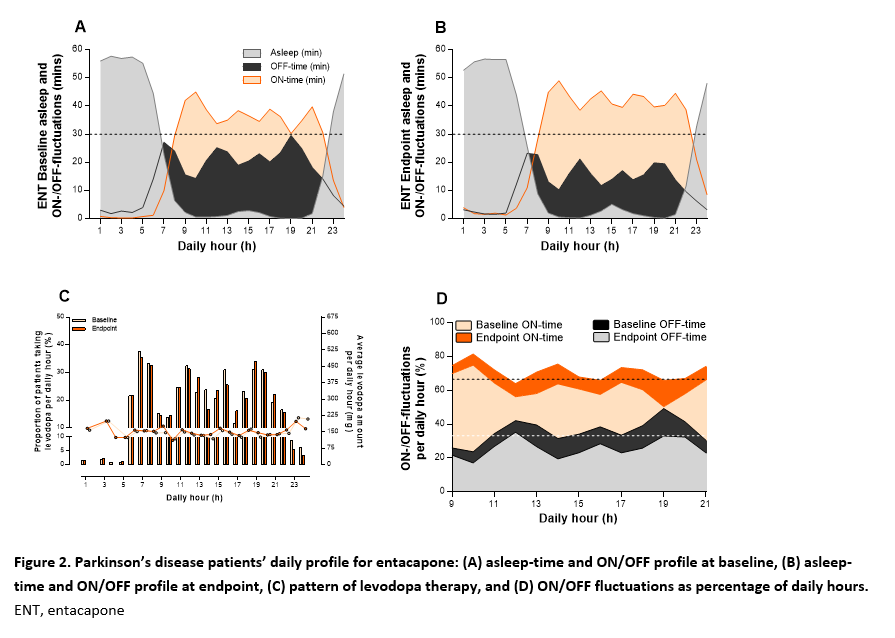
To evaluate the effect of opicapone (OPC) 50 mg versus entacapone (ENT) on daily pattern of motor fluctuations.
Background:
OPC, a once-daily catechol-O-methyltransferase inhibitor, was shown to be effective for end-of-dose motor-fluctuations in Parkinson’s disease (PD) patients in two large multinational trials (BIPARK-I and II) [1, 2].
Method: Home-diary data from OPC 50 mg and ENT BIPARK-I [1] patients with wearing-OFF were analyzed. Patients’ 24-h diary data were stratified per daily hour. Asleep and ON/OFF fluctuations were characterized and depicted by daily hour. An OFF-/ON-time threshold of 1/3 and 2/3 daily-hour, respectively, was defined; the area below the 1/3 (OFF-time) and above the 2/3 (ON-time) threshold was calculated.
Results: A total of 235 patients were included in this post-hoc analysis. For both treatments, at baseline or endpoint, the majority of asleep-time (>50%/h) was within 11pm to 6am (Figures 1A, 1B, 2A and 2B) and the proportion of patients taking levodopa per daily-hour were comparable (Figures 1C and 2C). When asleep-time was negligible (<5%/h; 9am–9pm, Figures 1D and 2D): for both treatment groups, at baseline, mean OFF-time area below the threshold of 1/3 daily-hour was >95%/h and mean ON-time area above the threshold of 2/3 daily-hour was <2.5%/h. At endpoint, for both treatment groups, virtually no OFF-time was above the threshold of 1/3 daily-hour and the increase in mean ON-time area above the threshold of 2/3 daily-hour was two-fold greater for OPC 50 mg than for ENT (13-fold vs 5.8-fold increase).
Conclusion: Opicapone 50 mg reduced OFF-time to less than 1/3 daily-hour and increased the mean ON-time area above 2/3 daily-hour twice as much as entacapone.
References: 1. Ferreira JJ, et al. Lancet Neurol. 2016;15:154–65. 2. Lees AJ, et al. JAMA Neurol. 2017;74:197–206.
To cite this abstract in AMA style:
A. Lees, O. Rascol, J. Ferreira, O. Klepitskaya, M. Fonseca, D. Magalhães, J.F Rocha, P. Soares-da-Silva. Effect of opicapone and entacapone on daily pattern of motor fluctuations in Parkinson’s disease patients [abstract]. Mov Disord. 2020; 35 (suppl 1). https://www.mdsabstracts.org/abstract/effect-of-opicapone-and-entacapone-on-daily-pattern-of-motor-fluctuations-in-parkinsons-disease-patients/. Accessed November 9, 2026.« Back to MDS Virtual Congress 2020
MDS Abstracts - https://www.mdsabstracts.org/abstract/effect-of-opicapone-and-entacapone-on-daily-pattern-of-motor-fluctuations-in-parkinsons-disease-patients/