
Objective: To assess the efficacy of virtual rehabilitation therapy compared to conventional physical therapy in patients with Parkinson’s disease.
Background: Rehabilitation is essential in managing Parkinson’s disease, improving mobility, balance, and reducing fall risk. Virtual rehabilitation therapy (VRT) has emerged as an innovative alternative to conventional physical therapy (CPT), though its effectiveness remains debated. This meta-analysis evaluates the impact of VRT on balance, functional mobility, motor performance, and fall risk in Parkinson’s patients.
Method: A systematic review was conducted in PubMed, Web of Science, and Scopus to identify comparative studies between VRT and CPT. Studies reporting measures of balance, functional mobility, motor performance, and fall risk were included. The mean difference (MD) with 95% confidence intervals was calculated using a random-effects model. Heterogeneity was assessed using I², and a sensitivity analysis was performed when necessary. A Trial Sequential Analysis was conducted to determine if the required information size was reached.
Results: Berg Balance Scale: Pooled mean difference was 2.26 [−1.04, 5.55], with no statistical significance (p = 0.18) and high heterogeneity (I² = 79%). TSA indicated that the required information size (RIS) of 464 patients has not been reached, suggesting inconclusive evidence and the need for further studies.
Timed Up and Go Test: Mean difference was 0.09 [0.00, 0.17], with marginal statistical significance (p = 0.04) and no heterogeneity (I² = 0%).
UPDRS Part III: Pooled mean difference was -0.19 [−3.28, 2.90], with no statistical significance (p = 0.91) and high heterogeneity (I² = 94%).
Dynamic Gait Index: A trend favoring VRT was observed (MD = 1.39 [−0.23, 3.02]), but without statistical significance (p = 0.09) and no heterogeneity (I² = 0%)
Conclusion: Although virtual rehabilitation therapy showed a positive trend in several assessed outcomes, none of the effects reached clear statistical significance. TSA confirmed that the current sample size is insufficient to draw definitive conclusions on balance improvements, indicating a high risk of Type II error. High heterogeneity in the balance and motor performance analyses suggests methodological variability among studies. Further studies with larger sample sizes and greater methodological rigor are needed.

Balance (Berg Balance Scale)
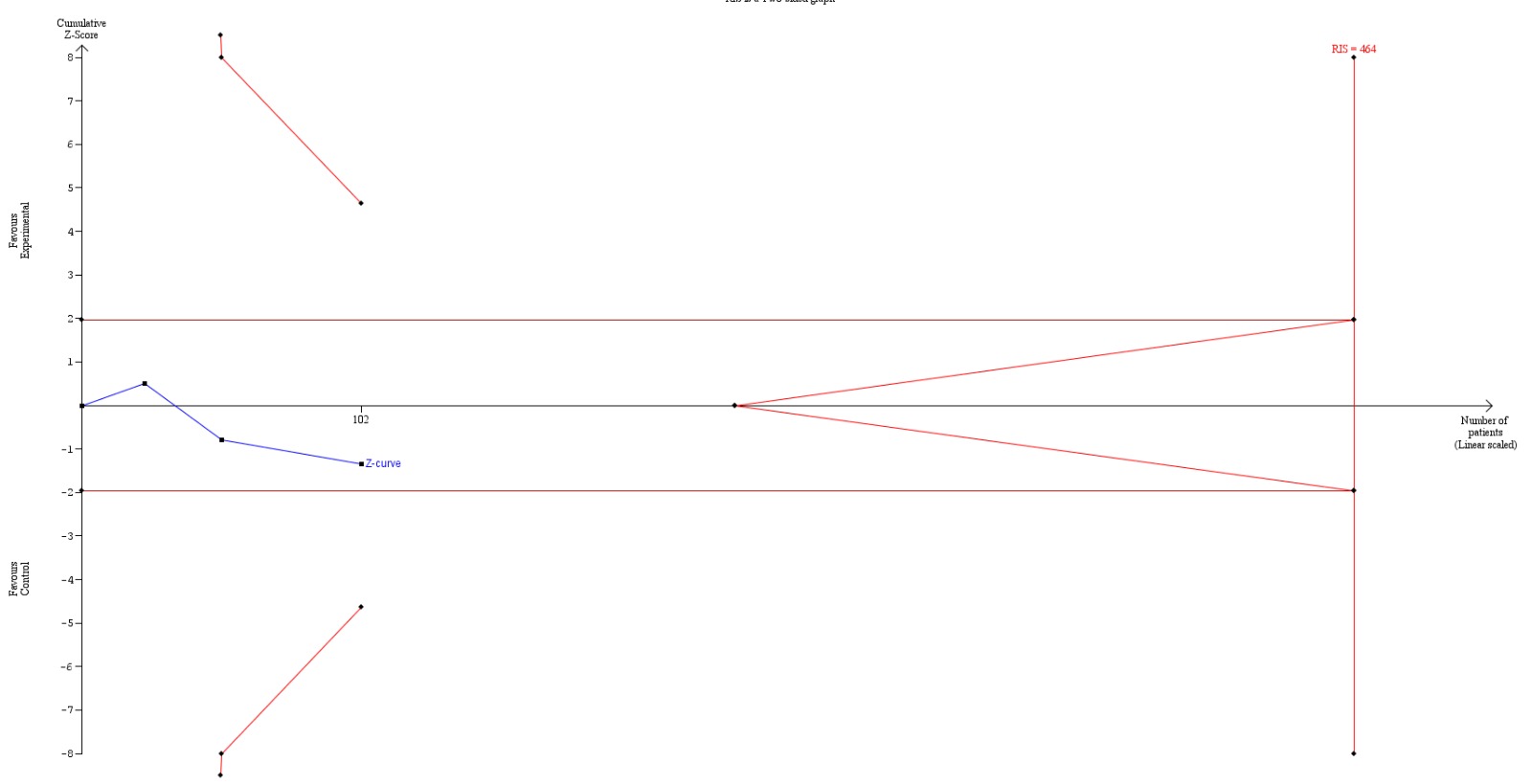
Balance (Berg Balance Scale) / TSA

Functional Mobility (Timed Up and Go Test)

Motor Performance (UPDRS Part III)

Fall Risk (Dynamic Gait Index)
References: 1.Goffredo M, Baglio F, DE Icco R, Proietti S, Maggioni G, Turolla A, et al. Efficacy of non-immersive virtual reality-based telerehabilitation on postural stability in Parkinson’s disease: a multicenter randomized controlled trial. Eur J Phys Rehabil Med. 2023 Dec;59(6):689–96.
2.Pazzaglia C, Imbimbo I, Tranchita E, Minganti C, Ricciardi D, Monaco RL, et al. Comparison of virtual reality rehabilitation and conventional rehabilitation in Parkinson’s disease: a randomised controlled trial. Physiotherapy. 2020 Mar 1;106:36–42.
3.Yang WC, Wang HK, Wu RM, Lo CS, Lin KH. Home-based virtual reality balance training and conventional balance training in Parkinson’s disease: A randomized controlled trial. J Formos Med Assoc. 2016 Sep 1;115(9):734–43.
4.Feng H, Li C, Liu J, Wang L, Ma J, Li G, et al. Virtual Reality Rehabilitation Versus Conventional Physical Therapy for Improving Balance and Gait in Parkinson’s Disease Patients: A Randomized Controlled Trial. Med Sci Monit. 2019 Jun 5;25:4186–92.
To cite this abstract in AMA style:
F. Luna-Rangel, B. Gonzalez-Bedolla, C. Armengol-Garcia, D. Martinez-Ramirez. Effect of Virtual Rehabilitation Therapy on Patients with Parkinson’s Disease: A Systematic Review and Meta-Analysis [abstract]. Mov Disord. 2025; 40 (suppl 1). https://www.mdsabstracts.org/abstract/effect-of-virtual-rehabilitation-therapy-on-patients-with-parkinsons-disease-a-systematic-review-and-meta-analysis/. Accessed October 13, 2026.« Back to 2025 International Congress
MDS Abstracts - https://www.mdsabstracts.org/abstract/effect-of-virtual-rehabilitation-therapy-on-patients-with-parkinsons-disease-a-systematic-review-and-meta-analysis/