
Category: Parkinson's Disease: Genetics
Objective: To evaluate whether polygenic risk scores (PRS) derived from a recent genome-wide association study (GWAS) improve Parkinson’s disease (PD) prediction compared with PRS derived from earlier GWAS data.
Background: Large GWAS meta-analyses have identified multiple genetic loci associated with PD. Nalls et al. (2019) reported 90 independent risk signals, whereas a recent GP2 meta-analysis (2025) identified 157 variants. Whether PRS derived from these expanded datasets improves PD risk prediction remains unclear.
Method: PRS were generated using GWAS summary statistics from Nalls et al. (2019) and GP2 (2025) and evaluated in an independent dataset from the Global Parkinson’s Genetics Program (release R10). The cohort included individuals of European ancestry (EUR; 7,461 cases, 1,826 controls) and Ashkenazi Jewish ancestry (AJ; 373 cases, 55 controls). PRS were calculated using PLINK. Logistic regression models included PRS, sex, and the first 10 genetic principal components. Model performance was evaluated using ROC curves, AUC, Youden’s J statistic, and classification metrics. Differences in AUC were assessed using the DeLong test. ChatGPT was used solely for language editing.
Results: In the EUR cohort, the GP2-derived PRS showed modestly improved performance compared with the Nalls-based PRS. The GP2 PRS was strongly associated with PD (β = 0.48, OR = 1.62, 95% CI 1.56–1.67, p = 3.0×10⁻⁶⁰, R² = 0.065) compared with the Nalls PRS (β = 0.42, OR = 1.53, 95% CI 1.47–1.58, p = 8.6×10⁻⁵⁰, R² = 0.060). Accuracy was slightly higher for the GP2 model (66.7% vs. 65.0%). ROC analysis showed a small but significant improvement in discrimination (AUC 0.678 vs. 0.670; p = 0.038).
In the AJ cohort, both PRS were significantly associated with PD risk. The GP2 PRS showed a larger effect size (OR 2.57 vs. 2.22), but ROC analysis showed no significant difference in AUC (0.727 vs. 0.715; p = 0.625).
Conclusion: PRS derived from the updated PD GWAS showed a modest but significant improvement in PD prediction in European ancestry. No improvement was observed in the AJ cohort, likely reflecting limited sample size and ancestry-specific genetic architecture.
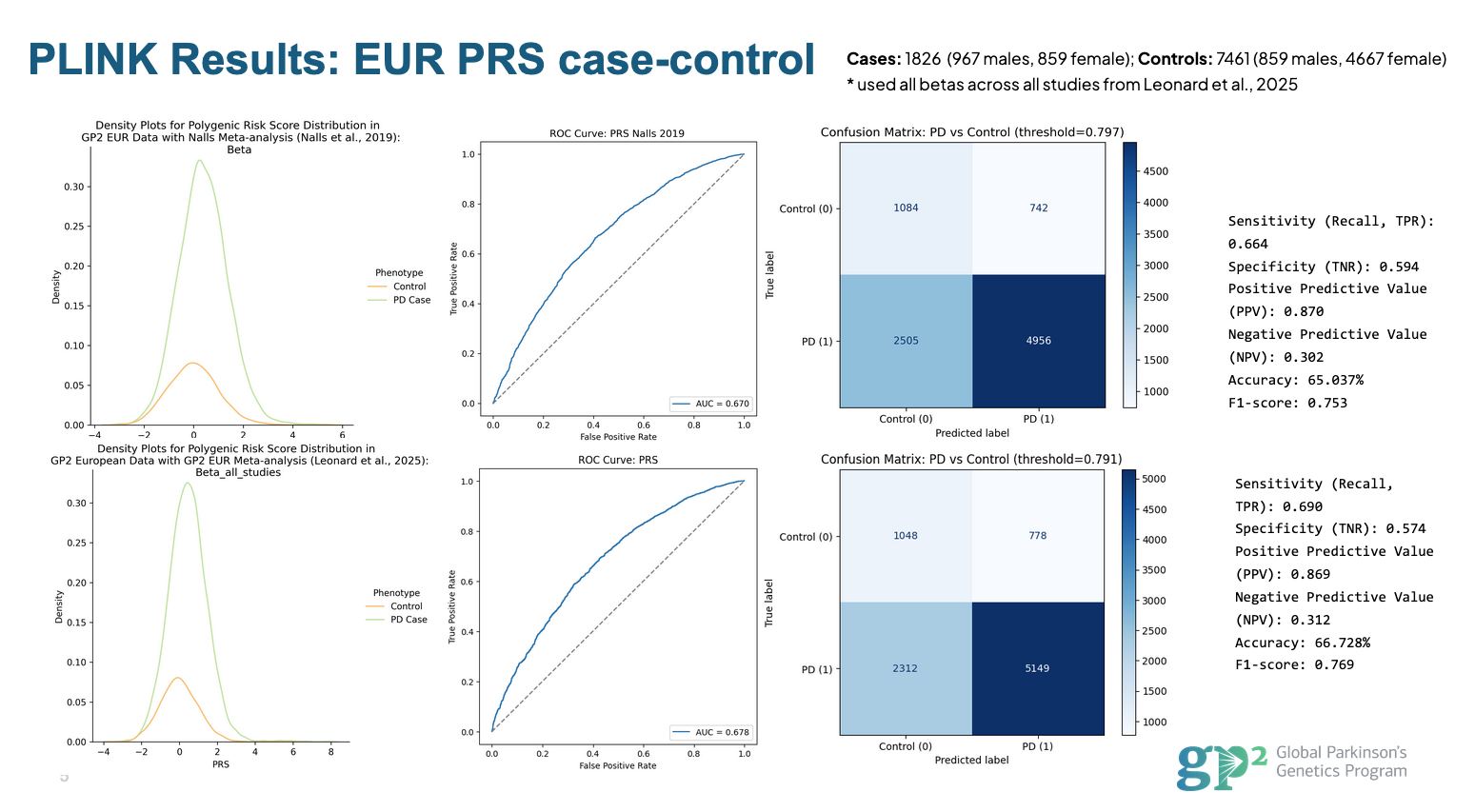
PRS Performance in European Cohort
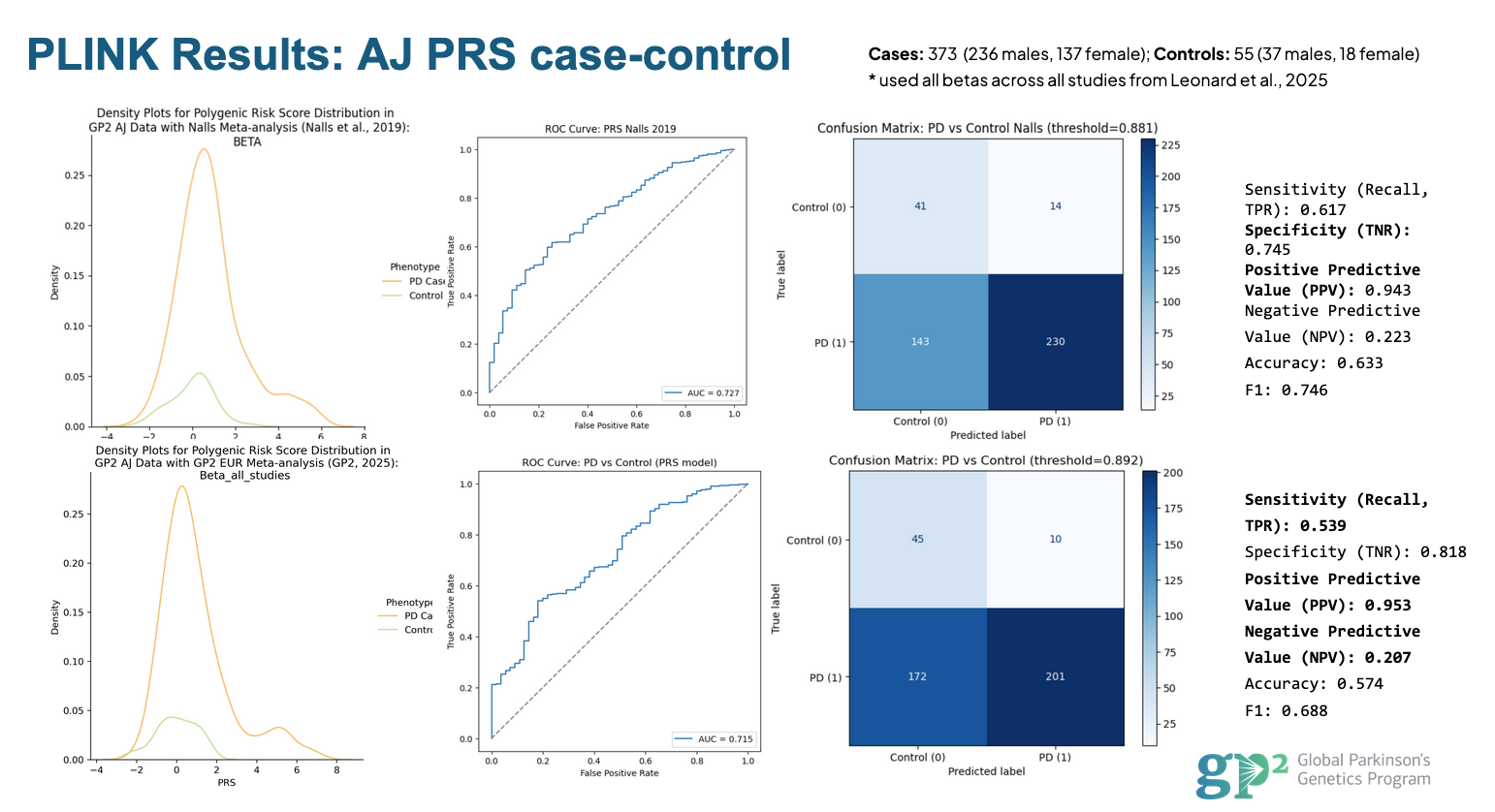
PRS Performance in Ashkenazi Jewish Cohort
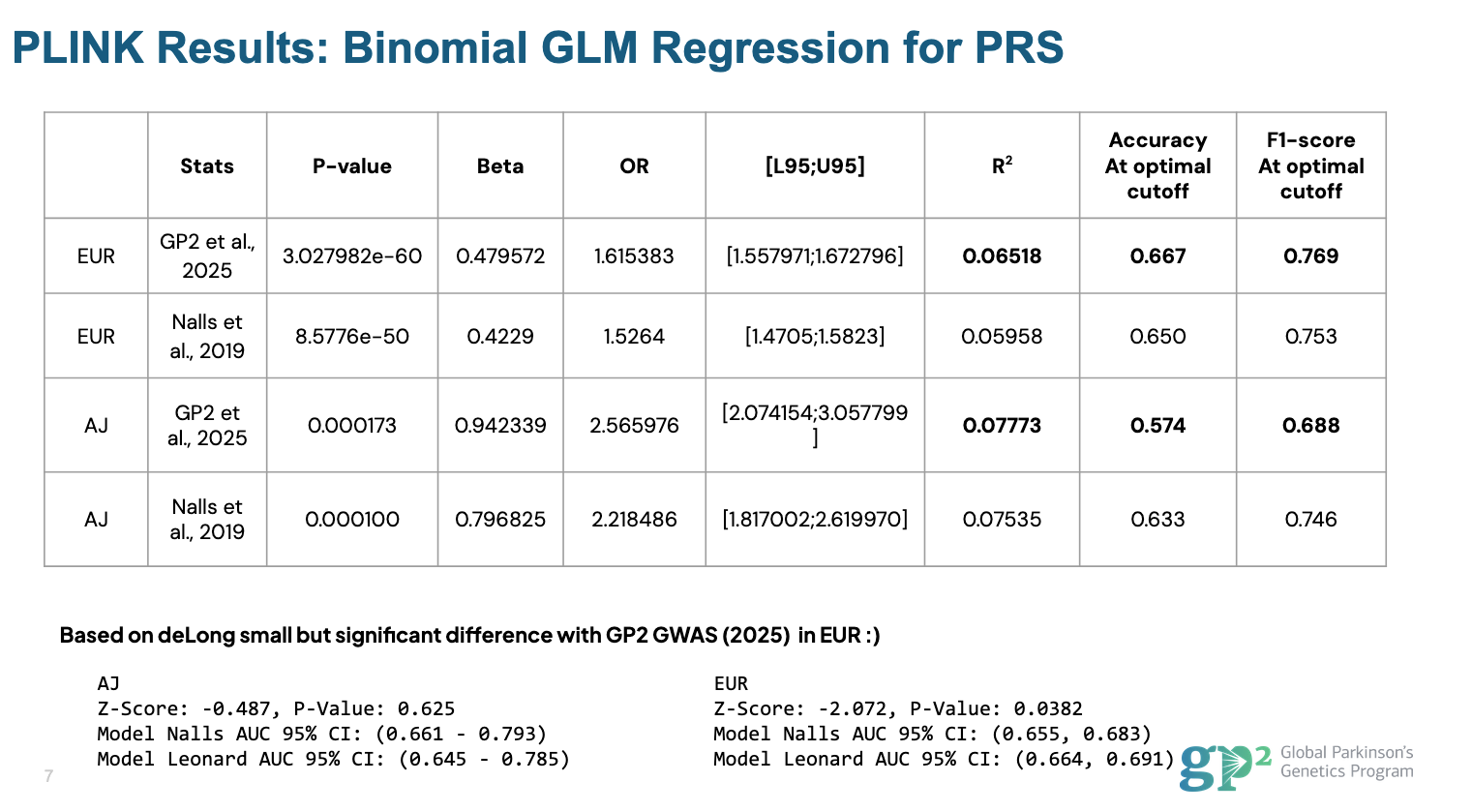
PRS Binomial Logistic Regression Analysis
References: 1. Nalls MA, Blauwendraat C, Vallerga CL, et al. Identification of novel risk loci, causal insights, and heritable risk for Parkinson’s disease: a meta-analysis of genome-wide association studies. Lancet Neurol. 2019;18(12):1091-1102. doi:10.1016/S1474-4422(19)30320-5
2. Leonard HL; Global Parkinson’s Genetics Program (GP2). Novel Parkinson’s Disease Genetic Risk Factors Within and Across European Populations. Preprint. medRxiv. 2025;2025.03.14.24319455. Published 2025 Mar 17. doi:10.1101/2025.03.14.24319455
To cite this abstract in AMA style:
B. Pizarro-Galleguillos, L. Faria-Costa, M. Isayan, A. Hernández-Medrano, M. Makarious. Evaluation of Polygenic Risk Scores Derived from an Updated Cross-European GWAS for Parkinson’s Disease Prediction in European and Ashkenazi Jewish Populations [abstract]. Mov Disord. 2026; 41 (suppl 1). https://www.mdsabstracts.org/abstract/evaluation-of-polygenic-risk-scores-derived-from-an-updated-cross-european-gwas-for-parkinsons-disease-prediction-in-european-and-ashkenazi-jewish-populations/. Accessed October 1, 2026.« Back to 2026 International Congress
MDS Abstracts - https://www.mdsabstracts.org/abstract/evaluation-of-polygenic-risk-scores-derived-from-an-updated-cross-european-gwas-for-parkinsons-disease-prediction-in-european-and-ashkenazi-jewish-populations/