
Objective: Identifying physiomarkers of PD motor function beyond total beta power by examining event-related subthalamic nucleus beta modulation during continuous finger tapping (FT) using synchronized local field potentials (LFPs), video-based kinematics, and clinician scores.
Background: Low-beta activity (13–20 Hz) modulates during voluntary movement, and its total power is used as a marker of motor function in Parkinson’s disease (PD). Movement-related beta modulation may be a marker, as it is attenuated in PD [1]. However, beta modulation also reduces with increased movement speed in healthy individuals [2], complicating the interpretation of beta dynamics during continuous motor tasks.
Method: LFP and video data were obtained during 150 assessments in 45 patients performing FT (MDS-UPDRS-III, item 3.4). LFP–kinematic alignment was achieved using artefacts induced by tapping the IPG [3]. Data was segmented into −0.3 to +0.3 s windows around FT events. Low beta was quantified with the Hilbert envelope and expressed as percentage from a 30 s resting baseline. The latency between event-related desynchronization (ERD) and synchronization (ERS) peaks, as well as the ERD–ERS amplitude difference, were calculated. The differences in these variables between the different severity scores were assessed with a Kruskal–Wallis test.
Results: Synchronization was achieved in 76 assessments (51%). 77 hemispheres were included due to e.g. unilateral recordings, and unidentifiable tapping. ERD-ERS did not differ across MDS-UPDRS-III score groups in amplitude (% change; p = 0.55; median [IQR]: score 0, 16.57 [11.92–23.58]; score 1, 17.11 [10.53–26.16]; score 2, 17.20 [11.59–25.15]; score 3, 15.88 [10.51–22.93]; score 4, 16.61 [14.11–22.99]; Figure 1A), or latency (seconds; p = 0.33; score 0, 0.17 [0.11–0.23]; score 1, 0.15 [0.12–0.22]; score 2, 0.18 [0.12–0.27]; score 3, 0.15 [0.12–0.20]; score 4, 0.15 [0.13–0.15]; Figure 1B).
Conclusion: Our approach enables synchronized analysis of subthalamic LFPs and video-based kinematics at individual tap events. Preliminary results show that ERD-ERS amplitude and latency were not associated with clinician-rated FT severity. Future analyses will test associations between beta dynamics and quantitative kinematic metrics, which may clarify the potential of event-related LFPs as physiomarkers for PD.
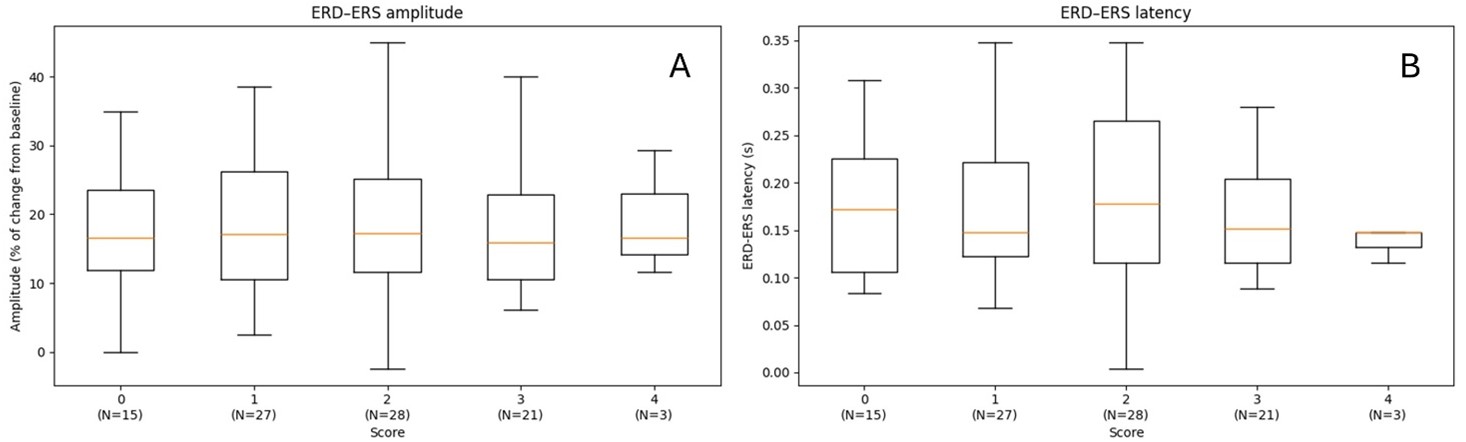
ERD amplitude (A) and latency (B).
References: 1. Heinrichs-Graham E, Wilson TW, Santamaria PM, Heithoff SK, Torres-Russotto D, Hutter-Saunders JAL, et al. Neuromagnetic Evidence of Abnormal Movement-Related Beta Desynchronization in Parkinson’s Disease. Cerebral Cortex. 2013;24(10):2669–78.
2. Houweling S, Beek PJ, Daffertshofer A. Spectral changes of interhemispheric crosstalk during movement instabilities. Cerebral cortex. 2010;20(11):2605–13.
3. Sarapata G, Hubers D, Beudel M, O’Keeffe J. A Simple Method for Synchronising Rich Kinematic Video Data with Local Field Potentials from DBS Systems. Brain Stimulation: Basic, Translational, and Clinical Research in Neuromodulation. 2025;18(4):1304–5.
To cite this abstract in AMA style:
D. Hubers, BJ. Keulen, A. Vander Weide, BCM. van Wijk, PR. Schuurman, RMA. de Bie, M. Beudel. Event-Locked Characterization of Movement-Related Beta Modulation using Synchronized Local Field Potentials and Video-Based Kinematics [abstract]. Mov Disord. 2026; 41 (suppl 1). https://www.mdsabstracts.org/abstract/event-locked-characterization-of-movement-related-beta-modulation-using-synchronized-local-field-potentials-and-video-based-kinematics/. Accessed October 1, 2026.« Back to 2026 International Congress
MDS Abstracts - https://www.mdsabstracts.org/abstract/event-locked-characterization-of-movement-related-beta-modulation-using-synchronized-local-field-potentials-and-video-based-kinematics/