
Objective: To assess the efficacy and safety of PTT as a rescue procedure after pallidotomy in two patients with refractory dystonia.
Background: In cases of severe or treatment-refractory dystonia, surgical management options include lesioning surgeries or neuromodulation, such as Deep Brain Stimulation (DBS). Recently, interest in Pallidothalamotractotomy (PTT) has resurfaced as a potential salvage therapy for refractory dystonia following failure of pallidotomy.
Method: This single-center case series analyzed two patients who underwent unilateral PTT for worsening dystonia post-pallidotomy at a tertiary movement disorders center. The Burke-Fahn-Marsden Dystonia Rating Scale (BFMDRS) was used to assess pre- and post-operative severity and disability.
Results: Two males with idiopathic dystonia underwent unilateral PTT (Table 1). The symptom duration before pallidotomy was 8 and 2 years respectively, and the interval between pallidotomy and PTT was 59 and 70 months. Both patients had undergone prior bilateral pallidotomy. The BFMDRS motor score for case 1 improved from 36 pre-PTT to 11.5 immediately post-PTT and then to 10, which was sustained till last follow up at six months (Table 2). However, he had worsening of post-operative dysarthria albeit without functional decline. Case 2 showed improvement from 20 pre-PTT to 9.5 immediately post-PTT and 10 at 3 months. The improvement was sustained for 10 months before he had worsening due to cervical compressive myeloneuropathy. He experienced no adverse effects after PTT.
Conclusion: Unilateral PTT may serve as a rescue treatment for refractory dystonia following failure of pallidotomy. While initial outcomes suggest benefit, larger studies are needed to validate long-term efficacy and safety.
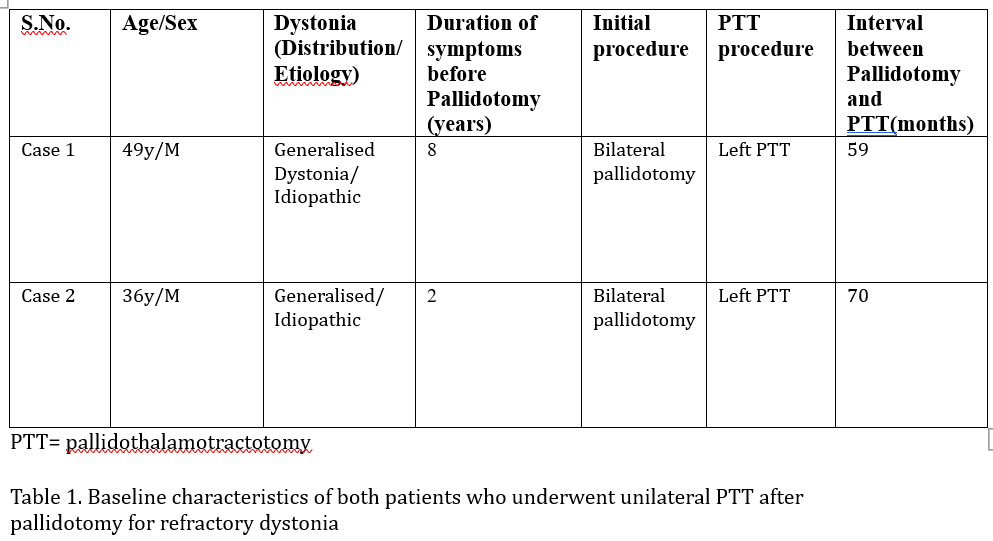
Table 1
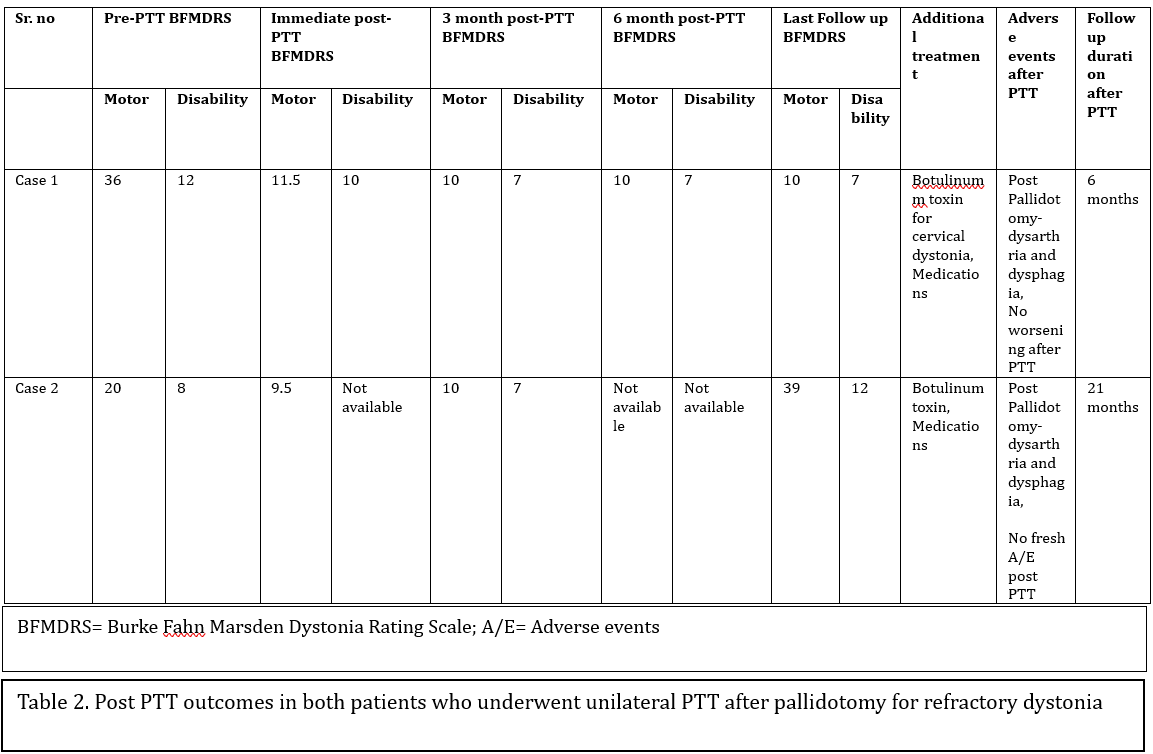
Table 2
To cite this abstract in AMA style:
A. Adhya, D. Garg, D. Radhakrishnan, A. Das, E. Arun, R. Rajan, A. Garg, A. Srivastava, K. Garg. Exploring Pallidothalamotractotomy as an Option for Management of Refractory Dystonia following Failure of Pallidotomy [abstract]. Mov Disord. 2025; 40 (suppl 1). https://www.mdsabstracts.org/abstract/exploring-pallidothalamotractotomy-as-an-option-for-management-of-refractory-dystonia-following-failure-of-pallidotomy/. Accessed October 16, 2026.« Back to 2025 International Congress
MDS Abstracts - https://www.mdsabstracts.org/abstract/exploring-pallidothalamotractotomy-as-an-option-for-management-of-refractory-dystonia-following-failure-of-pallidotomy/