
Category: Parkinson's Disease: Genetics
Objective: To investigate the causal roles of mitochondria-related gene expression in the pathogenesis of Parkinson’s Disease (PD).
Background: Mitochondria-related gene expression has been implicated in PD pathogenesis, but the causal relationships remain unclear. Understanding these relationships may provide insights into PD risk and potential therapeutic targets.
Method: A multi-omics Mendelian randomization approach was employed to explore causal relationships between epigenetic modifications, transcriptional activity, and protein expression of mitochondria-related genes with PD risk. Summary-level data for mitochondrial molecules were obtained from methylation quantitative trait loci (mQTL), expression quantitative trait loci (eQTL), and protein quantitative trait loci (pQTL) datasets. Genetic associations with PD were derived from the International Parkinson’s Disease Genomics Consortium and the Finnish Genetic Research Project datasets.
Results: Integration of multi-omics data revealed a strong association between IVD and PD risk at the levels of DNA methylation, gene transcription, and protein expression. MSRA exhibited significant associations with PD risk at both the methylation and transcription levels. Additionally, 32 mitochondrial genes were identified as associated with PD at a single-molecular level.
Conclusion: These findings implicate IVD, MSRA, and 32 additional mitochondria-related genes in the pathogenesis of PD, suggesting their potential as biomarkers for early detection and targets for therapeutic intervention.
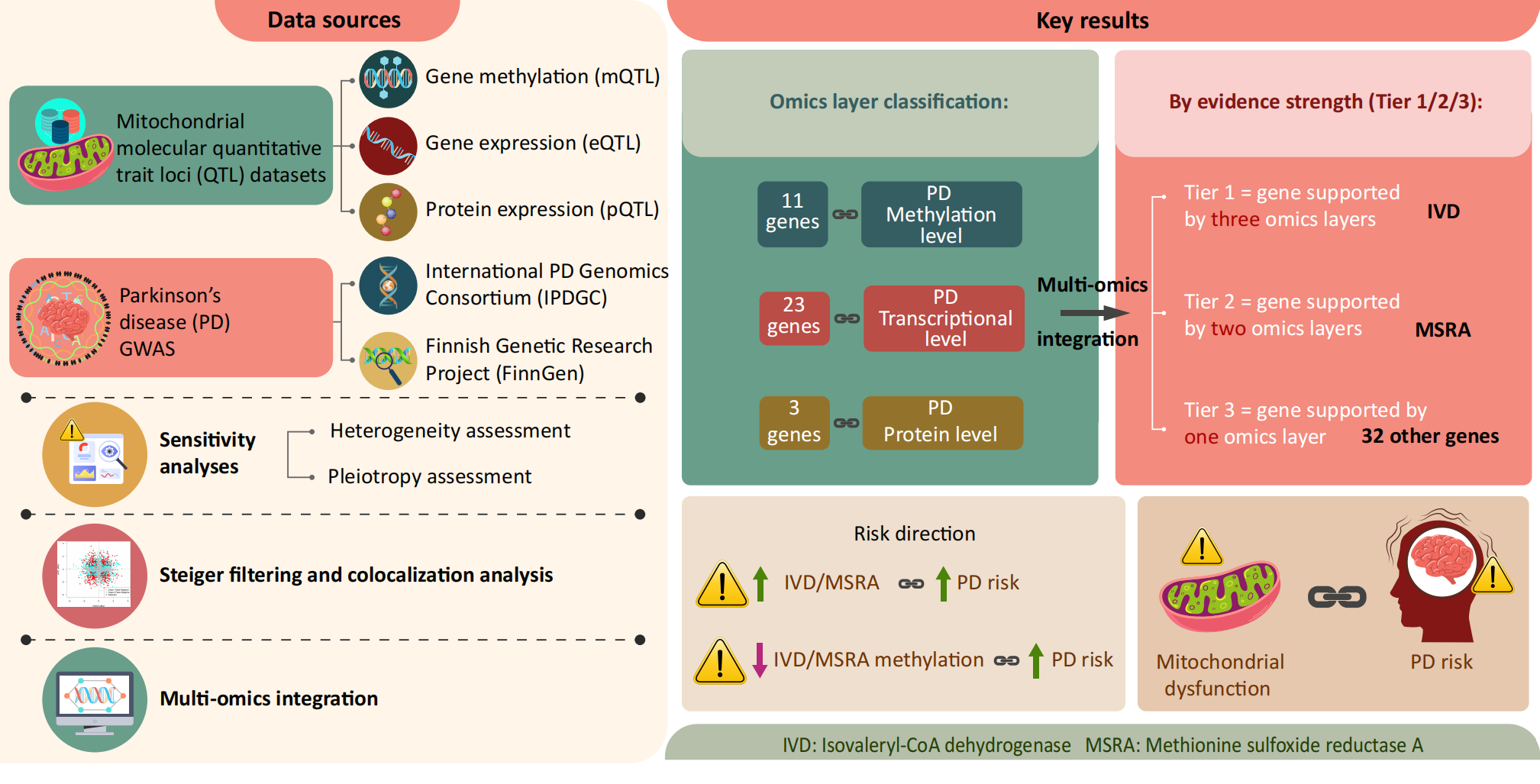
Graphical Abstract
![[figure 2]](https://www.mdsabstracts.org/wp-content/uploads/2026/09/0988_1474_000380_2.png)
[figure 2]
![[figure 1]](https://www.mdsabstracts.org/wp-content/uploads/2026/09/0988_1474_000380_3.png)
[figure 1]
References: [1] McRae AF, Marioni RE, Shah S, et al. Identification of 55,000 replicated DNA methylation QTL. Sci Rep. 2018;8:17605. doi:10.1038/s41598-018-35871-w.
[2] Võsa U, Claringbould A, Westra HJ, et al. Large-scale cis- and trans-eQTL analyses identify thousands of genetic loci and polygenic scores that regulate blood gene expression. Nat Genet. 2021;53:1300–1310. doi:10.1038/s41588-021-00913-z.
[3] Ferkingstad E, Sulem P, Atlason BA, et al. Large-scale integration of the plasma proteome with genetics and disease. Nat Genet. 2021;53:1712–1721. doi:10.1038/s41588-021-00978-w.
[4] Rath S, Sharma R, Gupta R, et al. MitoCarta3.0: an updated mitochondrial proteome now with sub-organelle localization and pathway annotations. Nucleic Acids Res. 2021;49:D1541–D1547. doi:10.1093/nar/gkaa1011.
[5] Nalls MA, Blauwendraat C, Vallerga CL, et al. Identification of novel risk loci, causal insights, and heritable risk for Parkinson’s disease: a meta-analysis of genome-wide association studies. Lancet Neurol. 2019;18:1091–1102. doi:10.1016/S1474-4422(19)30320-5.
[6] Kurki MI, Karjalainen J, Palta P, et al. FinnGen provides genetic insights from a well-phenotyped isolated population. Nature. 2023;613:508–518. doi:10.1038/s41586-022-05473-8.
To cite this abstract in AMA style:
Y. Zhang, M. Niu. Exploring the Causal Role of Mitochondria-related Genes in Parkinson’s Disease through Multi-Omics Mendelian Randomization [abstract]. Mov Disord. 2026; 41 (suppl 1). https://www.mdsabstracts.org/abstract/exploring-the-causal-role-of-mitochondria-related-genes-in-parkinsons-disease-through-multi-omics-mendelian-randomization/. Accessed October 1, 2026.« Back to 2026 International Congress
MDS Abstracts - https://www.mdsabstracts.org/abstract/exploring-the-causal-role-of-mitochondria-related-genes-in-parkinsons-disease-through-multi-omics-mendelian-randomization/