
Category: Huntington's Disease
Objective: To investigate a panel of extracellular small non-coding RNAs (sRNAs) in Huntington’s disease gene expansion individuals (HDGE) and its potential as CSF biomarkers.
Background: sRNAs including microRNAs (miRNAs) and tRNA-derived fragments (tRFs)[1], are emerging biomarkers detectable in biofluids that may reflect disease-related transcriptional dysregulation. In Huntington’s disease (HD), mutant HTT protein (mHTT) and expanded CAG-repeat RNA disrupt RNA processing and sRNA regulatory networks that participate in disease pathogenesis [2]. Altered sRNA signatures have been reported in HD tissues and peripheral biofluids [3], but their potential as CSF biomarkers remains unexplored.
Method: Candidate miRNAs and tRFs were selected through an in-house sRNA-sequencing (sRNA-seq) analysis pipeline, based on data from human brain samples and previous literature, and subsequently validated by qRT-PCR in independent putamen and cortex samples from HDGE and controls (n=8 per group).
The selected sRNA panel was assessed in CSF from 47 HDGE and 20 age-matched healthy controls (HC) [table1] using RT-qPCR. Relative expression levels were calculated and analyzed using sex- and age-adjusted linear mixed-effects models.
All participants underwent standardized clinical evaluations including cognitive, motor (UHDRS), and behavioral (PBA) assessments. Brain MRI was performed for Huntington’s disease integrated staging system (HD-ISS) classification. CSF NfL and mHTT were also measured. Associations were assessed using adjusted linear regression models and partial Spearman correlations. Discriminative performance was evaluated using ROC curve analysis.
Results: Several sRNAs from the selected panel, including tRF-Gly-GCC, tRF-Glu-CTC, miR-451a and let-7a-5p, were deregulated in CSF from early premanifest stages.
They showed age- and sex-adjusted associations with clinical and neurodegeneration-related measures, such as cUHDRS [tRF-Gly-GCC and tRF-Glu-CTC (standardized β ≈ −0.28, p = 0.021 and p=0.030)] and CSF NfL [let-7a-5p (standardized β = −0.29, p = 0.004)].
Combining sRNAs, alone or with NfL, improved discrimination at early disease stages, particularly between HC and HD-ISS 0, and between HD-ISS 0 and HD-ISS 1.
Conclusion: CSF sRNAs are deregulated from early HD stages and capture disease-related transcriptional alterations. Combined sRNA signatures may provide clinically relevant information complementary to established fluid biomarkers.
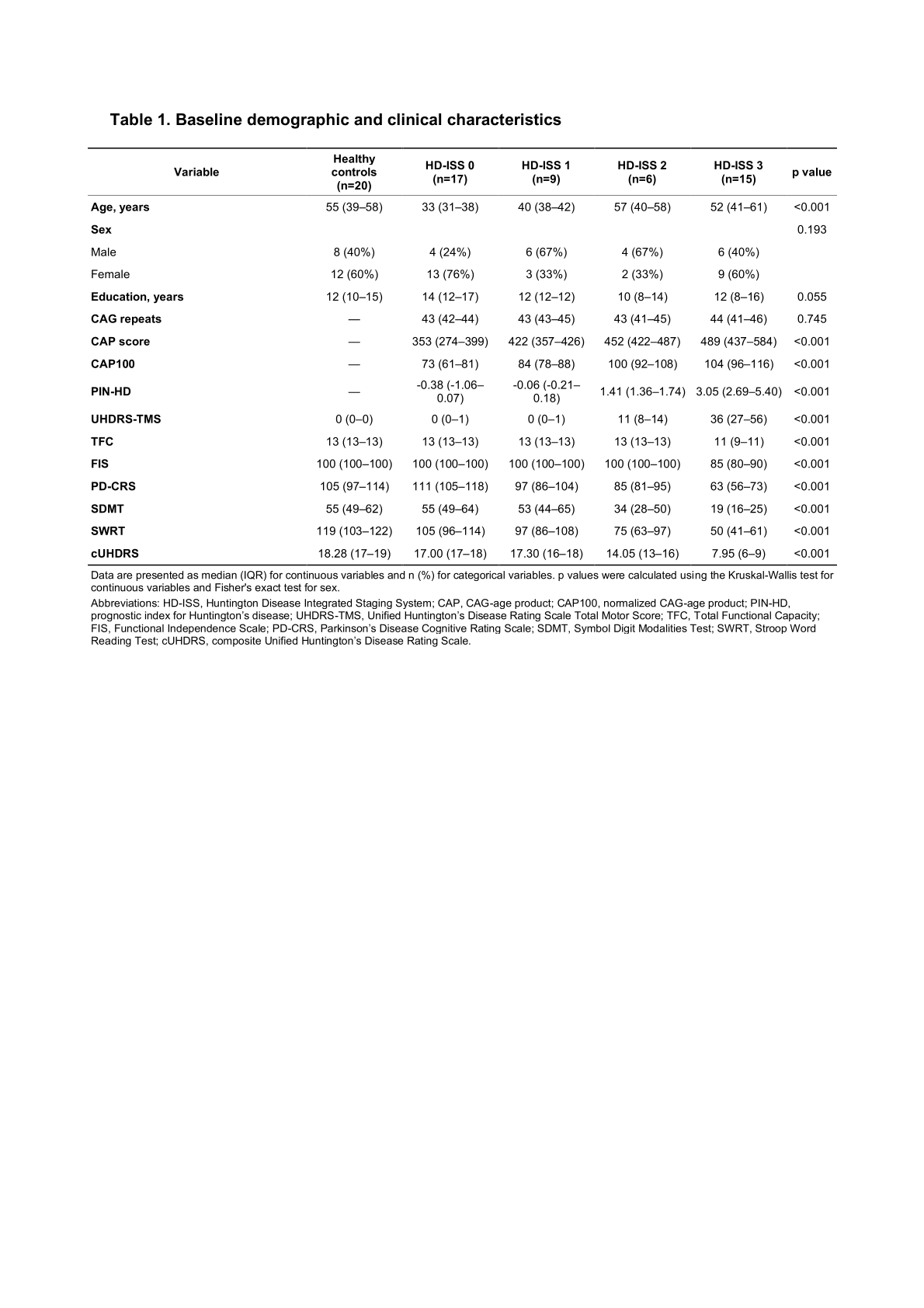
Table 1
References: [1] Winek K, Soreq H. Emerging roles of transfer RNA fragments in the CNS. Brain 2025; 148: 2631–2645.
[2] Creus-Muncunill J, Guisado-Corcoll A, Venturi V, et al. Huntington’s disease brain-derived small RNAs recapitulate associated neuropathology in mice. Acta Neuropathol 2021; 141: 565–584.
[3] Hoss AG, Lagomarsino VN, Frank S, et al. Study of plasma‐derived miRNAs mimic differences in Huntington’s disease brain. Movement Disorders 2015; 30: 1961–1964.
To cite this abstract in AMA style:
G. Olmedo-Saura, M. Herrero-Lorenzo, A. Cardona-Collado, A. Puig-Davi, A. Vazquez-Oliver, E. Rivas-Asensio, D. Alcolea, C. Franch-Marti, S. Martinez-Horta, A. Gámez-Valero, J. Kulisevsky, J. Perez Perez, E. Martí. Extracellular Small RNAs in Huntington’s disease: from Brain to CSF Analysis [abstract]. Mov Disord. 2026; 41 (suppl 1). https://www.mdsabstracts.org/abstract/extracellular-small-rnas-in-huntingtons-disease-from-brain-to-csf-analysis/. Accessed October 1, 2026.« Back to 2026 International Congress
MDS Abstracts - https://www.mdsabstracts.org/abstract/extracellular-small-rnas-in-huntingtons-disease-from-brain-to-csf-analysis/