
Category: Parkinson's disease: Neuroimaging
Objective: This study aimed to determine whether reduced dopaminergic integrity and increased iron deposition in the caudate are associated with altered BOLD activation during high executive-demand working memory (WM) manipulation in patients with early Parkinson’s disease (PD).
Background: WM impairment in PD is attributed to frontostriatal dysfunction due to dopaminergic deficiency. But also, iron accumulation in the basal ganglia has been associated with cognitive performance in healthy elderly1 and severity of cognitive decline in PD.2 However, it remains unclear how such striatal pathology shapes neural recruitment during WM operations with high executive demand. We aimed to characterize dopaminergic degeneration and iron accumulation and their potentially differential influence on neural responses during WM manipulation.
Method: 25 patients with early PD in the medication-off state and 35 sex- and age-matched healthy controls performed a validated WM paradigm3 to identify neural activity specifically associated with WM manipulation. Group differences in BOLD activation were assessed using two-sample t-tests. In 19 patients, mean specific binding ratios (SBRs) from dopamine transporter (DaT) SPECT and susceptibility values from quantitative susceptibility mapping (QSM) MRI were available and extracted from the caudate nucleus. Partial correlations tested associations between caudate pathology markers and task-related BOLD responses.
Results: Both groups showed widespread activation in the frontoparietal cerebellar and anterior striatal regions (Fig. 1A), with no significant group differences in activation and performance. Caudate SBR and iron load were negatively correlated (partial r=-0.547, p=0.023). Higher caudate DaT SBRs were associated with stronger BOLD responses (partial r=0.495, p=0.043), while higher iron load correlated with reduced BOLD activity (partial r=-0.681, p=0.006) during WM manipulation (Fig. 1B).
Conclusion: Despite preserved large-scale WM activation patterns in early PD, neural responses were associated with markers of caudate pathology. QSM may more directly translate into caudate pathology, while the weaker correlated DaT signal may be contaminated by compensatory downregulations. 4 These findings suggest dopamine- and iron-related neurodegenerative processes may shape executive neural recruitment before overt network-level alterations become detectable.
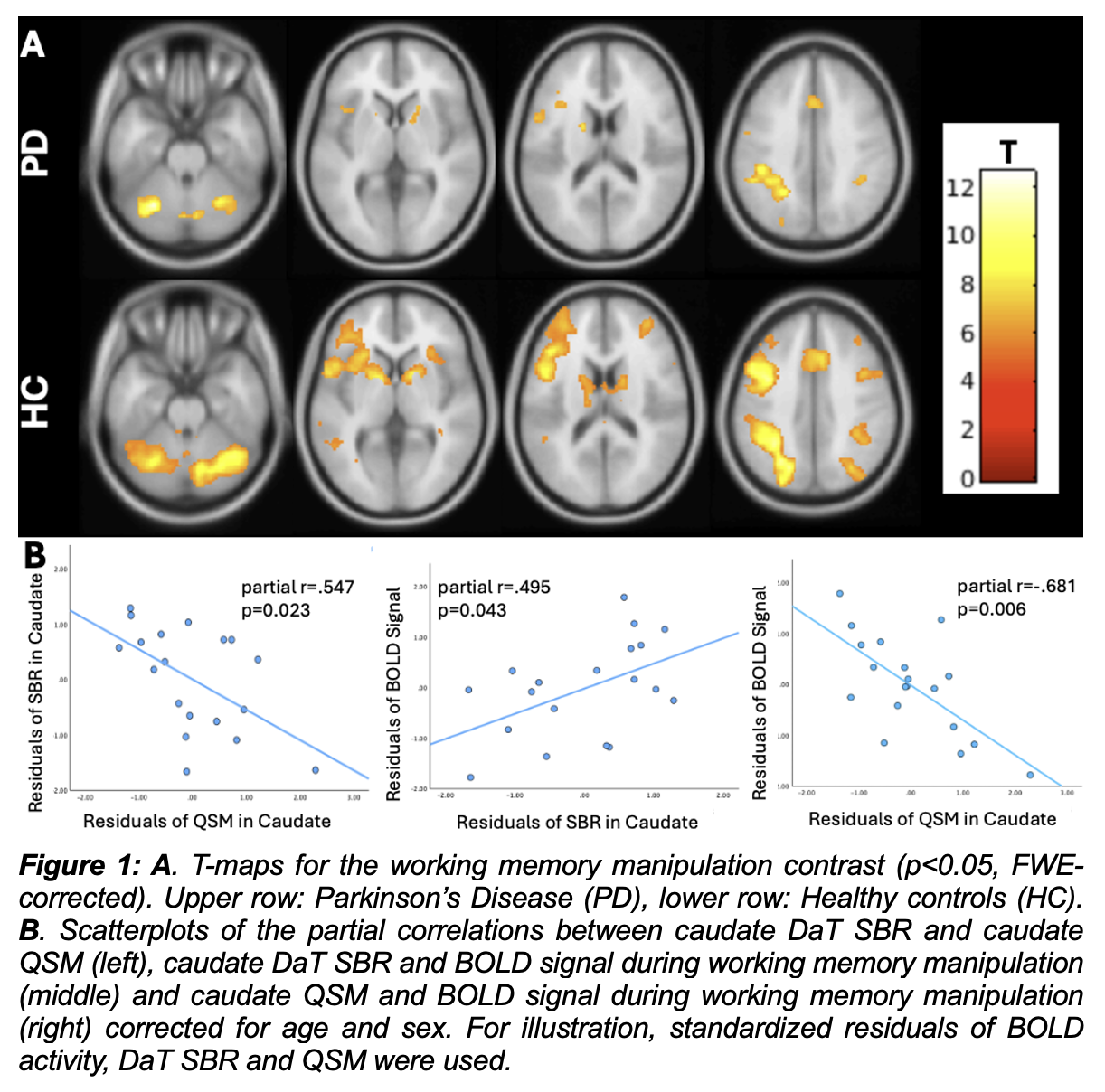
Fig. 1
References: 1 Spence H, McNeil CJ, Waiter GD. The impact of brain iron accumulation on cognition: A systematic review. PloS one. 2020 Oct 15;15(10):e0240697.
2 Thomas GE, Leyland LA, Schrag AE, Lees AJ, Acosta-Cabronero J, Weil RS. Brain iron deposition is linked with cognitive severity in Parkinson’s disease. Journal of Neurology, Neurosurgery & Psychiatry. 2020 Apr 1;91(4):418-25.
3 Giehl K, Ophey A, Hammes J, Rehberg S, Lichtenstein T, Reker P, Eggers C, Kalbe E, van Eimeren T. Working memory training increases neural efficiency in Parkinson’s disease: a randomized controlled trial. Brain communications. 2020;2(2):fcaa115.
4 Djang DS, Janssen MJ, Bohnen N, Booij J, Henderson TA, Herholz K, Minoshima S, Rowe CC, Sabri O, Seibyl J, Van Berckel BN. SNM practice guideline for dopamine transporter imaging with 123I-ioflupane SPECT 1.0. Journal of Nuclear Medicine. 2012 Jan 1;53(1):154-63.
To cite this abstract in AMA style:
K. Giehl, H. Theis, A. Asendorf, M. Banwinkler, V. Dzialas, R. Lubomierski, M. Hönig, T. van Eimeren. fMRI Activity during Working Memory Manipulation is Associated with Caudate Integrity in Early Parkinson’s Disease [abstract]. Mov Disord. 2026; 41 (suppl 1). https://www.mdsabstracts.org/abstract/fmri-activity-during-working-memory-manipulation-is-associated-with-caudate-integrity-in-early-parkinsons-disease/. Accessed October 1, 2026.« Back to 2026 International Congress
MDS Abstracts - https://www.mdsabstracts.org/abstract/fmri-activity-during-working-memory-manipulation-is-associated-with-caudate-integrity-in-early-parkinsons-disease/