
Category: Parkinson's Disease: Disease mechanisms
Objective: To explore the neural mechanisms underlying responsiveness to gait cueing in PD by assessing cortical reactivity using TMS-EEG.
Background: External cueing improves gait in PD, yet responses vary widely. Identifying neurophysiological mechanisms underlying cue responsiveness may clarify the neural basis of cueing and support personalized rehabilitation. Transcranial magnetic stimulation combined with electroencephalography (TMS-EEG) enables direct assessment of cortical reactivity within functional brain networks.
Method: Forty PD patients underwent TMS-EEG while resting with eyes open. Single-pulse TMS was delivered over bilateral primary motor cortex (M1) and dorsolateral prefrontal cortex (DLPFC). Cortical responses were quantified using TMS-evoked potentials (TEPs), focusing on the P30 and N100 components, as well as global mean field power (GMFP) and the interhemispheric signal propagation (ISP) index. Univariate comparisons were conducted between responders and non-responders at each stimulation site with correction for multiple comparisons. Logistic regression and receiver operating characteristic (ROC) analyses were used to examine the neurophysiological and motor-cognitive factors underlying cue responsiveness.
Results: Twenty five non-responders (age 69.7±1.4, disease duration 10±1.2, LEDD 811±115) and 15 responders (age 70.1±2.7, disease duration 8.3±0.9, LEDD 1038±174) were included [Table 1]. Responders demonstrated better cognitive performance than non-responders, as reflected by higher MoCA scores (25.1±1.0 vs. 22.9±0.6, p=0.022). Neurophysiologically, non-responders exhibited a stronger early excitatory cortical response, reflected by higher GMFP-P30 amplitude following stimulation of the left DLPFC (p=0.003) (Figure 1]. Logistic regression analyses revealed that incorporating left DLPFC GMFP-P30 improved prediction of cue responsiveness compared to a model based on cognition alone, yielding an AUC of 0.797 compared to 0.719.
Conclusion: PD patients responding to cueing show altered frontal cortical excitability, especially in the left DLPFC. Lower frontal hyperexcitability was linked to better responsiveness, indicating a key role for frontal network dynamics in motor-cognitive compensation. The left DLPFC is a well-established target for therapeutic brain stimulation, further highlighting its relevance as a potential neuromodulation site for gait and cognitive function in PD.
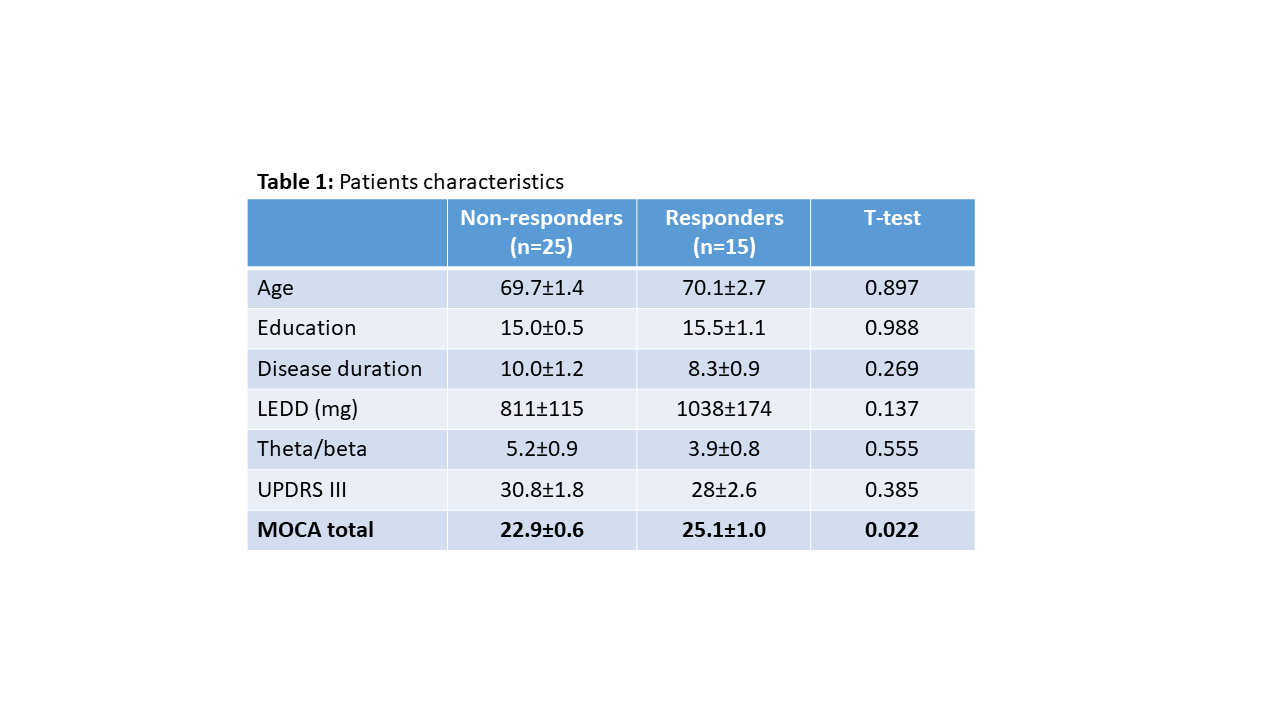
Table 1
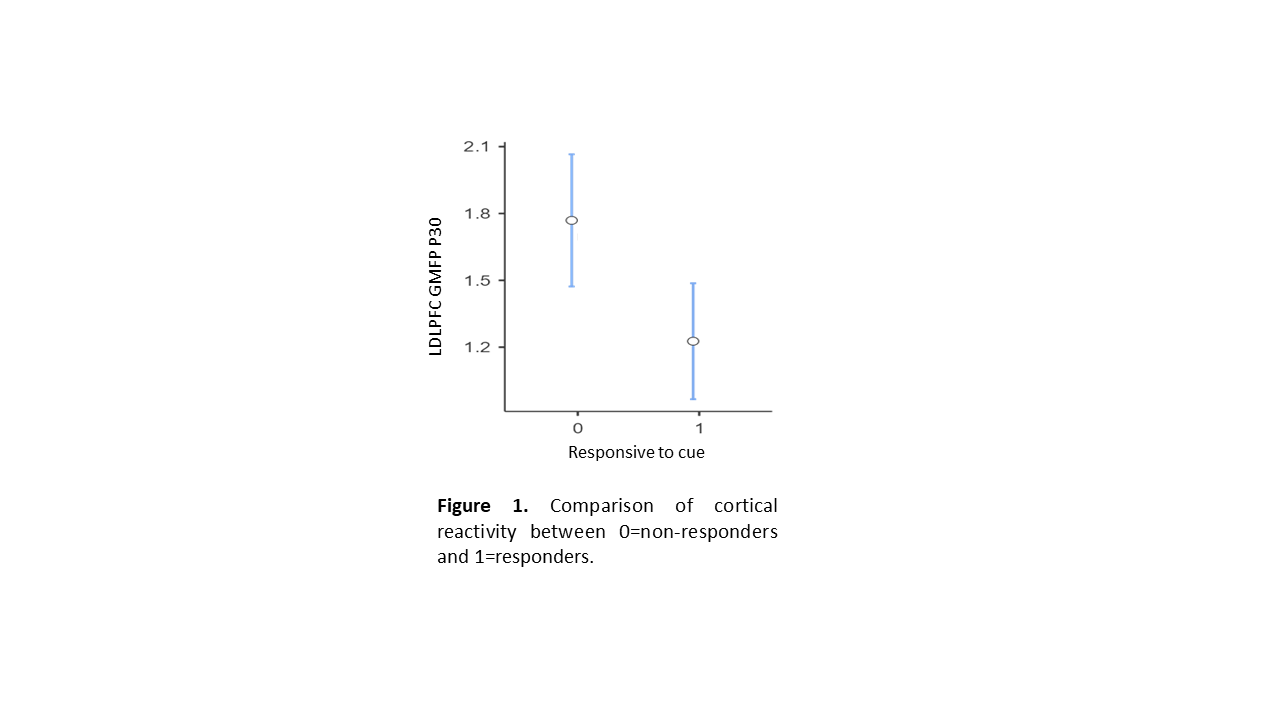
Figure 1
To cite this abstract in AMA style:
I. Maidan, Z. Katzir, M. Bouter, M. Gilat, J. Nonnekes, L. Avanzino, E. Pelosin, A. Mirelman. Frontal Cortical Reactivity Underlying Cue Responsiveness in Parkinson’s Disease: a TMS-EEG Study [abstract]. Mov Disord. 2026; 41 (suppl 1). https://www.mdsabstracts.org/abstract/frontal-cortical-reactivity-underlying-cue-responsiveness-in-parkinsons-disease-a-tms-eeg-study/. Accessed October 1, 2026.« Back to 2026 International Congress
MDS Abstracts - https://www.mdsabstracts.org/abstract/frontal-cortical-reactivity-underlying-cue-responsiveness-in-parkinsons-disease-a-tms-eeg-study/