
Category: Parkinson's disease: Neuroimaging
Objective: In this study, we aimed to identify network-defined subtypes of Parkinson’s Disease (PD) using resting-state functional connectivity (FC) features and to determine whether these subtypes are associated with diverse trajectories of disease progression.
Background: PD is characterized by clinical heterogeneity and variable disease progression, which cannot be adequately captured by symptom-based classifications alone. Identifying biologically meaningful subtypes and validating their prognostic relevance remain critical challenges.
Method: Resting-state functional MRI was used to characterize large-scale FC in patients with PD and healthy controls (HC). Principal component analysis was applied to extract network-level connectivity variation, and unsupervised clustering was performed to identify PD subtypes. Baseline clinical and gait characteristics were compared between subtypes. Longitudinal progression was assessed in a subset of patients using annualized change rates adjusted for baseline values and relevant covariates.
Results: In the present study, 289 PD patients showed greater anxiety and depression symptom burden together with slower gait speed and reduced stride length and cadence, compared with 54 HC. Two distinct PD subtypes were identified based on FC patterns. One subtype exhibited a globally hyperconnected network pattern across multiple intrinsic and cortical inter-network connectivity, whereas the other showed a comparatively hypo-connected profile with limited increases in cortico–subcortical connectivity. At baseline, the hypo-connected subtype exhibited more severe motor, non-motor, and gait impairments. During follow-up among 93 PD patients, the hypo-connected subtype demonstrated greater annualized increases in non-motor and motor symptom severity, and worsening stride length, gait speed and cadence. Correlation analyses further indicated that connectivity involving the sensorimotor network, visual network and basal ganglia was associated with motor disability and gait disturbances.
Conclusion: These findings demonstrate that PD comprises distinct subgroups characterized by different patterns of functional network connectivity and clinical progression. Network-level FC reflects underlying disease variability beyond clinical measures and may contribute to improved prognostic assessment in PD.
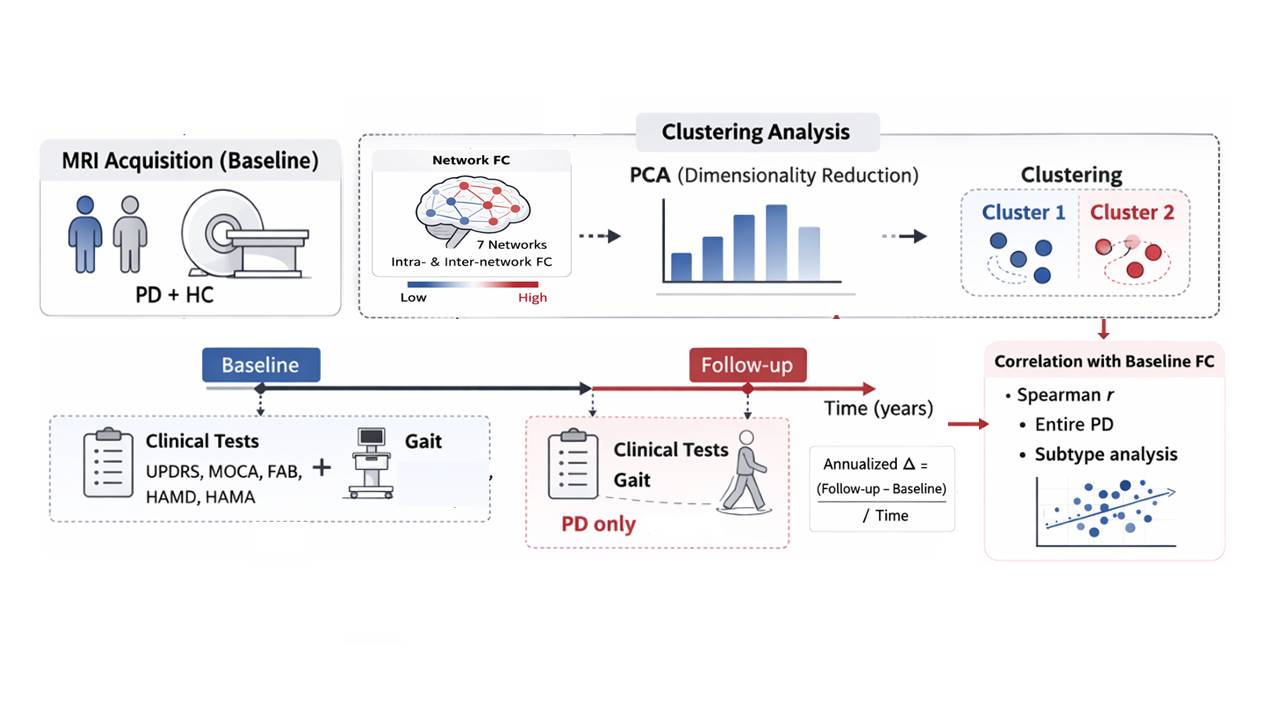
Figure 1
To cite this abstract in AMA style:
S. Wang, Y. Xiao, Y. Hou, C. Li, R. Ou, J. Lin, T. Yang, Q. Jiang, X. Zheng, J. Liu, H. Shang. Functional Connectivity Subtypes Predict Longitudinal Motor Progression and Gait Disturbance in Parkinson’s Disease [abstract]. Mov Disord. 2026; 41 (suppl 1). https://www.mdsabstracts.org/abstract/functional-connectivity-subtypes-predict-longitudinal-motor-progression-and-gait-disturbance-in-parkinsons-disease/. Accessed October 1, 2026.« Back to 2026 International Congress
MDS Abstracts - https://www.mdsabstracts.org/abstract/functional-connectivity-subtypes-predict-longitudinal-motor-progression-and-gait-disturbance-in-parkinsons-disease/