
Category: Parkinsonism (Other)
Objective: To report a case of parkinsonism with brain calcification, novel variant
Background:
Idiopathic Basal Ganglia Calcification (IBGC) is a rare neurological condition. With abnormal, bilateral, symmetrical calcium deposits in the basal ganglia, thalamus, cerebellum, and subcortical white matter are clinical features. Clinical presentations include symptoms of movement disorders and about 40% have psychiatric symptoms as their main complaint.
Method: case report :
Here, we describe a 67-year-old Kuwaiti man who has a novel MYORG mutation. The family observed slowness of ambulation and instability around the age of 62. The patient’s memory impairment started seven years ago and has since become worse, and the patient has been confined to a wheelchair. His motor symptoms and swallowing ability quickly worsened during the past year, MRI brain shows diffuse brain volume loss, bilateral and symmetrical abnormal signal involvement of the caudate, lentiform nuclei, thalami and dentate nuclei, which appear of high signal on T1 and iso to low on T2 with signal dropout on GRE, in keeping with massive calcification
On examination at the age of 67 years with a MOCA test result of less than 20/30, dysarthria, bilateral rest, kinetic tremors, bilateral bradykinesia and rigidity, slow saccadic eye movements without nystagmus, bilateral signs of cerebellar incoordination in upper and lower limbs, and diminished reflexes throughout and unable to stand or walk independently (video). There is currently no apparent improvement in motor symptoms with levodopa treatment. The family provided written informed consent.
Results:
We performed whole-exome sequencing on the patient, identifying that the proband had a homozygous nonsense variant in the MYORG gene, namely c.234C>A, (p.Tyr78*) that was confirmed by Sanger sequencing. The c.234C>A, (p.Tyr78*) in the MYORG gene, which changes Tyrosine to a premature stop codon at amino acid codon 78. This nonsense variant is predicted to cause loss of normal protein function through either protein truncation or nonsense-mediated mRNA decay. The c.234C>A, (p.Tyr78*) MYORG variant is not reported in gnomAD database or ClinVar.
Conclusion:
Mutations in the MYORG gene are one of the common genetic causes of IBGC, even when a family history of similar conditions is absent.
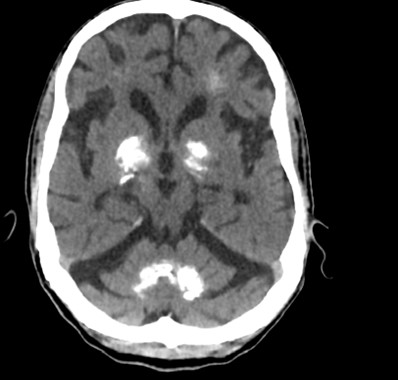
CT brain shows extensive calcification
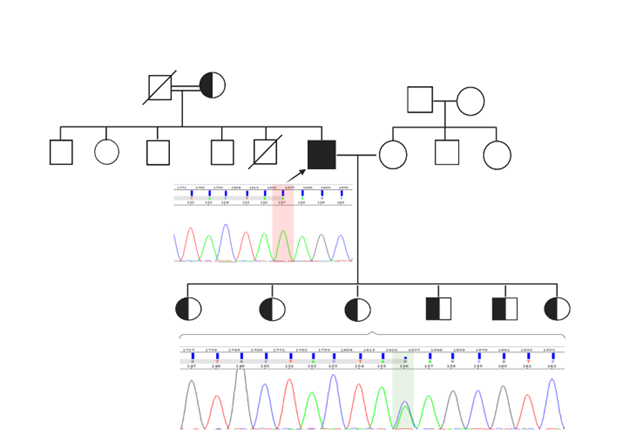
Family pedigree and sanger confirmation
To cite this abstract in AMA style:
W. Kamel, D. Al Mehatab, L. Bastaki. Identification of a Novel MYORG Mutation in Autosomal Recessive Idiopathic Basal Ganglia Calcification-7 (IBGC7): A Case Report [abstract]. Mov Disord. 2026; 41 (suppl 1). https://www.mdsabstracts.org/abstract/identification-of-a-novel-myorg-mutation-in-autosomal-recessive-idiopathic-basal-ganglia-calcification-7-ibgc7-a-case-report/. Accessed October 1, 2026.« Back to 2026 International Congress
MDS Abstracts - https://www.mdsabstracts.org/abstract/identification-of-a-novel-myorg-mutation-in-autosomal-recessive-idiopathic-basal-ganglia-calcification-7-ibgc7-a-case-report/