
Objective: To examine β- and muscle bursting patterns during impulse control in medicated and non-medicated people with Parkinson’s disease (PwPD) to disentangle effects of disease pathology from dopamine medication.
Background: Dopamine agonists in Parkinson’s pose a significant risk of impulse control disorders (e.g. hypersexuality), yet no objective methods exist to identify those at risk. We have shown that impaired impulse control in PwPD on dopamine agonists is marked by dysfunctional muscle bursting [1] but have yet to isolate the relative contribution from pathology versus medication. To elucidate the neural mechanisms underlying this muscle activity, we examined spatiotemporal patterns of EEG β-bursting, as a sensitive marker of transient functional inhibition [2][3].
Method: Twenty PwPD on ropinirole, fifteen de novo PwPD and twenty healthy older adults completed an anticipatory response inhibition task while EEG and EMG were recorded to capture β- and muscle bursting dynamics, respectively.
Results: Dysfunctional muscle bursting during response withholding and inhibition revealed a summative effect of pathology and medication [figure1]. Such stepwise effects could be explained by β-bursting dynamics during impulse control. Beyond comparable frontal activation, de novo PwPD revealed bilateral increases in sensorimotor β-bursting compared to controls, pointing to compensatory sensorimotor recruitment to partially restore motor control [figure2A]. This compensatory activity was absent in medicated PwPD, who also showed reduced recruitment of frontal regions implicated in successful impulse control [figure2B]. Across groups, muscle bursting was temporally linked to subsequent β-bursting, suggesting a preserved association and potential composite marker of impulse control across disease course.
Conclusion: In early, unmedicated PwPD, we present evidence of neural activity to compensate emerging impulse control deficits in the muscle. With the addition of dopamine medication, compensatory activity disappears and impulse control mechanisms are disrupted at both the neural and muscular level. Individually, β- and muscle burst measures were sensitive to distinct effects of pathology and medication on impulse control in PwPD. Future longitudinal work will establish the clinical utility of these objective markers, in isolation or combination, to predict the onset of impulse control disorders.
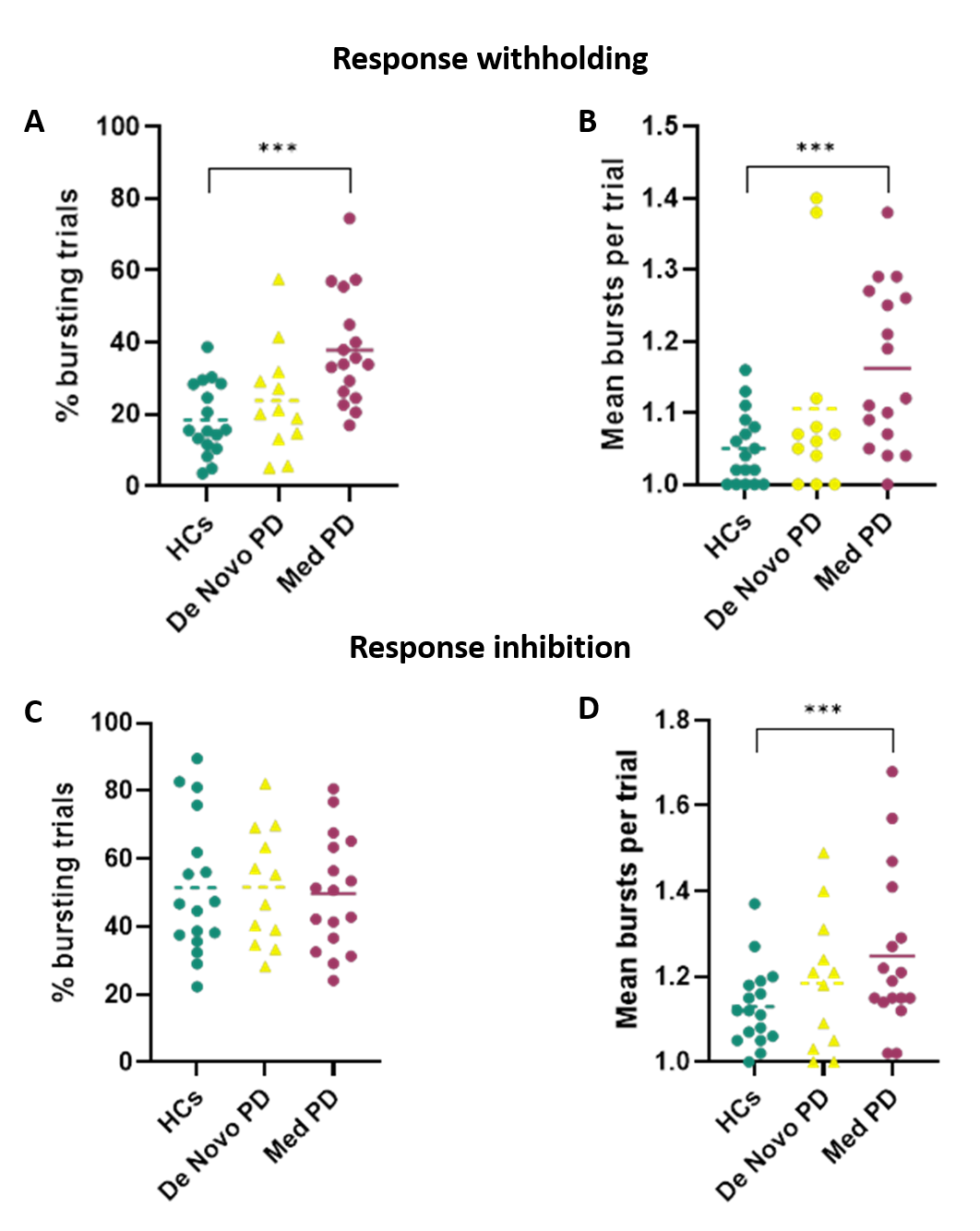
Muscle bursting results
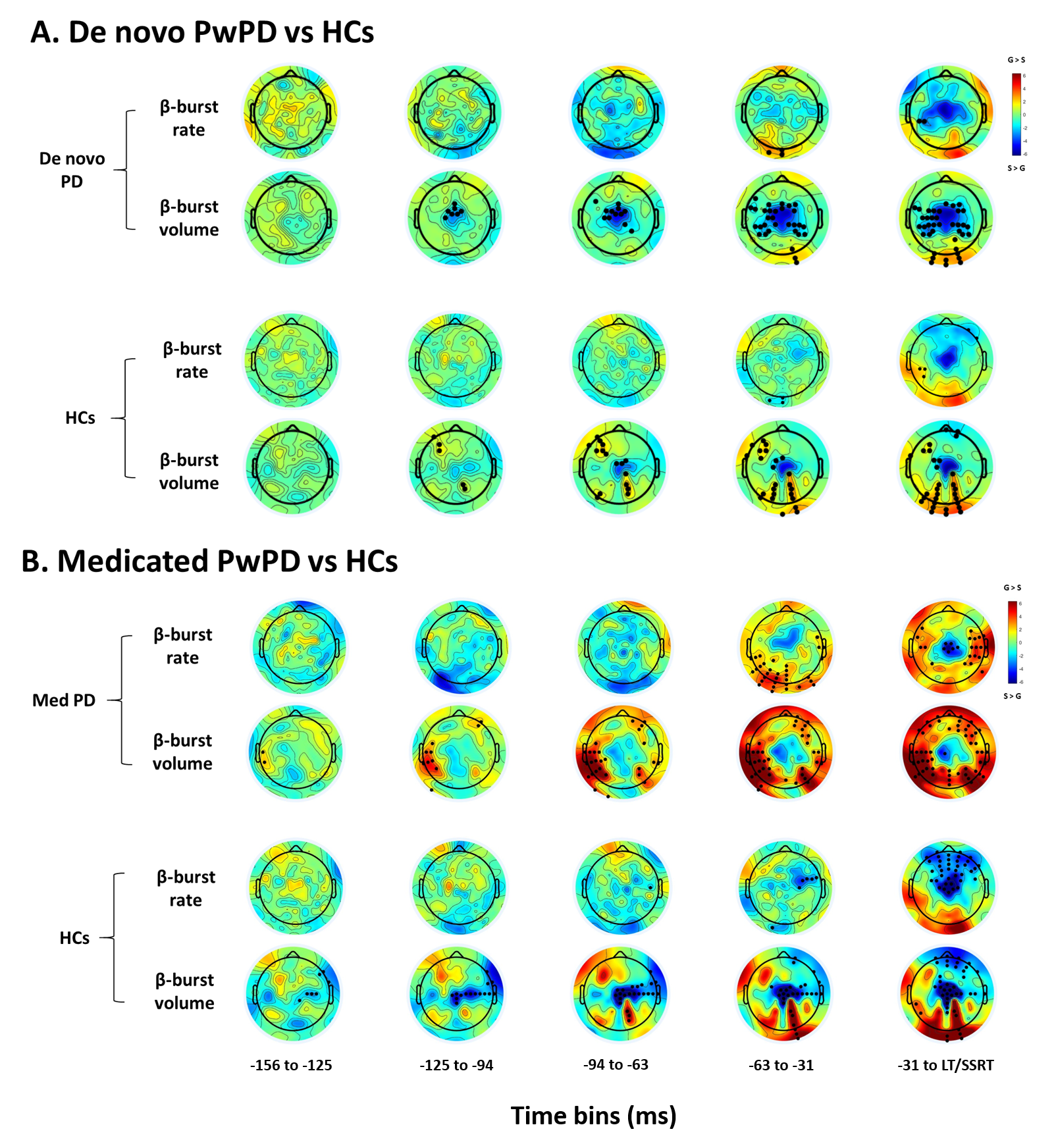
Topographical comparison of β-burst features
References: [1] Warden, A. C. M., Cruse, D., McAllister, C. J., & MacDonald, H. J. (2026). Muscle bursting and corticomotor excitability mark impaired impulse control in Parkinson’s disease. Journal of Neuroscience. https://doi.org/10.1523/JNEUROSCI.1151-25.2026
[2] Lundqvist, M., Miller, E. K., Nordmark, J., Liljefors, J., & Herman, P. (2024). Beta: Bursts of cognition. Trends in Cognitive Sciences, 28(7), 662–676. https://doi.org/10.1016/j.tics.2024.03.010
[3] Warden, A. C. M., McAllister, C. J., Cruse, D., et al. (2026). Muscle bursting and corticomotor excitability mark impaired impulse control in Parkinson’s disease. npj Parkinson’s Disease, 12, 11. https://doi.org/10.1038/s41531-025-01207-5
To cite this abstract in AMA style:
A. Warden, D. Cruse, C. Mcallister, B. Wright, H. Macdonald. Impulse Control in Parkinson’s: β- and Muscle Burst Dynamics Reveal Distinct Effects of Pathology and Dopamine Medication [abstract]. Mov Disord. 2026; 41 (suppl 1). https://www.mdsabstracts.org/abstract/impulse-control-in-parkinsons-%ce%b2-and-muscle-burst-dynamics-reveal-distinct-effects-of-pathology-and-dopamine-medication/. Accessed October 1, 2026.« Back to 2026 International Congress
MDS Abstracts - https://www.mdsabstracts.org/abstract/impulse-control-in-parkinsons-%ce%b2-and-muscle-burst-dynamics-reveal-distinct-effects-of-pathology-and-dopamine-medication/