
Category: Parkinson's Disease: Surgical Therapy
Objective: –
Background: The goal of deep brain stimulation (DBS) is to achieve optimal symptom control while minimizing stimulation-related side effects. Interleaving stimulation offers a practical strategy by alternating between two parameter sets, allowing beneficial effects from different contacts while avoiding stimulation-induced adverse effects.
Method: –
Results: A 64 year old Malaysian man was diagnosed with Parkinson’s disease in 2020 after 4 years of right leg pain and stiffness with progressive bradykinesia and worsening handwriting. He later developed right-sided tremor and limb rigidity. Initial treatment with ropinirole 2 mg daily caused severe somnolence and was switched to levodopa/benserazide 200/50mg ¼ tablet three times daily, gradually increased to ¾ tablet 4 times daily with selegiline 5mg daily (LEDD 500mg). Although bradykinesia and rigidity improved, tremor persisted and he declined further medication escalation.
In September 2022, he underwent bilateral STN DBS using Medtronic Activa 3389 RC for refractory tremor and motor fluctuations. Postoperatively he remained on levodopa/benserazide ¾ tablet 4 times daily with selegiline 5 mg daily. Increasing DBS parameters improved rigidity and bradykinesia, but right-hand tremor persisted. Baseline settings were C+3− 3.95 V, 60µs, 130Hz (left) and 10−11+ 3.45V, 60µs, 130Hz (right), with bilateral Total Electrical Energy Delivered (TEED) 172µJ/s and MDS‑UPDRSIII score of 45 (“on”).
Increasing frequency to 140Hz and raising the left STN voltage to 4.2V both improved tremor but worsened gait and balance. Changing to contact −2+C controlled tremor at 3.5V but produced speech difficulty, also seen with double monopolar stimulation, while bipolar settings failed to adequately control the tremor.
To mitigate gait and speech deterioration while maintaining tremor improvement, an interleaving DBS program was implemented: Left STN Program 1: −3+C 3.5V, 60µs, 125Hz; Program 2: −2+C 3.0V, 60µs, 125Hz; Right STN: −10+11 3.8V, 60µs, 125Hz (bilateral TEED 155µJ/s). The patient achieved MDS‑UPDRSIII score of 40 with no medication or stimulation adjustments over six months, indicating stable control at lower TEED and per-contact voltages.
Conclusion: We recommend interleaved DBS in patients with a narrow therapeutic window, as it may improve symptoms with fewer side effects and lower TEED, potentially prolonging battery life.
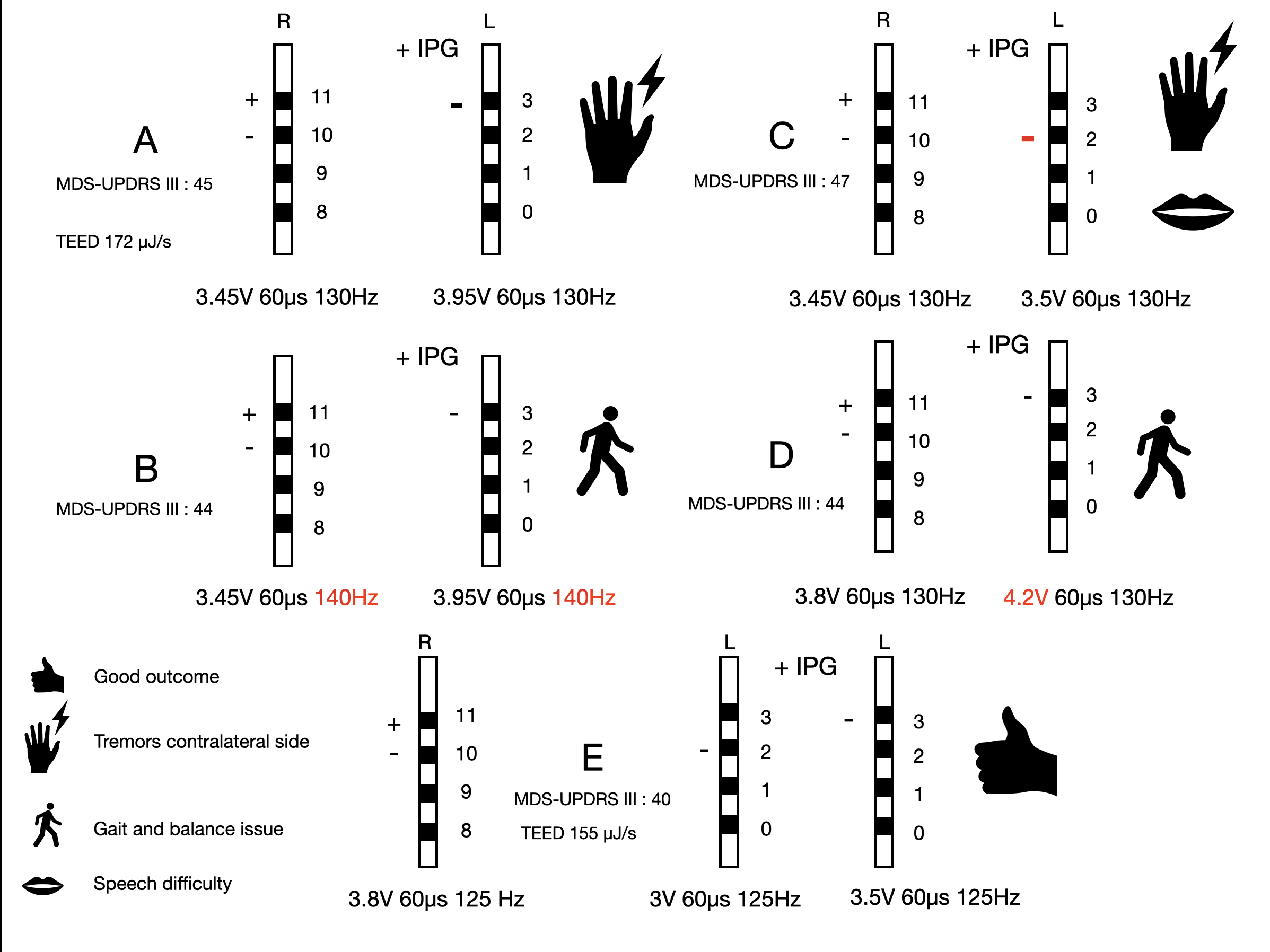
Variable DBS settings, clinical outcome and TEED
To cite this abstract in AMA style:
CY. Por, TT. Lim, O. Phokaewvarangkul, R. Bhidayasiri. Interleaving Deep Brain Stimulation: Achieving Optimal Clinical Outcomes at Lower Per-contact Voltages and Energy Consumption [abstract]. Mov Disord. 2026; 41 (suppl 1). https://www.mdsabstracts.org/abstract/interleaving-deep-brain-stimulation-achieving-optimal-clinical-outcomes-at-lower-per-contact-voltages-and-energy-consumption/. Accessed October 1, 2026.« Back to 2026 International Congress
MDS Abstracts - https://www.mdsabstracts.org/abstract/interleaving-deep-brain-stimulation-achieving-optimal-clinical-outcomes-at-lower-per-contact-voltages-and-energy-consumption/