
Objective: In this study we aimed to investigate differences in the subthalamic nucleus (STN) activity in Parkinson’s disease (PD) patients who developed hemidystonia.
Background: STN plays a crucial role in transmitting signals through the basal ganglia (BG), and its activity is expected to differ in hypokinetic (such as bradykinesia) and hyperkinetic (such as dystonia) states. Studying STN activity in patients with co-existing PD and focal dystonia, while comparing it to typical PD-related activity, should shed light on how BG handle both states simultaneously, and cases with hemidystonia seem the most illustrative.
Method: We investigated 3 PD patients with hemidystonia and compared them with 3 PD patients with feet dystonia and 5 PD patients without dystonia, all having mixed PD form. We recorded their single unit activity and local field potentials (LFP) in awake state during implantation of DBS electrodes in the STN. We then divided single units into tonic, irregular-burst and pause-burst using unsupervised clustering and analyzed LFP spectra.
Results:
No unified differences were found between the hemispheres in patients with hemidystonia at the single cell level, neither in neurons’ activity nor in their proportions. Interestingly, at the LFP level we observed higher power in both low and high beta in the STN ipsilateral to the dystonia hemibody [figure 1], albeit LFPs were only available in one hemidystonia patient.
All patients with dystonia demonstrated similarly high proportions of pause cells (48% and 50%) in contrast to patients with typical PD (25%). Both PD with dystonia groups demonstrated similarly high burst rate compared to typical PD, but only patients with feet dystonia housed neurons with high alpha (8-12 Hz) oscillating scores (all differences assessed by Kraskell-Walles test with corrected pairwise comparisons).
Conclusion: Although limited by small sample size, our findings suggest that dystonia presence in PD may be associated with specific STN activity which is observed in both hemispheres regardless of its localization. In hemidystonic patients, the unexpected absence of dystonia-associated [1] alpha oscillations and the co-occurrence of low (antikinetic) and high (prokinetic) beta activity [2] in the dystonia-ipsilateral STN are the open questions which require further studies.
The study was funded by Russian Science Foundation, project 22-15-00344-p.
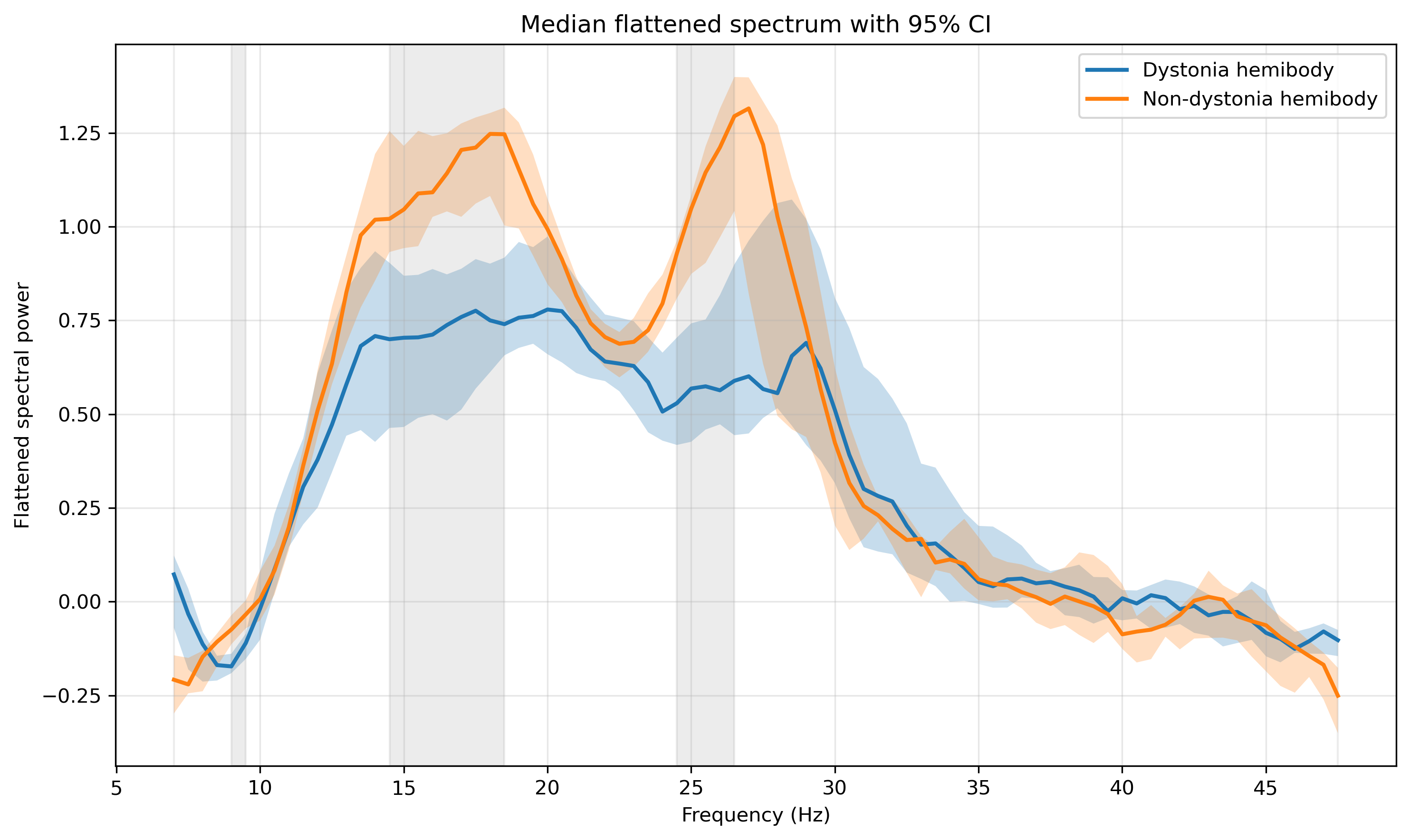
Fig.1
References: [1] J.W. Olson, A. Nakhmani, Z.T. Irwin, L.J. Edwards, C.L. Gonzalez, M.H. Wade, S.D. Black, M.Z. Awad, D.J. Kuhman, C.P. Hurt, B.L. Guthrie, H.C. Walker, Cortical and Subthalamic Nucleus Spectral Changes During Limb Movements in PARKINSON’S DISEASE Patients with and Without Dystonia, Mov. Disord. 37 (2022) 1683–1692. https://doi.org/10.1002/mds.29057.
[2] A. Oswal, C. Cao, C.-H. Yeh, W.-J. Neumann, J. Gratwicke, H. Akram, A. Horn, D. Li, S. Zhan, C. Zhang, Q. Wang, L. Zrinzo, T. Foltynie, P. Limousin, R. Bogacz, B. Sun, M. Husain, P. Brown, V. Litvak, Neural signatures of hyperdirect pathway activity in Parkinson’s disease, Nat. Commun. 12 (2021) 5185. https://doi.org/10.1038/s41467-021-25366-0.
Fig.1 Median flattened LFP spectra with 95% confidence interval, derived from the same patients with hemidystonia. Signals from the STN contralateral to body side with dystonia are shown in blue, ipsilateral in orange. Grey areas depict ranges of significant differences (assessed in each bin of 1 Hz by corrected Mann-Whitney test).
To cite this abstract in AMA style:
P. Pavlovsky, A. Golik, A. Gamaleya, A. Tomskiy, A. Sedov, E. Belova. Investigating Subthalamic Neuronal Activity in Parkinsonian Patients with Hemidystonia [abstract]. Mov Disord. 2026; 41 (suppl 1). https://www.mdsabstracts.org/abstract/investigating-subthalamic-neuronal-activity-in-parkinsonian-patients-with-hemidystonia/. Accessed October 1, 2026.« Back to 2026 International Congress
MDS Abstracts - https://www.mdsabstracts.org/abstract/investigating-subthalamic-neuronal-activity-in-parkinsonian-patients-with-hemidystonia/