
Category: Parkinson's Disease: Genetics
Objective: To explore the diagnostic yield and clinical relevance of Parkinsonism associated genes (PAGs) screening in Parkinson’s disease (PD).
Background: The contribution of well-known PD genes (KPGs) to PD has been reported multiple times in large PD datasets [1, 2, 3]. However, the contribution of PAGs, i.e. genes involved in broader neurological phenotypes which variably features parkinsonism, has been less investigated.
Method: Whole exome sequencing was performed in a cohort including 1779 PD probands, mainly of European origin (2108 individuals in total) [table 1]. We performed a three-step analysis [figure 1]: first, we excluded individuals with a causal pathogenic variant in one of the nine KPGs. Second, we screened for pathogenic variants in 239 PAGs selected by literature review. Finally, because the phenotype associated with most of these PAGs goes beyond parkinsonism and that a pathogenic variant is not always causal, we assessed the clinico-genetic concordance of the PAG-mutated probands.
Results: Median age at onset was 40 years. Most probands had no family history of PD (67.6%), whereas 32.4% probands reported a positive family history [table 1]. A causal pathogenic variant of a KPG was identified in 182 probands (10.2%). For the remaining 1,597 probands, 91 (5.7%) were carriers of a pathogenic variant in a PAG. Review of the available phenotypes (n=80) showed that most of the pathogenic variants were clinically compatible with causality (68/80, 85%), showing the importance of clinical assessment for interpreting the causality of PAG variants. While the distribution of causal PAGs was heterogeneous (37 genes), the seven most frequent (GCH1, PLA2G6, ATP13A2, ATXN2, ITSN1, FIG4, PPP2R5D) accounted for almost half of phenotypically compatible probands (31/68, 46%) [figure 2]. We provide clinical vignettes of causal and non-causal PAG pathogenic variants to illustrate the value and pitfalls of screening and reporting PAGs in the context of PD.
Conclusion: Our results indicate that extending the genetic screening of individuals with early-onset and familial parkinsonism beyond KPGs substantially increases the diagnostic yield (~4%). However, the inclusion of these additional genes is not a substitute for careful clinical evaluation, as our results show that a subset of pathogenic variants of PAGs are not causal.
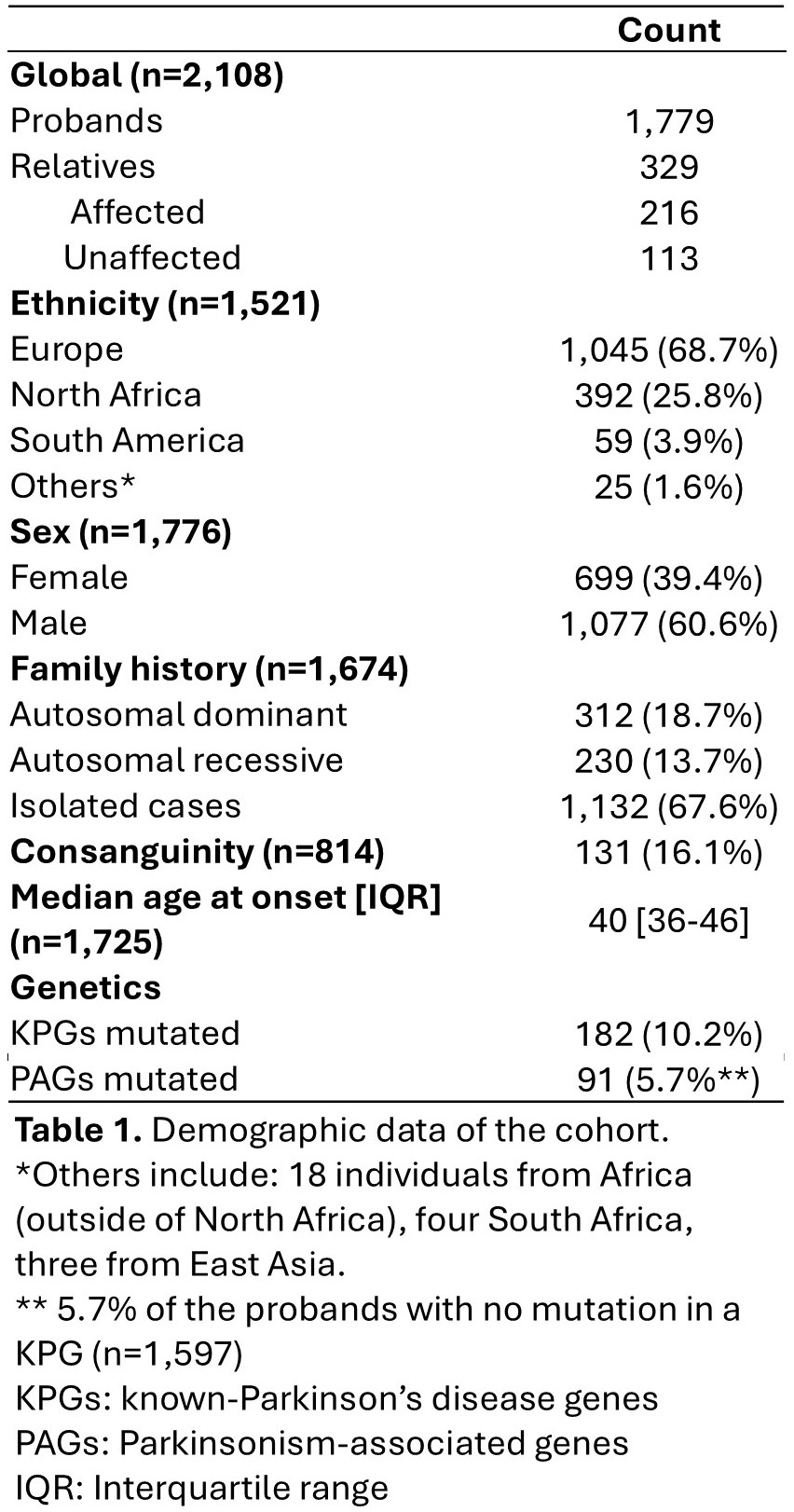
Table 1
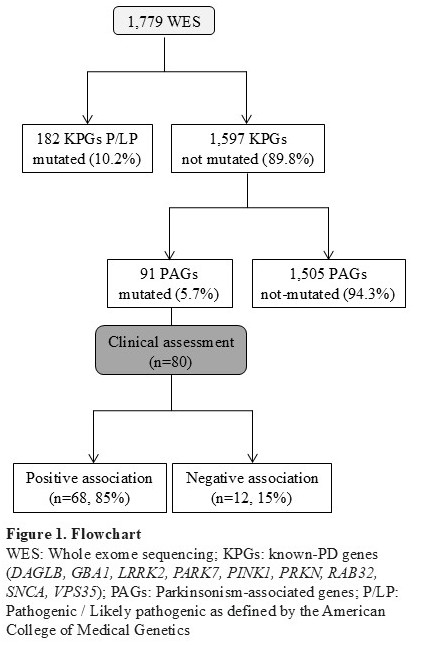
Figure 1
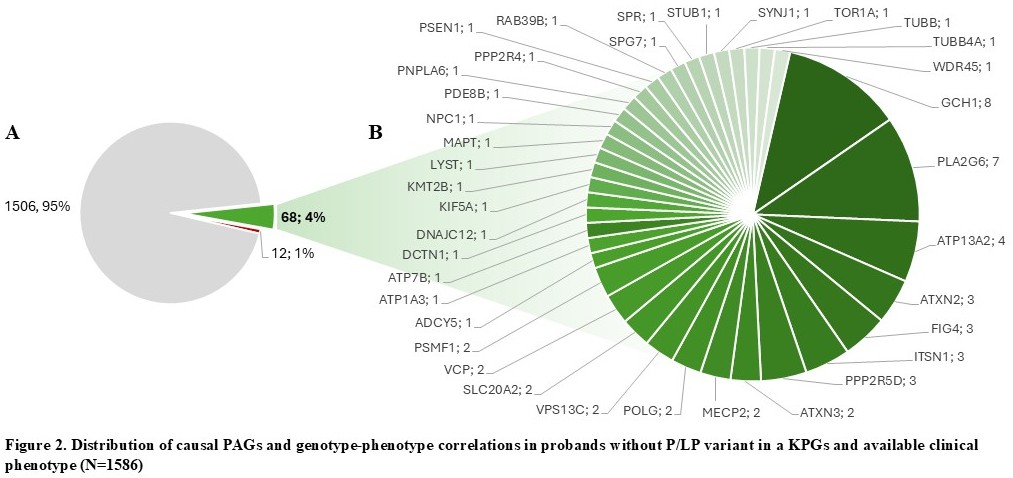
Figure 2
References: [1] Westenberger A, Skrahina V, Usnich T, et al. Relevance of genetic testing in the gene-targeted trial era: the Rostock Parkinson’s disease study. Brain. 2024;147(8):2652-2667. doi:10.1093/brain/awae188
[2] Cook L, Verbrugge J, Schwantes-An TH, et al. Parkinson’s disease variant detection and disclosure: PD GENEration, a North American study. Brain. 2024;147(8):2668-2679. doi:10.1093/brain/awae142
[3] Zhao Y, Qin L, Pan H, et al. The role of genetics in Parkinson’s disease: a large cohort study in Chinese mainland population. Brain. 2020;143(7):2220-2234. doi:10.1093/brain/awaa167
To cite this abstract in AMA style:
G. Cogan, K. Rousvoal, C. Tesson, L. Arnaud, A. Méneret, G. Mangone, S. Sambin, G. Kodjovi, A. Lanore, E. Leguern, J. Corvol, S. Lesage, A. Brice. Investigation of the Mendelian contribution of parkinsonism associated genes to Parkinson’s disease [abstract]. Mov Disord. 2026; 41 (suppl 1). https://www.mdsabstracts.org/abstract/investigation-of-the-mendelian-contribution-of-parkinsonism-associated-genes-to-parkinsons-disease/. Accessed October 1, 2026.« Back to 2026 International Congress
MDS Abstracts - https://www.mdsabstracts.org/abstract/investigation-of-the-mendelian-contribution-of-parkinsonism-associated-genes-to-parkinsons-disease/