
Objective: This post-hoc analysis evaluated opicapone’ s long-term safety and tolerability in Parkinson’s patients with recently diagnosed fluctuations (≤2 years).
Background: Opicapone is used to manage motor fluctuations in Parkinson’s patients, and its earlier initiation at wearing-off onset demonstrated benefits in OFF- and Good-ON-time without increasing dyskinesia over 1 year [Reference 1].
Method: Data were pooled from double-blind, placebo-controlled BIPARK I and II studies (3.5 months) and their 1-year open-label extensions. Analyses included participants randomized to placebo or opicapone 50mg who continued opicapone during the open-label phase and had developed wearing-off within ≤2 years prior to screening. Treatment-emergent adverse events (TEAEs), TEAEs considered related to treatment, and TEAEs leading to discontinuation were evaluated.
Results: Safety Set included 218 patients with recent-onset wearing-off (placebo, n=110; opicapone, n=118). During the double-blind phase, TEAEs occurred in 55.9% of opicapone-treated and 50.9% of placebo-treated patients, with potentially treatment-related TEAEs being reported in 30.5% and 20.0%, respectively (Table 1). Most frequent treatment-related TEAEs with opicapone were dyskinesia (9.3%) and insomnia (3.4%). In the 1-year open-label extension, potentially treatment-related TEAEs occurred in 39.0% of patients continuing opicapone and 35.5% of those switching from placebo, most commonly dyskinesia (8.5% and 13.6%, respectively) (Table 2). Treatment-related TEAEs leading to discontinuation were infrequent (3.4% and 0.0%, respectively); no deaths were reported.
Conclusion: Long-term opicapone exposure was generally safe and well-tolerated in patients with recent-onset fluctuations. Most TEAEs were mild/moderate and consistent with dopaminergic therapy. Dyskinesia occurred less frequently in early versus later starters during the open-label phase, supporting opicapone’ s favorable safety profile when initiated at wearing-off onset.
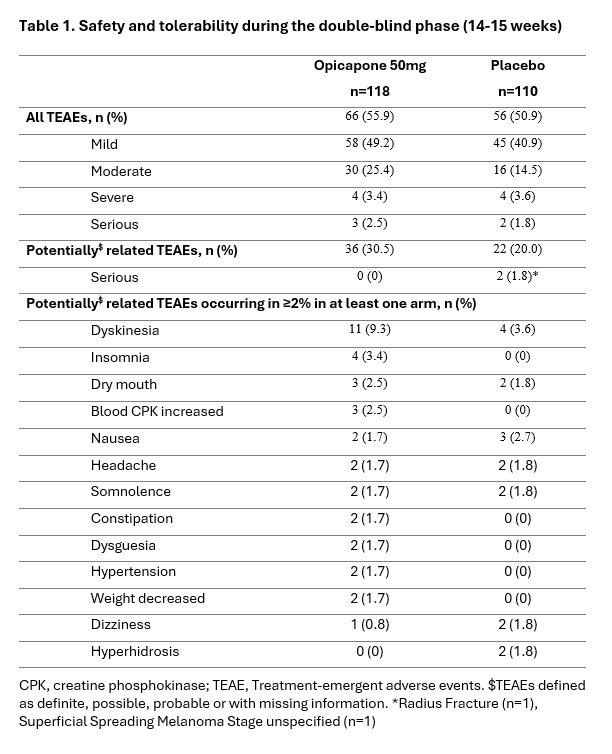
Table 1
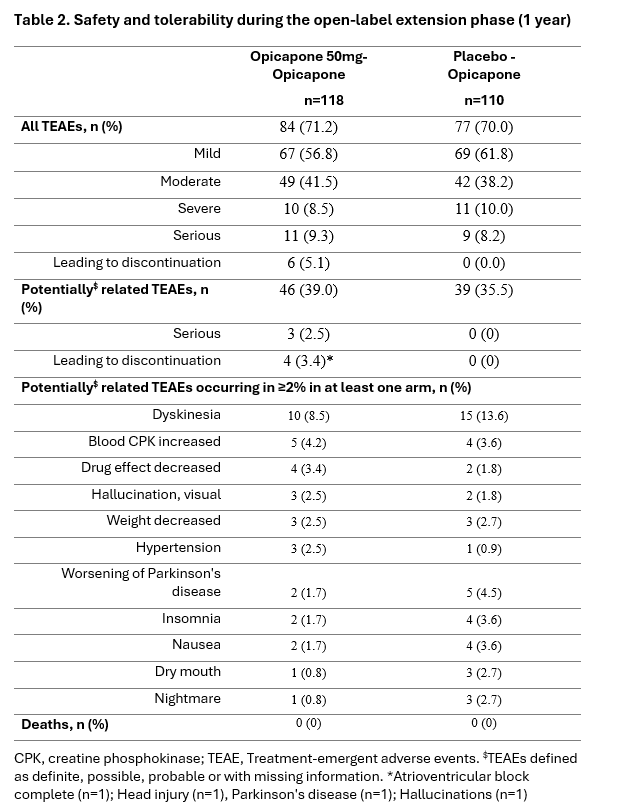
Table 2
References: Ferreira JJ, Stocchi F, Antonini A, Rascol O, Ebersbach G, Kulisevsky J, Fonseca MM, Ramos D, Rocha JF, Brigas HC, Holenz J, Poewe W. Early start of opicapone in Parkinson’s disease: evidence from a pooled analysis of phase 3 trials for sustained benefit in patients with recent onset of motor fluctuations. Front Neurol. 2025 Dec 15;16:1715748. doi: 10.3389/fneur.2025.1715748. PMID: 41473225; PMCID: PMC12745269.
To cite this abstract in AMA style:
JJ. Ferreira, F. Stocchi, A. Antonini, O. Rascol, G. Ebersbach, J. Kulisevsky, N. Pavese, G. Hoglinger, D. Ramos, J-F. Rocha, HC. Brigas, J. Holenz, W. Poewe. Long-term Safety of Opicapone in Parkinson’s Disease Patients with First Signs of Wearing-off [abstract]. Mov Disord. 2026; 41 (suppl 1). https://www.mdsabstracts.org/abstract/long-term-safety-of-opicapone-in-parkinsons-disease-patients-with-first-signs-of-wearing-off/. Accessed October 1, 2026.« Back to 2026 International Congress
MDS Abstracts - https://www.mdsabstracts.org/abstract/long-term-safety-of-opicapone-in-parkinsons-disease-patients-with-first-signs-of-wearing-off/