
Objective: To develop a machine learning (ML) model for early Huntington’s disease (HD) detection by integrating non-motor symptoms (NMS) and DNA methylation patterns, leveraging gender-specific algorithms to power a web-based risk assessment tool.
Background: Early HD identification is vital for optimal clinical management. While diagnosis traditionally relies on motor symptoms, NMS and epigenetic alterations often manifest much earlier. Because the disease trajectory exhibits gender-based variations, incorporating these differences alongside early biomarkers could significantly enhance predictive accuracy.
Method: Using Huntington’s Progression Markers Initiative (HPMI) data, feature selection techniques were applied to identify critical NMS. Three distinct ML methodologies were employed to create gender-specific predictive models: a recommender system for personalized risk forecasting, neural network-based transfer learning, and an ensemble model integrating Support Vector Machines (SVM-linear), Least Absolute Shrinkage and Selection Operator (LASSO), and Elastic Net regression. Gender-unique CpG sites were isolated to refine predictions, and pathway enrichment analysis evaluated HTT gene involvement. A Python (Flask) and JavaScript web interface was constructed to facilitate individualized risk evaluation using age, gender, and NMS inputs.
Results: The developed ML architectures achieved >80% predictive accuracy with robust Area Under the Receiver Operating Characteristic (AUC-ROC) metrics. The integration of gender-specific NMS profiles markedly improved predictive precision. Concurrently, pathway analysis elucidated critical biological mechanisms tied to HD pathogenesis. The resulting interactive web application successfully provides an accessible platform for early disease risk stratification.
Conclusion: This study underscores the diagnostic utility of NMS and gender-specific epigenetic biomarkers in HD. The resulting ML framework and interactive prognostic tool offer a novel, individualized adjunct to traditional diagnostic paradigms, warranting further clinical validation for broader implementation.
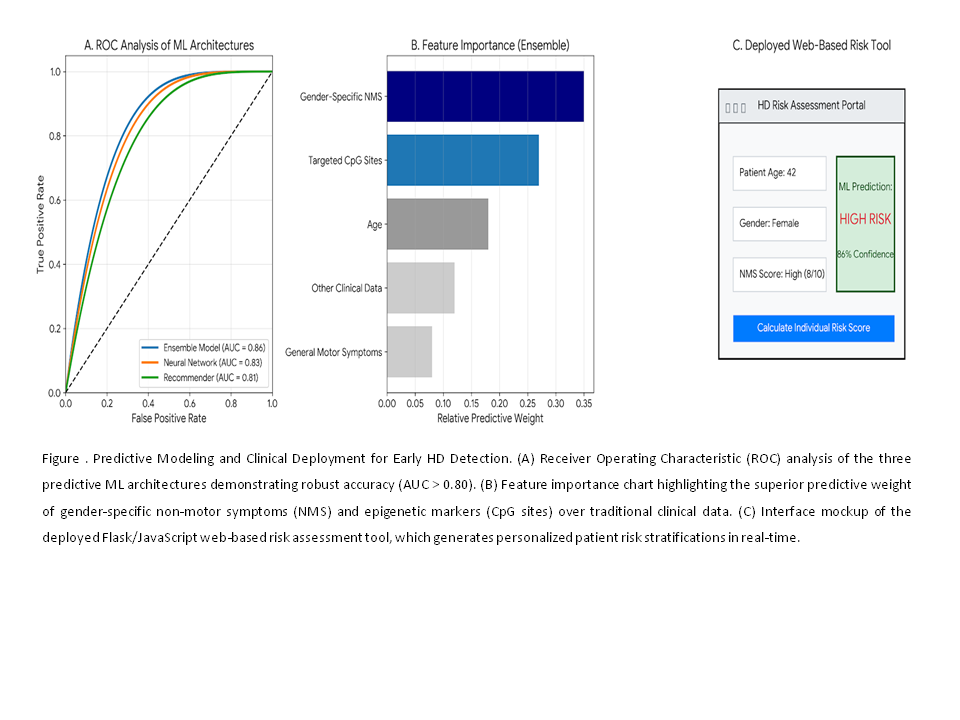
Predictive Modeling for Early HD Detection.
To cite this abstract in AMA style:
S. Rajput, P. Tiwari, S. Sinha. Machine Learning for Early Detection of Huntington’s Disease: Integrating Non-Motor Symptoms and Gender-Specific Differences [abstract]. Mov Disord. 2026; 41 (suppl 1). https://www.mdsabstracts.org/abstract/machine-learning-for-early-detection-of-huntingtons-disease-integrating-non-motor-symptoms-and-gender-specific-differences/. Accessed October 1, 2026.« Back to 2026 International Congress
MDS Abstracts - https://www.mdsabstracts.org/abstract/machine-learning-for-early-detection-of-huntingtons-disease-integrating-non-motor-symptoms-and-gender-specific-differences/