
Category: Parkinson's Disease: Surgical Therapy
Objective: To assess the 12-month efficacy and safety of staged bilateral STN-MRgFUS in patients with PD.
Background: MR-guided focused ultrasound subthalamotomy (STN-MRgFUS) has emerged as an effective treatment for asymmetric Parkinson’s disease (PD), providing significant contralateral motor benefit after unilateral lesioning [1-5]. However, because PD is progressive, outcomes of bilateral intervention remain insufficiently characterized [6-7].
Method: Patients were evaluated using the MDS-UPDRS before the first procedure (baseline-1), before the second procedure (baseline-2), and at 6 and 12 months after the second procedure. Given the small sample size, outcomes were analyzed descriptively and are reported as median [interquartile range]; longitudinal change was expressed as percentage change in the group median. The primary outcomes were change in total MDS-UPDRS III score from baseline-1 to 12 months in the OFF-medication state and safety at 12 months. Secondary outcomes included MDS-UPDRS III by treated side, MDS-UPDRS II and IV, and levodopa equivalent daily dose (LEDD) [8].
Results: Five patients underwent staged bilateral STN-MRgFUS [Table 1]. At 12 months, median total MDS-UPDRS III scores improved by 51.8% in the OFF-medication state [Table 2]. Improvement was maintained over time on both hemibody sides [Table 2]. Median MDS-UPDRS II scores also improved. MDS-UPDRS IV improved at 6 months but not at 12 months, mainly due to dyskinesias and increase in OFF time. At 6 months, one patient reported no side effects, although longer follow-up is not yet available. Among the three patients with 12-month follow-up, all had mild persistent side effects (dyskinesia or subjective instability), and one experienced moderate persistent side effects consisting of leg spasticity and moderate dysarthria [Table 3]. Despite these effects, the patient remained satisfied because bilateral tremor was fully controlled.
Conclusion: Staged bilateral STN-MRgFUS may provide additional motor benefit in selected patients with progression after unilateral treatment [7]. However, bilateral procedures may also result in moderate persistent side effects and should therefore be considered cautiously. Small sample size and variability in patient selection likely influenced the results.
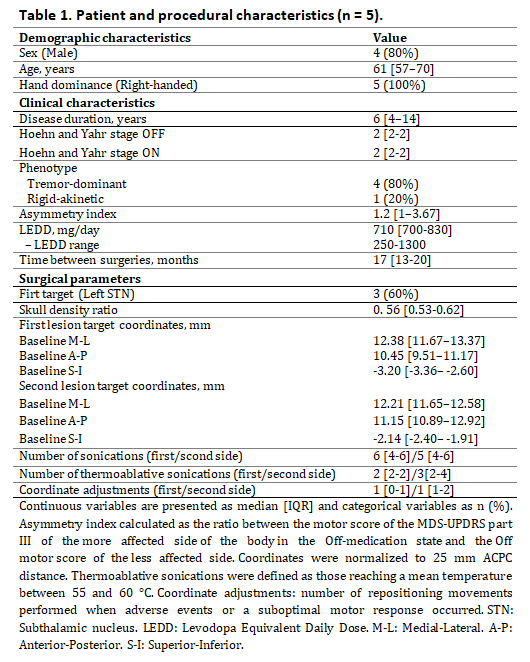
Table 1. Patient and procedural characteristics
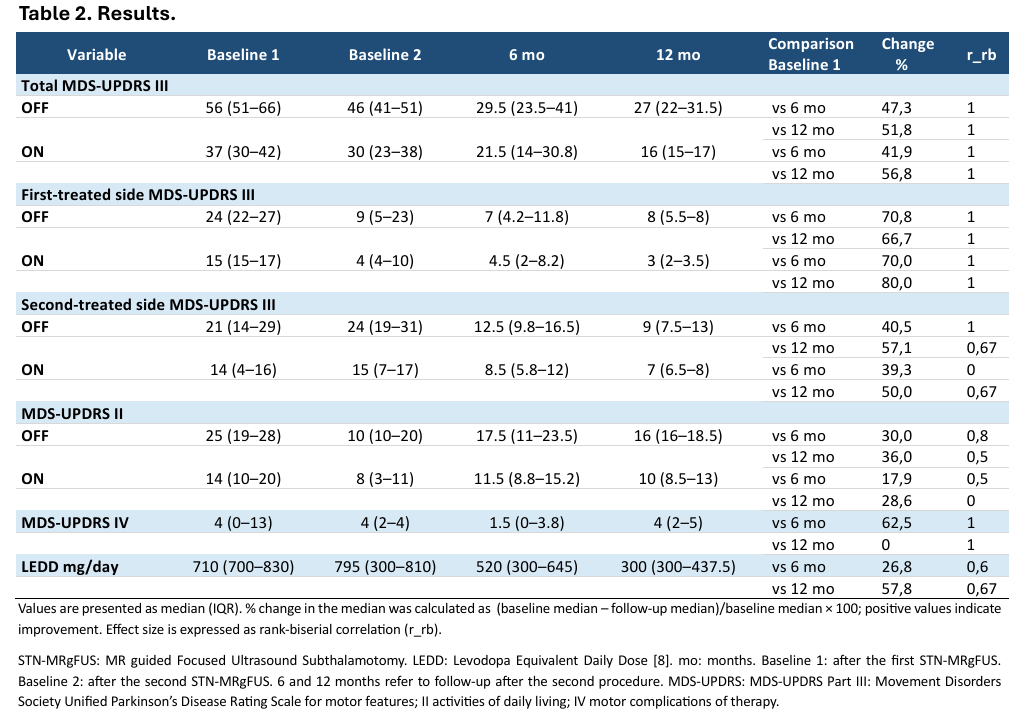
Table 2. Results
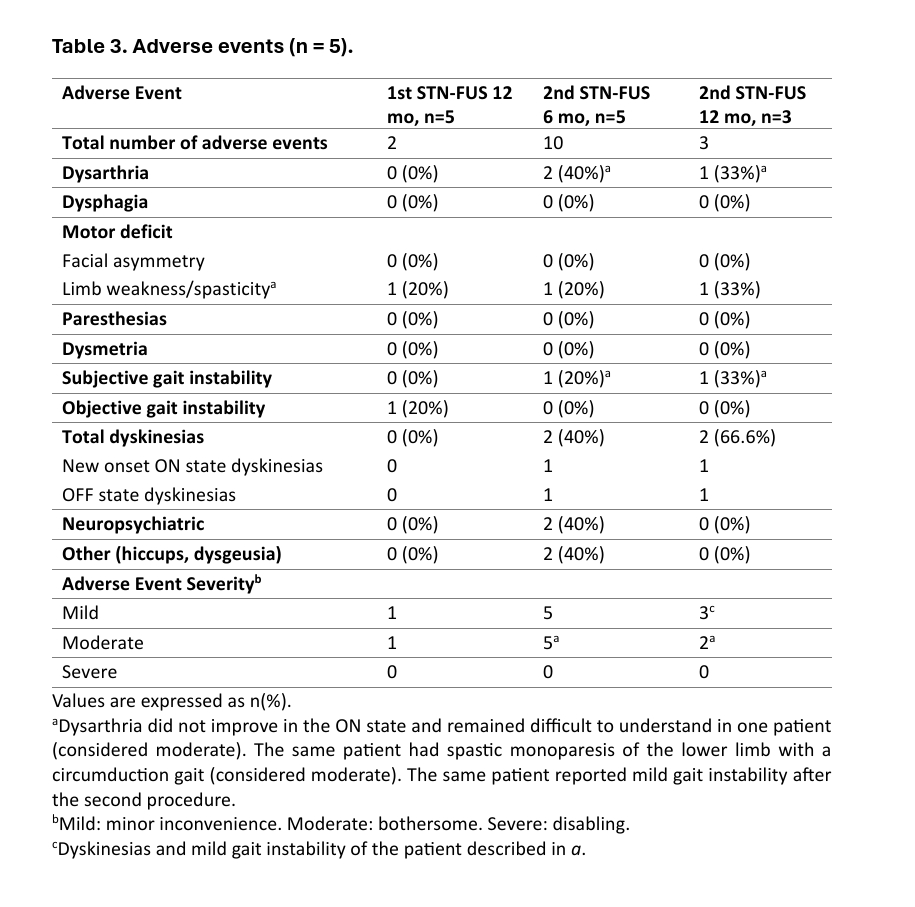
Table 3. Adverse events
References: [1] Martínez-Fernández R, Rodríguez-Rojas R, del Álamo M, Hernández-Fernández F, Pineda-Pardo JA, Dileone M, et al. Focused ultrasound subthalamotomy in patients with asymmetric Parkinson’s disease: a pilot study. Lancet Neurol. 2018;17(1):54-63.
[2] Martínez-Fernández R, Máñez-Miró JU, Rodríguez-Rojas R, del Álamo M, Shah BB, Hernández-Fernández F, et al. Randomized trial of focused ultrasound subthalamotomy for Parkinson’s disease. N Engl J Med. 2020;383(26):2501-2513.
[3] Campins-Romeu M, Conde-Sardón R, Sastre-Bataller I, Morata-Martínez C, Losada-López M, León-Guijarro JL, et al. MRgFUS subthalamotomy in Parkinson’s disease: an approach aimed at minimizing lesion volume. npj Parkinsons Dis. 2024;10:230
[4] Armengou-Garcia L, Sanchez-Catasus CA, Aviles-Olmos I, Jiménez-Huete A, Montoya-Murillo G, Gorospe A, Martin-Bastida A, Gonzalez-Quarante LH, Guridi J, Rodriguez-Oroz MC. Unilateral Magnetic Resonance-Guided Focused Ultrasound Lesion of the Subthalamic Nucleus in Parkinson’s Disease: A Prospective Study. Mov Disord. 2024 Dec;39(12):2230-2241. doi: 10.1002/mds.30020. Epub 2024 Sep 18. PMID: 39295191; PMCID: PMC11657072.
[5] Martínez-Fernández R, Natera-Villalba E, Máñez-Miró JU, Rodríguez-Rojas R, del Álamo M, Pineda-Pardo JA, et al. Prospective long-term follow-up of focused ultrasound unilateral subthalamotomy for Parkinson disease. Neurology. 2023;100(13):e1395-e1405.
[6] Alvarez L, Macias R, Lopez G, Alvarez E, Pavon N, Rodriguez-Oroz MC, et al. Bilateral subthalamotomy in Parkinson’s disease: initial and long-term response. Brain. 2005;128(Pt 3):570-583.
[7] Martínez-Fernández R, Natera-Villalba E, Rodríguez-Rojas R, Del Álamo M, Pineda-Pardo JA, Obeso I, et al. Staged bilateral MRI-guided focused ultrasound subthalamotomy for Parkinson disease. JAMA Neurol. 2024;81(6):638-644.
[8] Schade S, Mollenhauer B, Trenkwalder C. Levodopa equivalent dose conversion factors: an updated proposal including opicapone and safinamide. Mov Disord Clin Pract. 2020;7(3):343-345.
To cite this abstract in AMA style:
E. Navarro-Mocholí, R. Conde-Sardón, M. Campins-Romeu, I. Sastre-Bataller, M. Losada-López, C. Morata-Martínez, MJ. Ibáñez-Julià, MN. Afkir-Ortega, A. Lozano, A. Gutiérrez-Martín, I. Martínez-Torres. Motor outcomes and safety of staged bilateral MR-guided focused ultrasound subthalamotomy in Parkinson disease [abstract]. Mov Disord. 2026; 41 (suppl 1). https://www.mdsabstracts.org/abstract/motor-outcomes-and-safety-of-staged-bilateral-mr-guided-focused-ultrasound-subthalamotomy-in-parkinson-disease/. Accessed October 1, 2026.« Back to 2026 International Congress
MDS Abstracts - https://www.mdsabstracts.org/abstract/motor-outcomes-and-safety-of-staged-bilateral-mr-guided-focused-ultrasound-subthalamotomy-in-parkinson-disease/