
Objective: To examine the evolution of neuropsychiatric symptoms (NPS) in biomarker-defined Parkinson’s disease over the first decade following diagnosis.
Background: Parkinson’s disease (PD) is frequently accompanied, and sometimes preceded, by NPS,1 which often emerge early2 and co-occur.3 The long-term evolution of NPS remains incompletely characterized, particularly in biomarker-defined cohorts. We examined the 10-year course of NPS following diagnosis using data from the Parkinson’s Progression Markers Initiative (PPMI),4 in a dual biomarker-defined cohort.
Method: De novo, untreated PD (N=846) and HC (N=282) participants were enrolled in PPMI. PD required dual biomarker confirmation (positive CSF ⍺-synuclein seed amplification assay and abnormal dopamine transporter imaging). Nine neuropsychiatric symptoms were assessed longitudinally. Changes over 10 years were analyzed using generalized estimating equations (GEEs), adjusted for demographic and clinical covariates. Symptom factor structure was evaluated using principal components analysis (PCA), and participant sub-groups were identified using two-step cluster analysis.
Results: In PD, absolute prevalence increased for eight of nine NPS over 10 years (by 6.6–16.0%), while anxiety declined slightly. GEE models demonstrated increasing odds of all NPS in PD except anxiety, with the largest annual increases observed for psychosis and apathy. Compared with HC, PD participants had significantly higher rates of depression, apathy, RBD, daytime sleepiness, ICDs, and impaired cognition over time. Mean number of NPS nearly doubled over time in PD participants, while HC remained relatively stable (Figure 1). PCA identified three stable symptom domains (affective-motivational, perceptual, and impulsive) across timepoints. Cluster analysis revealed consistent low-, intermediate, and high-burden subgroups, with expansion of the high-burden group over time (Table 1).
Conclusion: NPS increase in individual prevalence and co-occurrence during the first decade of biomarker-defined PD. Stable symptom domains and expanding high-burden sub-groups highlight the progressive and multidimensional nature of neuropsychiatric involvement in PD.
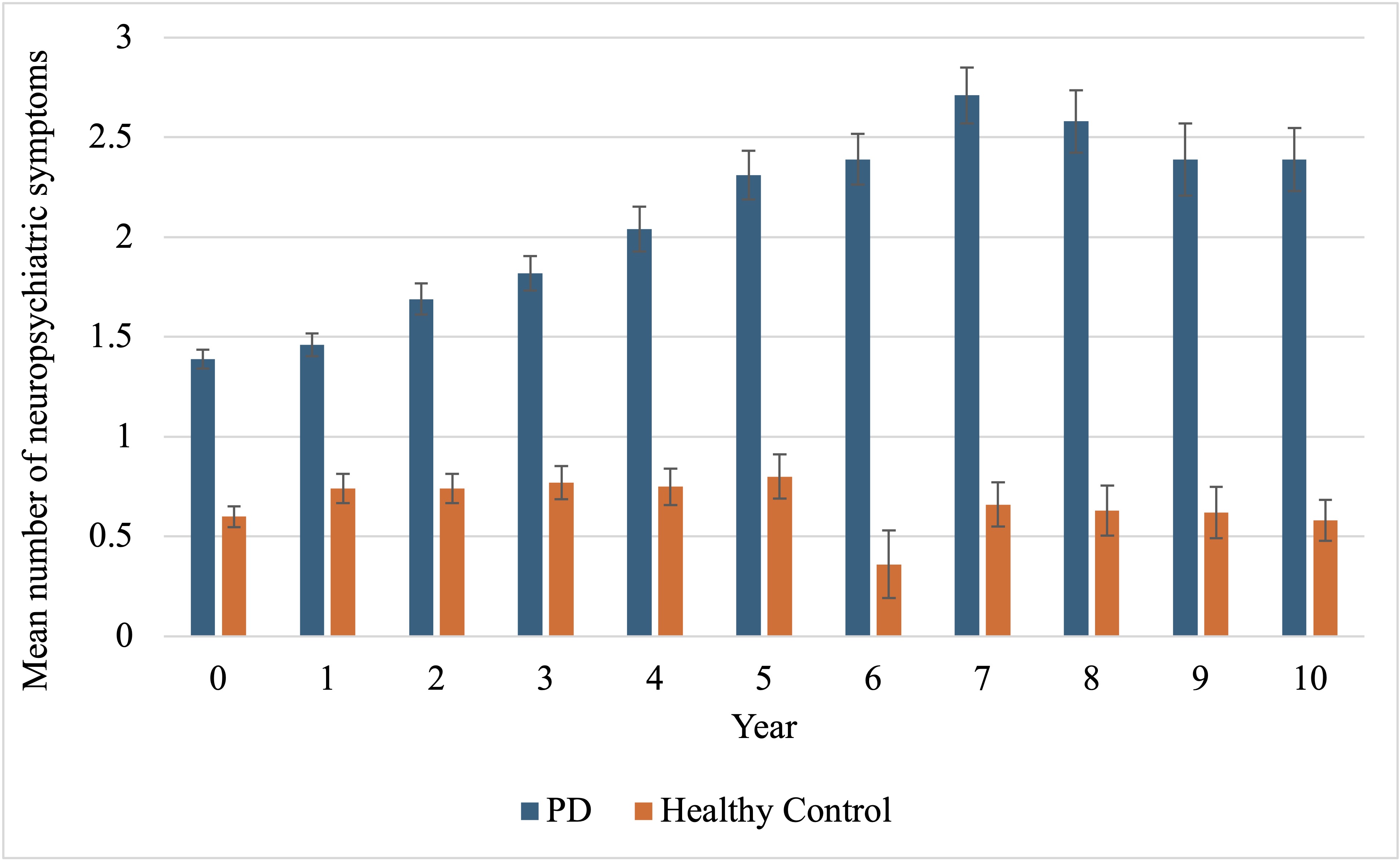
Figure 1. Mean number of NPS over time
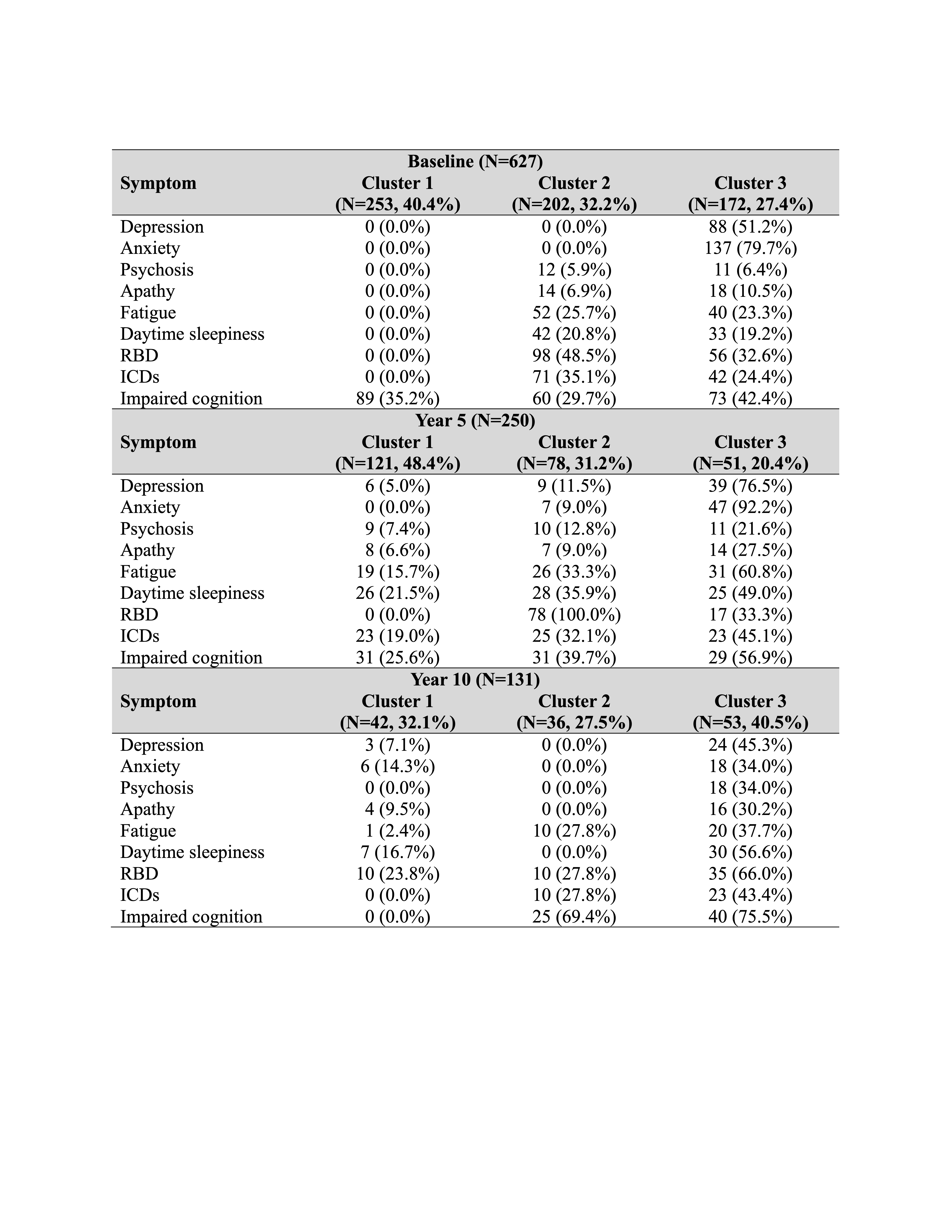
Table 1. Clustering of NPS among PD participants
References: 1. Weintraub D, Burn D. Parkinson’s disease: the quintessential neuropsychiatric disorder. Movement Disorders. 2011;26:1022-31.
2. Aarsland D, Brønnick K, Alves G, Tysnes O, Pedersen K, Ehrt U, et al. The spectrum of neuropsychiatric symptoms in patients with early untreated Parkinson’s disease. Journal of Neurology, Neurosurgery, and Psychiatry. 2009;80:928-30.
3. Weintraub D, Mamikonyan E. The neuropsychiatry of Parkinson disease: a perfect storm. Am J Geriatr Psychiatry. 2019;27(9):998-1018.
4. Marek K, Jennings D, Lasch S, Siderowf A, Tanner C, Simuni T, et al. The Parkinson Progression Marker Initiative (PPMI). Progress in Neurobiology. 2011;95:629-35.
To cite this abstract in AMA style:
I. Schoen, J. Wang, S. Xie, C. Caspell-Garcia, E. Mamikonyan, M. Stark, N. Dahodwala, A. Siderowf, R. Dobkin, M. York, D. Weintraub. Neuropsychiatric Symptom Evolution Over the First Decade of Biomarker-Defined Parkinson’s Disease [abstract]. Mov Disord. 2026; 41 (suppl 1). https://www.mdsabstracts.org/abstract/neuropsychiatric-symptom-evolution-over-the-first-decade-of-biomarker-defined-parkinsons-disease/. Accessed October 1, 2026.« Back to 2026 International Congress
MDS Abstracts - https://www.mdsabstracts.org/abstract/neuropsychiatric-symptom-evolution-over-the-first-decade-of-biomarker-defined-parkinsons-disease/